0 · Recall Warm-up
Answer from memory first. Answers are in the Answer Vault at the bottom.
- 16-bit words, 6-bit fields, 10 two-address instructions: max one-address? from Lesson 1.1.4
- What is an immediate operand? from Lesson 1.1.1
- What does CMP do to its operands? from Lesson 1.1.3
1 · The Hook
🎣
An operand field holds a number, say 300. Is that the value itself? The address where the value lives? The address of the address? Each answer is a different addressing mode, and each costs a different number of memory accesses. GATE gives a memory table and asks what gets loaded.
2 · Predict First
🤔
Memory holds M[300] = 400 and M[400] = 700. The instruction LOAD R0, @300 means "300 is the address of the address of the operand." What ends up in R0?
Make a guess in your head. The answer opens Section 3.
3 · Core Concept
💡
Predict First — the answer
M[300] = 400 is the operand's address; the operand is M[400] = 700.
Effective address
The effective address (EA) is the memory address where the operand finally sits. Addressing modes differ in how the EA (or the operand) is obtained from the operand field.
The memory and registers used in this chapter:
| Address | Contents |
|---|---|
| 200 | 500 |
| 300 | 400 |
| 400 | 700 |
| 500 | 600 |
| 600 | 900 |
| 700 | 800 |
| 800 | 300 |
Registers: R1 = 400, R2 = 200, R3 = 100.
The five basic modes
| Mode | Written | Operand | Data memory accesses | LOAD R0, … gives |
|---|---|---|---|---|
| Immediate | #300 | the field itself: 300 | 0 | 300 |
| Register | R1 | contents of the register | 0 | 400 |
| Direct (absolute) | 300 | M[300]; EA = 300 | 1 | 400 |
| Indirect (memory indirect) | @300 | M[M[300]]; EA = M[300] | 2 | 700 |
| Register indirect | (R1) | M[R1]; EA = R1 | 1 | 700 |
- Immediate is fastest (no memory access) but the constant must fit in the field.
- Direct reaches any address the field can name, but the field must be as wide as an address.
- Indirect reaches a full-width address from a short field, at the cost of one extra memory access.
- Register indirect gets the same effect cheaply: the register holds a full address (a pointer).
Also: implied (implicit) mode, where the operand is not named because the opcode implies it (the accumulator in ADD M, the stack top in ADD on a stack machine, the flags in "clear carry").
Counting memory references for an instruction
Total = instruction fetch (one access per instruction word) + operand accesses (from the table) + result store (1 if the result goes to memory). ADD R0, @300 in a one-word instruction: 1 + 2 = 3 accesses.
4 · Visual
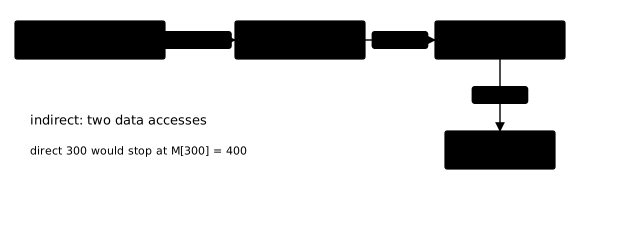
Indirect addressing: the field gives the address of the address.
5 · Worked Examples
Example 1 Easy
Using the chapter table, what does LOAD R0, 500 (direct) load?
Solution
M[500] = 600.
Example 2 Medium
What does LOAD R0, @500 (indirect) load, and how many data memory accesses does it make?
Solution
EA = M[500] = 600; operand M[600] = 900; 2 accesses.
Example 3 GATE
A one-word instruction ADD @200, R1 adds R1 to the memory operand reached indirectly through 200 and writes the sum back to that same operand. How many memory accesses in total, and what value is written?
Solution
Fetch 1; EA = M[200] = 500 (1 access); read M[500] = 600 (1 access); write 600 + 400 = 1000 to M[500] (1 access). Total 4.
6 · GATE Traps
⚠️
- Immediate ≠ direct:
#300is the number 300;300is M[300]. - Indirect costs two data accesses (address, then operand); register indirect costs one.
- Register mode makes no data memory access.
- Don't forget the instruction fetch when a question says "total memory references".
7 · Memory Hook
🧠
"# is the thing, plain is one hop, @ is two hops, (R) is one hop from a register."
8 · Connect the Dots
These five modes take the operand from one place. Next lesson adds an addition to the address: indexed, base and PC-relative modes, plus modes that step a register automatically.
9 · Self-Test
GATE format. Try every question before opening the vault.
Q1MCQ1 markIndirect
With the chapter table, LOAD R0, @200 loads:
- (A) 600
- (B) 900
- (C) 200
- (D) 500
Q2NAT1 markRegister indirect
With the chapter table (R2 = 200), what does LOAD R0, (R2) load?
Numerical answer: ________
Q3NAT1 markMemory references
How many memory accesses does the one-word instruction ADD R0, @X make in total (fetch included)? The result goes to R0.
Numerical answer: ________
Q4MSQ2 marksNo data access
Which modes obtain the operand without any data memory access?
- (A) Register
- (B) Direct
- (C) Immediate
- (D) Register indirect
Q5NAT2 marksChain
With the chapter table, what does LOAD R0, @700 load?
Numerical answer: ________
10 · Rule Card
- EA = where the operand finally is.
- Immediate #c: operand c (0 accesses). Register R: operand in R (0).
- Direct A: EA = A (1). Indirect @A: EA = M[A] (2). Register indirect (R): EA = R (1).
- Total references = fetch words + operand accesses + 1 if the result goes to memory.
11 · Concept Ledger
Unlocked in this lesson. From here on, these terms may be used.
addressing modeeffective address (EA)immediate moderegister modedirect (absolute) modeindirect moderegister indirect modepointerimplied modememory references per instruction
12 · Answer Vault
Answer Vault
Try the questions first. Open when you are ready to check.
Recall Warm-up
- (16 − 10) × 64 = 384.
- A constant stored inside the instruction itself.
- Nothing; it only sets the flags.
Self-Test
Q1 Answer: (A)1 mark
EA = M[200] = 500; operand M[500] = 600.
- (B) is wrong: That would be a third hop.
- (C) is wrong: That is immediate mode.
- (D) is wrong: That is direct mode.
Re-read: Lesson 1.2.1 — Immediate, register, direct, indirect and register-indirect modes
Q2 Answer: 5001 mark
EA = R2 = 200; M[200] = 500.
Re-read: Lesson 1.2.1 — Immediate, register, direct, indirect and register-indirect modes
Q3 Answer: 31 mark
1 fetch + 2 (address, then operand).
Re-read: Lesson 1.2.1 — Immediate, register, direct, indirect and register-indirect modes
Q4 Answer: (A) (C)2 marks
The operand is inside the instruction or a register.
- (B) is wrong: Needs one access to M[address].
- (D) is wrong: Needs one access to M[R].
Re-read: Lesson 1.2.1 — Immediate, register, direct, indirect and register-indirect modes
Q5 Answer: 3002 marks
EA = M[700] = 800; M[800] = 300.
Re-read: Lesson 1.2.1 — Immediate, register, direct, indirect and register-indirect modes