0 · Recall Warm-up
Answer from memory first. Answers are in the Answer Vault at the bottom.
- What makes a counter self-starting? from Lesson 6.2.3
- Minimum flip-flops for N states? from Lesson 6.2.2
- With D flip-flops, what is D for each bit? from Lesson 6.2.3
1 · The Hook
🎣
A combination lock opens only after the right sequence of digits; a vending machine gives a chocolate after enough coins. Both are finite state machines: a few states, an input at each step, and an output. GATE asks you to read state diagrams, to give the output for an input sequence, to count the states a sequence detector needs, and to minimise state tables.
2 · Predict First
🤔
A machine must output 1 whenever the last three input bits were 1, 0, 1. What does it need to remember between steps?
Make a guess in your head. The answer opens Section 3.
3 · Core Concept
💡
Predict First — the answer
How much of the pattern it has seen so far: nothing, "1", or "10". That is 3 states (plus, for some designs, a fourth "just saw 101" state).
🗣️
In plain words
A state machine remembers only which state it is in. At each clock it reads the input, moves to the next state and produces an output. In a Moore machine the output depends only on the state; in a Mealy machine it depends on the state and the current input (so it can react in the same clock cycle).
1. Mealy vs Moore
| Column 1 | Moore | Mealy |
|---|---|---|
| Output depends on | state only | state and input |
| Written | inside the state circle | on the arrow, "input/output" |
| States for the same job | usually more | usually fewer |
| Output timing | changes after the clock (one cycle later) | can change as soon as the input changes |
2. Sequence detector for 101 (overlapping)
States: S0 = nothing useful seen, S1 = seen "1", S2 = seen "10". Mealy (3 states):
| Present | x = 0 | x = 1 |
|---|---|---|
| S0 | S0 / 0 | S1 / 0 |
| S1 | S2 / 0 | S1 / 0 |
| S2 | S0 / 0 | S1 / 1 |
After detecting 101, the last "1" can start a new pattern, so S2 --1--> S1 (overlapping). For non-overlapping detection, S2 --1--> S0. Moore needs a 4th state S3 = "seen 101" with output 1 (S3 --0--> S2, S3 --1--> S1). Input 1 0 1 0 1 1 0 1 → overlapping output 0 0 1 0 1 0 0 1; non-overlapping 0 0 1 0 0 0 0 1. Rule of thumb: detecting a k-bit sequence needs k states (Mealy) and k + 1 states (Moore).
3. Number of flip-flops
A machine with s states needs ⌈log₂ s⌉ flip-flops (binary state assignment).
4. State minimisation
Two states are equivalent if, for every input sequence, they give the same outputs. Find them by partitioning:
- Split the states into groups with equal outputs.
- Split a group further if two of its states go (on some input) to different groups.
- Repeat until nothing changes; each final group becomes one state.
Example (Moore, output Z):
| State | x = 0 | x = 1 | Z |
|---|---|---|---|
| A | B | C | 0 |
| B | D | E | 0 |
| C | D | E | 0 |
| D | A | F | 1 |
| E | A | F | 1 |
| F | A | F | 0 |
Outputs: {A, B, C, F}, {D, E}. Next-state groups split {A, B, C, F} into {A}, {B, C}, {F}. Final: {A}, {B, C}, {D, E}, {F} → 4 states (2 flip-flops).
4 · Visual
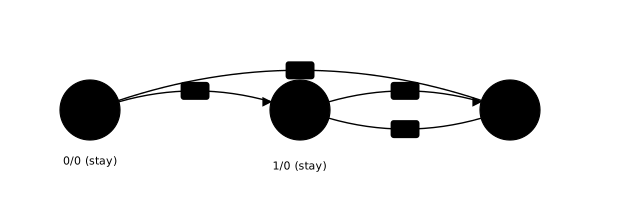
Mealy detector for 101 with overlap: arrows are labelled input/output; the 1/1 arrow fires on the final 1 of 101.
5 · Worked Examples
Example 1 Easy
How many flip-flops does a 5-state machine need?
Solution
⌈log₂ 5⌉ = 3.
Example 2 Medium
Give the outputs of the overlapping Mealy 101 detector for input 1 0 1 0 1.
Solution
0 0 1 0 1 (two overlapping detections).
Example 3 GATE
Minimum number of states for a Moore machine that detects the sequence 1011 (overlapping allowed)?
Solution
k + 1 = 5.
6 · GATE Traps
⚠️
- Moore output belongs to the state, Mealy output to the transition.
- Overlapping detectors reuse the tail of a match; non-overlapping restart from S0.
- Moore usually needs one more state than Mealy for the same detector.
- Equivalent states need equal outputs and equivalent next states for every input.
7 · Memory Hook
🧠
"Moore: output in the state. Mealy: output on the arrow. k-bit detector: k (Mealy) or k + 1 (Moore) states. Minimise by splitting groups."
8 · Connect the Dots
Phase 6 is complete, and so is the whole syllabus. Phase 7 gathers it: the master rule sheet, mixed practice, the GATE pattern drill and the final test.
9 · Self-Test
GATE format. Try every question before opening the vault.
Q1NAT1 markFlip-flops
How many flip-flops are needed for a state machine with 9 states?
Numerical answer: ________
Q2MCQ1 markMoore vs Mealy
In a Mealy machine, the output depends on:
- (A) the clock only
- (B) the input only
- (C) the present state only
- (D) the present state and the present input
Q3NAT2 marksDetector output
The overlapping Mealy 101 detector of this lesson receives 1 1 0 1 0 1 0 1. How many 1s does it output?
Numerical answer: ________
Q4NAT2 marksMinimisation
In the minimisation example of this lesson, how many states remain?
Numerical answer: ________
Q5NAT1 markDetector states
Minimum number of states of a Mealy machine detecting the sequence 1101?
Numerical answer: ________
10 · Rule Card
- Moore: output = f(state). Mealy: output = f(state, input); usually fewer states.
- k-bit sequence detector: k states (Mealy), k + 1 (Moore). Overlapping vs non-overlapping changes the arrows after a match.
- s states → ⌈log₂ s⌉ flip-flops.
- Minimise by partition: group by outputs, split by next-state groups, repeat.
11 · Concept Ledger
Unlocked in this lesson. From here on, these terms may be used.
finite state machinestate diagramstate tableMoore machineMealy machineoutput timingsequence detectoroverlapping and non-overlapping detectionstate assignment and flip-flop countequivalent statesstate minimisation by partitioning
12 · Answer Vault
Answer Vault
Try the questions first. Open when you are ready to check.
Recall Warm-up
- Every unused state leads into the main cycle.
- ⌈log₂ N⌉.
- The next value of that bit.
Self-Test
Q1 Answer: 41 mark
2³ = 8 < 9.
Re-read: Lesson 6.2.4 — Finite state machines: Mealy and Moore, sequence detectors, state minimisation
Q2 Answer: (D)1 mark
That is the definition.
- (A) is wrong: No.
- (B) is wrong: Then it would be combinational.
- (C) is wrong: Moore.
Re-read: Lesson 6.2.4 — Finite state machines: Mealy and Moore, sequence detectors, state minimisation
Q3 Answer: 32 marks
Detections end at positions 4, 6 and 8.
Re-read: Lesson 6.2.4 — Finite state machines: Mealy and Moore, sequence detectors, state minimisation
Q4 Answer: 42 marks
{A}, {B, C}, {D, E}, {F}.
Re-read: Lesson 6.2.4 — Finite state machines: Mealy and Moore, sequence detectors, state minimisation
Q5 Answer: 41 mark
k states for a k-bit sequence.
Re-read: Lesson 6.2.4 — Finite state machines: Mealy and Moore, sequence detectors, state minimisation