0 · Recall Warm-up
Answer from memory first. Answers are in the Answer Vault at the bottom.
- What makes a prime implicant essential? from Lesson 4.1.2
- How many minterms does a term with 2 of 4 variables cover? from Lesson 3.2.1
- Which BCD patterns are invalid? from Lesson 1.2.1
1 · The Hook
🎣
A circuit reads a BCD digit (0–9). The inputs 1010 to 1111 can never arrive, so we don't care what the circuit outputs for them. Marking those cells X (don't care) lets us treat them as 1 when that makes a group bigger, often halving the circuit. GATE loves functions given as Σm(…) + d(…). And five-variable maps, built from two four-variable maps, appear now and then.
2 · Predict First
🤔
A BCD input ABCD should give F = 1 when the digit is 5 or more (5, 6, 7, 8, 9). If cells 10–15 may be used freely, can the whole row AB = 10 and row AB = 11 be one group?
Make a guess in your head. The answer opens Section 3.
3 · Core Concept
💡
Predict First — the answer
Yes: rows 11 (12–15) and 10 (8–11) together are 8, 9 plus don't-cares, so the group A is allowed.
🗣️
In plain words
A don't-care cell is a wild card. Use it as a 1 if it lets you draw a bigger group; otherwise leave it out. Never draw a group made only of don't-cares, because it covers nothing that matters.
1. Don't-care conditions
Written F = Σm(…) + d(…), or X in the map. Rules:
- An X may be included in a group as if it were 1 (to make the group bigger).
- An X need not be covered.
- Prime implicants are found with Xs counted as 1s; essential PIs are decided by the real 1s only.
2. Example: BCD digit ≥ 5
F(A, B, C, D) = Σm(5, 6, 7, 8, 9) + d(10, 11, 12, 13, 14, 15).
- A (8–15): uses 8, 9 and six Xs.
- BD (5, 7, 13, 15) and BC (6, 7, 14, 15).
- F = A + BD + BC (5 literals). Without the don't-cares the best is AB'C' + A'BD + A'BC (9 literals).
3. Example with a choice
F = Σm(1, 3, 7, 11, 15) + d(0, 2, 5):
- CD (3, 7, 11, 15) is essential.
- m₁ can go with A'B' (0, 1, 2, 3, using Xs 0, 2) or A'D (1, 3, 5, 7, using X 5).
- Two minimal answers: CD + A'B' or CD + A'D. They differ only on the don't-care inputs.
4. Five-variable maps
Draw two 4-variable maps, one for A = 0 (minterms 0–15) and one for A = 1 (16–31). A cell is also adjacent to the cell in the same position in the other map. A group spanning both maps loses A. F(A, B, C, D, E) = Σm(0, 2, 4, 6, 9, 13, 21, 23, 25, 29, 31):
- A'B'E' (0, 2, 4, 6) in the A = 0 map.
- BD'E (9, 13, 25, 29): same positions in both maps.
- ACE (21, 23, 29, 31) in the A = 1 map.
- F = A'B'E' + BD'E + ACE.
4 · Visual
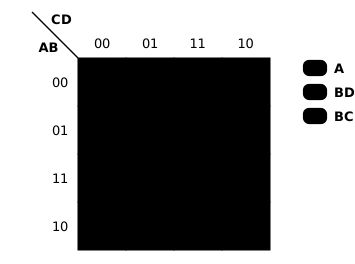
BCD digit ≥ 5 with don't-cares: F = A + BD + BC.
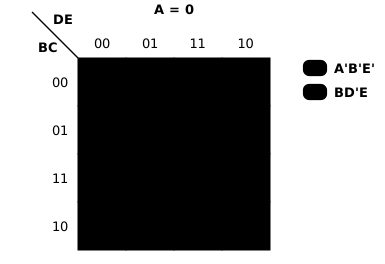
Left half of a 5-variable map (A = 0).
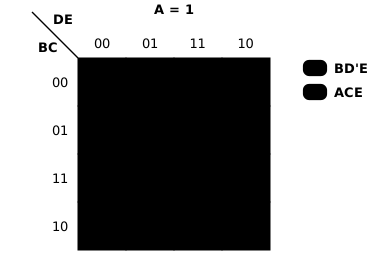
Right half (A = 1). The orange cells sit in the same positions in both halves, so they form one group BD'E.
5 · Worked Examples
Example 1 Easy
In F = Σm(1, 3) + d(5, 7) with 3 variables, what is the minimal SOP?
Solution
Use the Xs: 1, 3, 5, 7 → C.
Example 2 Medium
F(A, B, C, D) = Σm(1, 3, 7, 11, 15) + d(0, 2, 5). Give one minimal SOP.
Solution
CD + A'B' (or CD + A'D).
Example 3 GATE
F(A, B, C, D) = Σm(1, 3, 5, 7, 9) + d(10, 11, 12, 13, 14, 15) (BCD "digit is odd"). Minimal SOP?
Solution
1, 3, 5, 7, 9 plus Xs 11, 13, 15 fill both D = 1 columns → D.
6 · GATE Traps
⚠️
- Don't-cares are optional: include them only to enlarge groups.
- Never make a group of only don't-cares.
- Essential PIs are judged by the real 1s, not by Xs.
- In 5-variable maps, adjacency across the two halves is by same position, not by touching edges.
7 · Memory Hook
🧠
"X = wild card: use it if it helps, ignore it if it doesn't. Five variables = two maps stacked."
8 · Connect the Dots
Chapter 4.1 is complete. K-maps get hard beyond 5 or 6 variables and depend on spotting groups by eye. The tabular method in Chapter 4.2 finds prime implicants mechanically, for any number of variables.
9 · Self-Test
GATE format. Try every question before opening the vault.
Q1MCQ2 marksDon't-cares
The minimal SOP of F(A, B, C, D) = Σm(5, 6, 7, 8, 9) + d(10, 11, 12, 13, 14, 15) is:
- (A) AB'C' + A'BD + A'BC
- (B) A + B
- (C) A + BD + BC
- (D) A + BC
Q2NAT1 markDon't-cares
F(A, B, C, D) = Σm(1, 3, 5, 7, 9) + d(10, 11, 12, 13, 14, 15). How many literals in the minimal SOP?
Numerical answer: ________
Q3NAT2 marksChoice
F = Σm(1, 3, 7, 11, 15) + d(0, 2, 5). How many different minimal SOPs are there?
Numerical answer: ________
Q4MCQ1 markRules
Which statement about don't-care cells is true?
- (A) A group may consist only of don't-cares
- (B) Every don't-care must be covered
- (C) Don't-cares must be treated as 0
- (D) A don't-care may be treated as 1 to enlarge a group
Q5NAT2 marksFive variables
F(A, B, C, D, E) = Σm(0, 2, 4, 6, 9, 13, 21, 23, 25, 29, 31). How many literals are in its minimal SOP?
Numerical answer: ________
10 · Rule Card
- Don't-cares (d or X): may be used as 1s to enlarge groups; need not be covered; never group only Xs.
- PIs computed with Xs as 1s; essentiality judged on the real 1s.
- 5-variable map: two 4-variable maps (A = 0, A = 1); same position in both halves is adjacent; a group in both halves drops A.
11 · Concept Ledger
Unlocked in this lesson. From here on, these terms may be used.
don't-care conditionsd-notationusing don't-cares in groupsBCD don't-caresmultiple minimal answers with don't-caresfive-variable K-mapsadjacency between the two halves
12 · Answer Vault
Answer Vault
Try the questions first. Open when you are ready to check.
Recall Warm-up
- It is the only PI covering some 1.
-
- 1010 to 1111.
Self-Test
Q1 Answer: (C)2 marks
Use the don't-cares to make A, BD and BC.
- (A) is wrong: Ignores the don't-cares (9 literals).
- (B) is wrong: Covers 4 (0100), which must be 0.
- (D) is wrong: Misses 5.
Re-read: Lesson 4.1.3 — Don't-care conditions and 5-variable maps
Q2 Answer: 11 mark
F = D.
Re-read: Lesson 4.1.3 — Don't-care conditions and 5-variable maps
Q3 Answer: 22 marks
CD + A'B' and CD + A'D.
Re-read: Lesson 4.1.3 — Don't-care conditions and 5-variable maps
Q4 Answer: (D)1 mark
They are wild cards.
- (A) is wrong: Useless.
- (B) is wrong: Optional.
- (C) is wrong: No.
Re-read: Lesson 4.1.3 — Don't-care conditions and 5-variable maps
Q5 Answer: 92 marks
A'B'E' + BD'E + ACE.
Re-read: Lesson 4.1.3 — Don't-care conditions and 5-variable maps