0 · Recall Warm-up
Answer from memory first. Answers are in the Answer Vault at the bottom.
- Minimum clock period formula? from Lesson 6.1.3
- D flip-flop equation? from Lesson 6.1.2
- Gray code property? from Lesson 1.2.1
1 · The Hook
🎣
A row of D flip-flops sharing one clock can hold a whole number: a register. Connect each flip-flop's input to its neighbour's output and the bits march one place per clock: a shift register, used to turn serial data into parallel and back. Feed the last bit back to the first and the pattern circulates for ever: ring and Johnson counters, which GATE asks about by their state sequences.
2 · Predict First
🤔
A 4-bit shift register (shifting right) holds 1011. A 0 is fed in at the left and the clock ticks once. What does it hold now?
Make a guess in your head. The answer opens Section 3.
3 · Core Concept
💡
Predict First — the answer
0101: every bit moves one place right, the rightmost bit falls out, the new bit enters on the left.
🗣️
In plain words
A register is several flip-flops clocked together. In a shift register, each flip-flop copies its neighbour at each clock edge, so the stored pattern slides along by one place per clock. Closing the loop turns it into a counter that cycles through a fixed set of patterns.
1. Registers and shift registers
- Register: n D flip-flops with a common clock; loads n bits at once (parallel in, parallel out: PIPO).
- Shift register: D of each flip-flop = Q of its neighbour. Kinds by how data enters/leaves: SISO, SIPO, PISO, PIPO.
- An n-bit serial-in register needs n clock pulses to load n bits; with SISO the first bit reaches the serial output after n pulses.
- Shifting right divides an unsigned value by 2; shifting left multiplies by 2 (Lesson 0.1.3).
2. Ring counter
Output of the last flip-flop fed back to the first. Start with a single 1: 1000 → 0100 → 0010 → 0001 → 1000.
- n flip-flops → n states (mod-n). Needs to be initialised (all-0 would stay all-0).
- Each state has one 1: decoding needs no gates.
3. Johnson (twisted-ring) counter
The complement of the last output is fed back. Start at 000: 000 → 100 → 110 → 111 → 011 → 001 → 000 (3 flip-flops).
- n flip-flops → 2n states. 4 flip-flops: 0000, 1000, 1100, 1110, 1111, 0111, 0011, 0001.
- Unused states (2ⁿ − 2n) can form a separate cycle (lock-out) unless extra logic corrects them.
4 · Visual
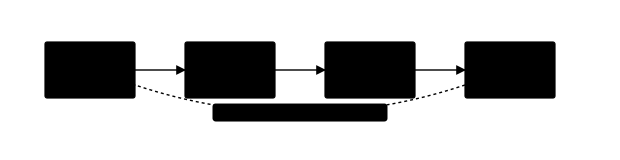
A 4-bit shift register closed into a loop: feed back Q4 for a ring counter (4 states) or Q4' for a Johnson counter (8 states).
5 · Worked Examples
Example 1 Easy
How many states does a 5-flip-flop ring counter have?
Solution
5.
Example 2 Medium
How many states does a 5-flip-flop Johnson counter have?
Solution
2 × 5 = 10.
Example 3 GATE
A 3-bit Johnson counter starts at 000. What is its state after 4 clock pulses?
Solution
000 → 100 → 110 → 111 → 011.
6 · GATE Traps
⚠️
- Ring: n states; Johnson: 2n states; plain binary: 2ⁿ.
- A ring counter must start with exactly one 1 (or one 0); all-zeros never changes.
- Johnson feeds back the complement of the last stage.
- Serial loading of n bits takes n clocks.
7 · Memory Hook
🧠
"Ring: one 1 goes round, n states. Johnson: twist the feedback, 2n states."
8 · Connect the Dots
Ring and Johnson counters waste most of their 2ⁿ states. The next lesson builds counters that use all 2ⁿ states, the simplest way first: ripple counters, where each flip-flop clocks the next.
9 · Self-Test
GATE format. Try every question before opening the vault.
Q1NAT1 markRing
How many states does a 6-flip-flop ring counter cycle through?
Numerical answer: ________
Q2NAT1 markJohnson
How many states does a 4-flip-flop Johnson counter cycle through?
Numerical answer: ________
Q3MCQ1 markJohnson sequence
A 4-bit Johnson counter starts at 0000. Its state after 5 clock pulses is:
- (A) 1110
- (B) 1111
- (C) 0111
- (D) 0011
Q4NAT2 marksUnused states
How many of the 16 possible states does a 4-bit Johnson counter never use (in its main cycle)?
Numerical answer: ________
Q5MCQ1 markShift register
A 4-bit right-shift register holds 1011; the serial input is 1 for one clock. New contents?
- (A) 1101
- (B) 0110
- (C) 0101
- (D) 1011
10 · Rule Card
- Register: n D flip-flops, common clock. Shift register: D = neighbour's Q; SISO, SIPO, PISO, PIPO; n clocks to load n bits serially.
- Ring counter: feed back Q of the last stage; n states; must be initialised.
- Johnson counter: feed back Q' of the last stage; 2n states; 2ⁿ − 2n unused.
11 · Concept Ledger
Unlocked in this lesson. From here on, these terms may be used.
registershift registerSISO, SIPO, PISO and PIPOserial loadingring counterJohnson (twisted-ring) counternumber of states of ring and Johnson countersunused states and lock-out
12 · Answer Vault
Answer Vault
Try the questions first. Open when you are ready to check.
Recall Warm-up
- t_pd + t_comb + t_su.
- Q⁺ = D.
- Neighbours differ in one bit.
Self-Test
Q1 Answer: 61 mark
One per position of the 1.
Re-read: Lesson 6.2.1 — Registers, shift registers, ring and Johnson counters
Q2 Answer: 81 mark
2n.
Re-read: Lesson 6.2.1 — Registers, shift registers, ring and Johnson counters
Q3 Answer: (C)1 mark
0000, 1000, 1100, 1110, 1111, 0111.
- (A) is wrong: After 3.
- (B) is wrong: After 4.
- (D) is wrong: After 6.
Re-read: Lesson 6.2.1 — Registers, shift registers, ring and Johnson counters
Q4 Answer: 82 marks
16 − 8.
Re-read: Lesson 6.2.1 — Registers, shift registers, ring and Johnson counters
Q5 Answer: (A)1 mark
1 enters on the left, everything moves right.
- (B) is wrong: That is a left shift with 0.
- (C) is wrong: That is with a 0 entering.
- (D) is wrong: Unchanged.
Re-read: Lesson 6.2.1 — Registers, shift registers, ring and Johnson counters