0 · Recall Warm-up
Answer from memory first. Answers are in the Answer Vault at the bottom.
- 4:1 MUX output equation? from Lesson 5.2.1
- Number of 2:1 MUXes in a 2ⁿ:1 MUX? from Lesson 5.2.1
- Minterm m₅ of F(A, B, C)? from Lesson 3.2.1
1 · The Hook
🎣
A lift panel has a button per floor; the controller must know which button was pressed (encoder). A memory chip receives an address and must switch on exactly one row of cells (decoder). These two circuits are everywhere, and a decoder plus an OR gate can build any function, a quick GATE question.
2 · Predict First
🤔
A circuit has 3 inputs and 8 outputs, and exactly one output is 1: the one numbered by the input code. Which output is 1 for input 101?
Make a guess in your head. The answer opens Section 3.
3 · Core Concept
💡
Predict First — the answer
Output 5. Each output is one minterm: Y₅ = AB'C.
🗣️
In plain words
A decoder turns an n-bit code into 2ⁿ separate lines, switching on exactly the line whose number is the code; each output is a minterm. An encoder does the reverse: given one active line, it outputs its number. A priority encoder copes with several active lines by reporting the highest one. A demultiplexer sends one data input to the output chosen by the select lines.
1. Decoders
- n-to-2ⁿ decoder: output Yₖ = mₖ (the k-th minterm of the inputs). Often with an enable E: all outputs 0 when E = 0.
- Any function = decoder + OR gate: OR together the outputs of its minterms. F(A, B, C) = Σm(1, 2, 6, 7) → a 3-to-8 decoder and a 4-input OR of Y₁, Y₂, Y₆, Y₇. (If F has more 1s than 0s, a NOR of the 0-outputs is smaller.)
- Bigger from smaller: a 4-to-16 decoder = two 3-to-8 decoders with enables driven by A and A'. Or from 2-to-4 decoders in a tree: one for the top two bits enabling four for the bottom two → 5 decoders.
2. Encoders
- 2ⁿ-to-n encoder: exactly one input is 1; the output is its number. For 4-to-2: Y₁ = D₂ + D₃, Y₀ = D₁ + D₃.
- Problem: if two inputs are 1 at once, the output is wrong; if none is 1, it outputs 0 like D₀.
3. Priority encoder
The highest-numbered active input wins, and a valid output V says whether any input is 1. For 4 inputs D₃ … D₀:
- Y₁ = D₃ + D₂
- Y₀ = D₃ + D₂'D₁
- V = D₃ + D₂ + D₁ + D₀
| D₃ D₂ D₁ D₀ | Y₁ Y₀ | V |
|---|---|---|
| 0 0 0 0 | x x | 0 |
| 0 0 0 1 | 0 0 | 1 |
| 0 0 1 x | 0 1 | 1 |
| 0 1 x x | 1 0 | 1 |
| 1 x x x | 1 1 | 1 |
4. Demultiplexer
1-to-2ⁿ: the data input D goes to output k chosen by the selects; the others are 0. It is the same circuit as a decoder whose enable is used as the data input.
4 · Visual
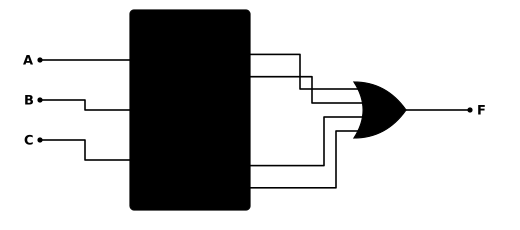
F(A, B, C) = Σm(1, 2, 6, 7): a 3-to-8 decoder supplies the minterms, a 4-input OR collects the ones F needs.
5 · Worked Examples
Example 1 Easy
A 2-to-4 decoder has inputs A B = 10. Which output is 1?
Solution
Y₂.
Example 2 Medium
A 4-input priority encoder receives D₃ D₂ D₁ D₀ = 0110. What are Y₁ Y₀ and V?
Solution
Highest active input is D₂ → Y₁Y₀ = 10, V = 1.
Example 3 GATE
How many 2-to-4 decoders (with enable) are needed to build a 4-to-16 decoder?
Solution
1 for the top two bits + 4 for the bottom two = 5.
6 · GATE Traps
⚠️
- Decoder outputs are minterms; to build F, OR the minterms of F (not the maxterms).
- A plain encoder assumes exactly one active input; use a priority encoder otherwise.
- Priority encoders need the valid bit V to tell "D₀ active" from "nothing active".
- Demultiplexer = decoder with the enable used as data.
7 · Memory Hook
🧠
"Decoder: code in, one line out (minterms). Encoder: one line in, code out. Priority: highest wins, V says someone pressed."
8 · Connect the Dots
Decoders + OR gates and multiplexers can build any function, but large designs need something more compact and reprogrammable. The last lesson of the phase covers ROMs and PLAs: arrays that store functions.
9 · Self-Test
GATE format. Try every question before opening the vault.
Q1NAT1 markDecoder
How many outputs does a 5-to-32 decoder have that are 1 for any single input code?
Numerical answer: ________
Q2NAT2 marksFunction with decoder
F(A, B, C) = Σm(0, 3, 5) is built from a 3-to-8 decoder and one OR gate. How many inputs does the OR gate need?
Numerical answer: ________
Q3MCQ1 markPriority encoder
A 4-input priority encoder (D₃ highest) receives D₃D₂D₁D₀ = 0011. The output Y₁Y₀ is:
- (A) 01
- (B) 11
- (C) 00
- (D) 10
Q4MCQ1 markPriority equations
For a 4-input priority encoder, Y₀ equals:
- (A) D₃ + D₂
- (B) D₃ + D₂'D₁
- (C) D₀ + D₂
- (D) D₁ + D₃
Q5NAT2 marksDecoder tree
How many 3-to-8 decoders with enable are needed to build a 6-to-64 decoder as a tree (one first-level decoder enabling the others)?
Numerical answer: ________
10 · Rule Card
- n-to-2ⁿ decoder: Yₖ = mₖ (with enable). Function = decoder + OR of its minterm outputs.
- Decoder trees: 4-to-16 from five 2-to-4 decoders, or from two 3-to-8 with enables.
- Encoder 2ⁿ-to-n assumes one active input. Priority encoder (4-input): Y₁ = D₃ + D₂, Y₀ = D₃ + D₂'D₁, V = OR of all.
- Demultiplexer = decoder with the enable as data.
11 · Concept Ledger
Unlocked in this lesson. From here on, these terms may be used.
decoderenable inputdecoder outputs as mintermsimplementing functions with a decoder and OR gatedecoder treesencoderpriority encodervalid bitdemultiplexer
12 · Answer Vault
Answer Vault
Try the questions first. Open when you are ready to check.
Recall Warm-up
- S₁'S₀'I₀ + S₁'S₀I₁ + S₁S₀'I₂ + S₁S₀I₃.
- 2ⁿ − 1.
- AB'C.
Self-Test
Q1 Answer: 11 mark
Exactly one minterm is true.
Re-read: Lesson 5.2.2 — Decoders, encoders, priority encoders and demultiplexers
Q2 Answer: 32 marks
One per minterm.
Re-read: Lesson 5.2.2 — Decoders, encoders, priority encoders and demultiplexers
Q3 Answer: (A)1 mark
D₁ is the highest active input.
- (B) is wrong: That is D₃.
- (C) is wrong: That is D₀.
- (D) is wrong: That is D₂.
Re-read: Lesson 5.2.2 — Decoders, encoders, priority encoders and demultiplexers
Q4 Answer: (B)1 mark
Y₀ = 1 for D₃, or for D₁ when D₂ is off.
- (A) is wrong: That is Y₁.
- (C) is wrong: No.
- (D) is wrong: The plain-encoder equation; fails for 0110.
Re-read: Lesson 5.2.2 — Decoders, encoders, priority encoders and demultiplexers
Q5 Answer: 92 marks
1 + 8.
Re-read: Lesson 5.2.2 — Decoders, encoders, priority encoders and demultiplexers