0 · Recall Warm-up
Answer from memory first. Answers are in the Answer Vault at the bottom.
- Circuit delay is determined by? from Lesson 5.1.1
- A ⊕ B ⊕ C is 1 when? from Lesson 3.2.3
- Carry rule in binary addition? from Lesson 0.1.3
1 · The Hook
🎣
Adding two 32-bit numbers by hand means 32 columns, each adding two bits and a carry. A full adder is one column in hardware; chaining 32 of them gives a 32-bit adder. The catch: each column must wait for the carry from the column to its right, so the carry ripples across, and GATE asks how long that takes.
2 · Predict First
🤔
One column adds bits A and B and an incoming carry C. If A = 1, B = 1, C = 1, what are the sum bit and the outgoing carry?
Make a guess in your head. The answer opens Section 3.
3 · Core Concept
💡
Predict First — the answer
1 + 1 + 1 = 3 = 11₂ → sum 1, carry 1.
🗣️
In plain words
A half adder adds two bits: the sum is their XOR, the carry is their AND. A full adder adds three bits (two digits and a carry in): the sum is the XOR of all three, and the carry out is 1 when at least two of them are 1 (majority). Put n full adders in a row, each passing its carry to the left, and you have an n-bit ripple-carry adder.
1. Half adder
| A B | Sum S | Carry C |
|---|---|---|
| 0 0 | 0 | 0 |
| 0 1 | 1 | 0 |
| 1 0 | 1 | 0 |
| 1 1 | 0 | 1 |
S = A ⊕ B, C = AB.
2. Full adder
Inputs A, B, Cᵢₙ; outputs S, Cₒᵤₜ.
- S = A ⊕ B ⊕ Cᵢₙ (minterms 1, 2, 4, 7).
- Cₒᵤₜ = AB + BCᵢₙ + ACᵢₙ = AB + Cᵢₙ(A ⊕ B) (minterms 3, 5, 6, 7, the majority).
- A full adder = two half adders + an OR gate: the first adds A and B, the second adds Cᵢₙ to that sum, and the OR combines the two carries.
3. Ripple-carry adder (RCA)
n full adders; the carry out of stage i is the carry in of stage i + 1; C₀ is the carry into the LSB stage. Timing: suppose every full adder produces its carry t_c after its inputs are ready and its sum t_s after. Stage i's carry is ready at (i + 1)·t_c, so:
- final carry Cₙ at n·t_c;
- most significant sum Sₙ₋₁ at (n − 1)·t_c + t_s;
- the addition is complete at the larger of the two.
Example: 4-bit RCA with t_c = 2 ns, t_s = 3 ns: C₄ at 8 ns, S₃ at 6 + 3 = 9 ns. Delay grows linearly with n.
4. Subtractors (briefly)
Half subtractor: D = A ⊕ B, borrow = A'B. Full subtractor: D = A ⊕ B ⊕ Bᵢₙ, Bₒᵤₜ = A'B + Bᵢₙ(A ⊕ B)'. In practice subtraction reuses the adder (next lesson).
4 · Visual
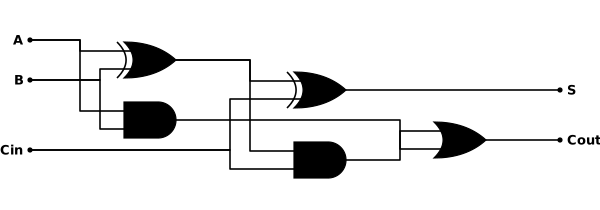
A full adder from two half adders (XOR + AND each) and an OR gate: S = A ⊕ B ⊕ Cin, Cout = AB + Cin(A ⊕ B).
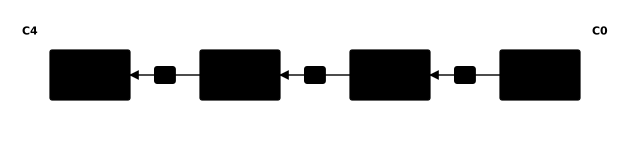
A 4-bit ripple-carry adder: each stage waits for the carry from the stage on its right.
5 · Worked Examples
Example 1 Easy
A half adder gets A = 1, B = 1. Outputs?
Solution
S = 0, C = 1.
Example 2 Medium
A full adder gets A = 1, B = 0, Cᵢₙ = 1. Outputs?
Solution
1 + 0 + 1 = 10₂ → S = 0, Cₒᵤₜ = 1.
Example 3 GATE
A 16-bit ripple-carry adder uses full adders with carry delay 2 ns and sum delay 3 ns. When is the most significant sum bit valid?
Solution
15 × 2 + 3 = 33 ns.
6 · GATE Traps
⚠️
- Full-adder carry is the majority of A, B, Cᵢₙ, not their AND.
- RCA delay: the last sum needs (n − 1) carries plus one sum delay; the last carry needs n carry delays.
- A half adder has no carry input; you can't chain half adders alone into a multi-bit adder.
- Ripple delay grows linearly with the number of bits.
7 · Memory Hook
🧠
"Sum = XOR of all three, carry = majority. Ripple: (n − 1) carries then a sum."
8 · Connect the Dots
Waiting for the carry to ripple through 32 or 64 stages is slow. The next lesson computes all carries at once (carry lookahead), turns the adder into a subtractor with XOR gates, and builds comparators.
9 · Self-Test
GATE format. Try every question before opening the vault.
Q1MCQ1 markHalf adder
The outputs of a half adder are:
- (A) S = AB, C = A ⊕ B
- (B) S = A + B, C = AB
- (C) S = A ⊙ B, C = A + B
- (D) S = A ⊕ B, C = AB
Q2NAT1 markFull adder
How many of the 8 input combinations of a full adder give Cₒᵤₜ = 1?
Numerical answer: ________
Q3NAT2 marksRipple delay
An 8-bit ripple-carry adder uses full adders with carry delay 3 ns and sum delay 4 ns. When is the final carry C₈ valid (ns)?
Numerical answer: ________
Q4NAT2 marksRipple delay
Same adder (carry delay 3 ns, sum delay 4 ns, 8 bits). When is the most significant sum bit S₇ valid (ns)?
Numerical answer: ________
Q5MCQ1 markBuilding
A full adder can be built from:
- (A) two half adders and an OR gate
- (B) one half adder and an XOR gate
- (C) three AND gates
- (D) two half adders only
10 · Rule Card
- Half adder: S = A ⊕ B, C = AB.
- Full adder: S = A ⊕ B ⊕ Cᵢₙ; Cₒᵤₜ = AB + BCᵢₙ + ACᵢₙ = AB + Cᵢₙ(A ⊕ B); = 2 half adders + OR.
- n-bit RCA: Cₙ at n·t_c; Sₙ₋₁ at (n − 1)·t_c + t_s; delay linear in n.
11 · Concept Ledger
Unlocked in this lesson. From here on, these terms may be used.
half adderfull addersum and carry equationsfull adder from half addersripple-carry addercarry propagation delaytiming of the last sum and carryhalf and full subtractors
12 · Answer Vault
Answer Vault
Try the questions first. Open when you are ready to check.
Recall Warm-up
- The slowest (critical) path.
- An odd number of inputs are 1.
- Carry when a column reaches 2.
Self-Test
Q1 Answer: (D)1 mark
Sum is XOR, carry is AND.
- (A) is wrong: Swapped.
- (B) is wrong: 1 + 1 would give S = 1.
- (C) is wrong: No.
Re-read: Lesson 5.1.2 — Half adder, full adder and the ripple-carry adder
Q2 Answer: 41 mark
Majority: 3, 5, 6, 7.
Re-read: Lesson 5.1.2 — Half adder, full adder and the ripple-carry adder
Q3 Answer: 242 marks
8 × 3.
Re-read: Lesson 5.1.2 — Half adder, full adder and the ripple-carry adder
Q4 Answer: 252 marks
7 × 3 + 4.
Re-read: Lesson 5.1.2 — Half adder, full adder and the ripple-carry adder
Q5 Answer: (A)1 mark
Two partial sums and two carries combined by OR.
- (B) is wrong: Carry logic missing.
- (C) is wrong: No.
- (D) is wrong: The two carries must be combined.
Re-read: Lesson 5.1.2 — Half adder, full adder and the ripple-carry adder