0 · Recall Warm-up
Answer from memory first. Answers are in the Answer Vault at the bottom.
- What is AB + AB'? from Lesson 3.1.2
- Canonical SOP of F(A, B, C) = A + B'C? from Lesson 3.2.1
- In Gray code, how many bits change between neighbours? from Lesson 1.2.1
1 · The Hook
🎣
Simplifying with Boolean laws needs luck: you must spot which law to apply. Maurice Karnaugh found a picture that does the spotting for you. Lay the truth table out as a grid where neighbouring cells differ in exactly one variable; then every pair, square or strip of 1s you can circle is a simplification you can read off directly. GATE asks a K-map question in almost every paper.
2 · Predict First
🤔
Two neighbouring cells hold the minterms A'BC and A'BC'. What single term covers both?
Make a guess in your head. The answer opens Section 3.
3 · Core Concept
💡
Predict First — the answer
A'BC + A'BC' = A'B(C + C') = A'B. The variable that changes (C) disappears.
🗣️
In plain words
A Karnaugh map (K-map) is a truth table drawn as a grid. Rows and columns are labelled in Gray-code order (00, 01, 11, 10), so any two cells side by side differ in one variable. Circle groups of 1s whose size is a power of two (1, 2, 4, 8, …) in a rectangle. Inside a group, any variable that changes drops out; the variables that stay fixed form the group's product term.
1. Layouts
- 2 variables: 2 × 2 (A rows, B columns).
- 3 variables: 2 × 4 (A rows; BC columns 00, 01, 11, 10).
- 4 variables: 4 × 4 (AB rows 00, 01, 11, 10; CD columns 00, 01, 11, 10).
4-variable cell numbers (row AB, column CD):
| AB \ CD | 00 | 01 | 11 | 10 |
|---|---|---|---|---|
| 00 | 0 | 1 | 3 | 2 |
| 01 | 4 | 5 | 7 | 6 |
| 11 | 12 | 13 | 15 | 14 |
| 10 | 8 | 9 | 11 | 10 |
Note the order 3 before 2, and rows 12–15 before 8–11 (Gray code).
2. Adjacency
Two cells are adjacent if they differ in one variable. That includes wrap-around: the left and right edges are neighbours, the top and bottom edges are neighbours, and the four corners form one group of 4.
3. Grouping rules
- A group is a rectangle of 1, 2, 4, 8 or 16 cells (a power of 2), possibly wrapping around the edges.
- It contains only 1s.
- A group of 2ᵏ cells removes k variables: write only the variables that are constant across the group (plain if 1, primed if 0).
- To minimise: make every group as large as possible, use as few groups as possible, cover every 1 at least once. Groups may overlap.
4. Worked example
F(A, B, C, D) = Σm(0, 2, 5, 7, 8, 10, 13, 15).
- The four corners 0, 2, 8, 10: B = 0 and D = 0 throughout → B'D'.
- The centre square 5, 7, 13, 15: B = 1 and D = 1 → BD.
- F = BD + B'D' (which is B ⊙ D).
4 · Visual
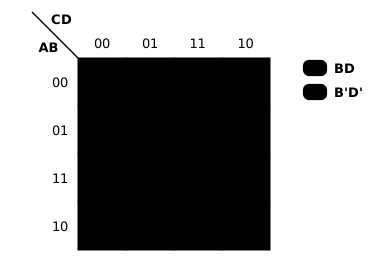
F = Σm(0, 2, 5, 7, 8, 10, 13, 15). The four corners are one group (wrap-around both ways): F = BD + B'D'.
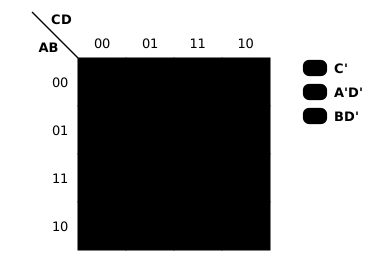
F = Σm(0, 1, 2, 4, 5, 6, 8, 9, 12, 13, 14) = C' + A'D' + BD'. The 8-cell group removes three variables.
5 · Worked Examples
Example 1 Easy
In a 4-variable map, a group covers cells 8, 9, 10, 11 (the bottom row). What term is it?
Solution
Row AB = 10 throughout, C and D change → AB'.
Example 2 Medium
Minimise F(A, B, C) = Σm(1, 3, 4, 5, 6, 7).
Solution
Column pairs with C = 1 (1, 3, 5, 7) → C; the whole A = 1 row (4, 5, 6, 7) → A. F = A + C.
Example 3 GATE
Minimise F(A, B, C, D) = Σm(0, 1, 2, 4, 5, 6, 8, 9, 12, 13, 14). How many literals are in the minimal SOP?
Solution
C' + A'D' + BD' → 1 + 2 + 2 = 5 literals.
6 · GATE Traps
⚠️
- Columns go 00, 01, 11, 10: cell 3 sits before cell 2.
- Corners and opposite edges are adjacent; don't miss wrap-around groups.
- Group sizes must be powers of 2 and rectangular (no L-shapes, no groups of 3 or 6).
- Bigger groups are always better: a group of 4 is cheaper than two groups of 2 covering the same cells.
7 · Memory Hook
🧠
"Gray-code the edges, wrap the borders, circle powers of two, keep what doesn't change."
8 · Connect the Dots
Grouping by eye works, but which groups are really needed? The next lesson names them: prime implicants and essential prime implicants, and shows how to get the minimal SOP (and POS) without guessing.
9 · Self-Test
GATE format. Try every question before opening the vault.
Q1MCQ1 markReading a group
In a 4-variable K-map (AB rows, CD columns), a group covers cells 1, 3, 9, 11. Its term is:
- (A) A'D
- (B) B'C
- (C) CD
- (D) B'D
Q2NAT1 markLiterals removed
A group of 8 cells in a 4-variable K-map leaves how many literals in its term?
Numerical answer: ________
Q3MCQ2 marksMinimise
F(A, B, C, D) = Σm(0, 2, 8, 10). The minimal SOP is:
- (A) B'D'
- (B) B'C'D'
- (C) BD
- (D) A'B'D'
Q4NAT2 marksMinimise
F(A, B, C, D) = Σm(0, 1, 2, 4, 5, 6, 8, 9, 12, 13, 14). How many product terms are in the minimal SOP?
Numerical answer: ________
Q5MCQ1 markLayout
In a 3-variable K-map with A as rows and BC as columns, which minterm is in row A = 1, column BC = 10?
- (A) m₄
- (B) m₆
- (C) m₅
- (D) m₇
10 · Rule Card
- K-map rows and columns in Gray order (00, 01, 11, 10); adjacent cells differ in one variable; edges and corners wrap.
- Groups: rectangles of 2ᵏ cells containing only 1s; a 2ᵏ group drops k variables.
- Term of a group: the variables that stay constant (1 → plain, 0 → primed).
- Minimise: largest possible groups, fewest groups, every 1 covered; overlaps allowed.
11 · Concept Ledger
Unlocked in this lesson. From here on, these terms may be used.
Karnaugh map2-, 3- and 4-variable layoutsGray-code labellingadjacency and wrap-aroundcorner groupsgroup sizes as powers of tworeading a group's termminimisation by grouping
12 · Answer Vault
Answer Vault
Try the questions first. Open when you are ready to check.
Recall Warm-up
- A.
- Σm(1, 4, 5, 6, 7).
- One.
Self-Test
Q1 Answer: (D)1 mark
Rows 00 and 10 (B = 0), columns 01 and 11 (D = 1).
- (A) is wrong: A changes between rows 00 and 10.
- (B) is wrong: C changes.
- (C) is wrong: Covers rows 01 and 11 too.
Re-read: Lesson 4.1.1 — Karnaugh maps for 2, 3 and 4 variables: adjacency and grouping
Q2 Answer: 11 mark
2³ cells remove 3 of the 4 variables.
Re-read: Lesson 4.1.1 — Karnaugh maps for 2, 3 and 4 variables: adjacency and grouping
Q3 Answer: (A)2 marks
The four corners.
- (B) is wrong: Covers 0 and 8 only.
- (C) is wrong: The centre.
- (D) is wrong: Too narrow.
Re-read: Lesson 4.1.1 — Karnaugh maps for 2, 3 and 4 variables: adjacency and grouping
Q4 Answer: 32 marks
C' + A'D' + BD'.
Re-read: Lesson 4.1.1 — Karnaugh maps for 2, 3 and 4 variables: adjacency and grouping
Q5 Answer: (B)1 mark
ABC = 110.
- (A) is wrong: Column 00.
- (C) is wrong: Column 01.
- (D) is wrong: Column 11.
Re-read: Lesson 4.1.1 — Karnaugh maps for 2, 3 and 4 variables: adjacency and grouping