0 · Recall Warm-up
Answer from memory first. Answers are in the Answer Vault at the bottom.
- Which NOR SR latch input is forbidden? from Lesson 6.1.1
- What does a gated D latch do while enabled? from Lesson 6.1.1
- XOR of a bit with 1? from Lesson 3.1.2
1 · The Hook
🎣
A clock in a computer ticks hundreds of millions of times per second, and on each rising edge every flip-flop takes one snapshot of its input. Between edges nothing changes. Four kinds of flip-flop exist (D, T, JK, SR); GATE asks you to trace them, to write their equations and to fill in their excitation tables, which drive every counter design.
2 · Predict First
🤔
A flip-flop has one input T. When T = 1 its output flips at each clock edge; when T = 0 it stays. Starting from Q = 0 with T = 1, what are Q after four clock edges?
Make a guess in your head. The answer opens Section 3.
3 · Core Concept
💡
Predict First — the answer
1, 0, 1, 0: it toggles (halving the clock frequency).
🗣️
In plain words
A flip-flop is a one-bit memory that changes only at a clock edge. Each type has a rule for the next value Q⁺ from the current Q and its inputs: D copies D, T toggles when T = 1, JK is like SR but J = K = 1 toggles instead of being forbidden. The excitation table answers the reverse question: "to go from this Q to that Q⁺, what must the inputs be?"
1. Edge triggering
A positive-edge-triggered flip-flop samples its inputs at the instant the clock goes 0 → 1 and ignores them the rest of the time. (Negative-edge: at 1 → 0.)
2. The four flip-flops
| Type | Characteristic table | Equation Q⁺ |
|---|---|---|
| D | D = 0 → 0; D = 1 → 1 | Q⁺ = D |
| T | T = 0 → Q; T = 1 → Q' | Q⁺ = T ⊕ Q |
| JK | 00 → Q; 01 → 0; 10 → 1; 11 → Q' | Q⁺ = JQ' + K'Q |
| SR | 00 → Q; 01 → 0; 10 → 1; 11 not allowed | Q⁺ = S + R'Q (with SR = 0) |
3. Excitation tables (Q → Q⁺ : required inputs; x = don't care)
| Q → Q⁺ | D | T | J K | S R |
|---|---|---|---|---|
| 0 → 0 | 0 | 0 | 0 x | 0 x |
| 0 → 1 | 1 | 1 | 1 x | 1 0 |
| 1 → 0 | 0 | 1 | x 1 | 0 1 |
| 1 → 1 | 1 | 0 | x 0 | x 0 |
Read the JK row 0 → 1 as: J must be 1 (set or toggle both work), K may be anything.
4. Tracing a JK flip-flop
Start Q = 0. Inputs (J, K) at successive edges: (1, 0), (0, 0), (1, 1), (1, 1), (0, 1), (1, 1) → Q = 1, 1, 0, 1, 0, 1.
5. Race-around and master–slave
A level-triggered JK latch with J = K = 1 toggles again and again while the clock stays high (if the pulse is longer than the gate delay): the race-around condition. Fixes: a master–slave JK (master follows while the clock is high, slave copies on the falling edge) or edge triggering.
4 · Visual
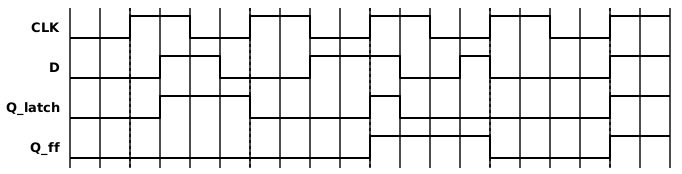
The same D drives a D latch (enabled while CLK = 1) and a positive-edge D flip-flop. The latch follows D during each high phase; the flip-flop changes only at the dashed rising edges.
5 · Worked Examples
Example 1 Easy
A T flip-flop has Q = 1 and T = 1 at a clock edge. Q⁺?
Solution
Toggle → 0.
Example 2 Medium
A JK flip-flop has Q = 1, J = 0, K = 1. Q⁺?
Solution
Reset → 0.
Example 3 GATE
Using the excitation table, what J and K are needed for a JK flip-flop to go from Q = 1 to Q⁺ = 1?
Solution
J = x, K = 0.
6 · GATE Traps
⚠️
- JK with J = K = 1 toggles; SR with S = R = 1 is forbidden.
- Excitation tables are read from the transition (Q → Q⁺) to the inputs, the reverse of characteristic tables.
- T flip-flop: T = 0 holds (doesn't reset).
- Edge-triggered flip-flops ignore input changes between edges.
7 · Memory Hook
🧠
"D copies, T toggles, JK = SR with 11 → toggle. Excitation: 0→1 needs J = 1, 1→0 needs K = 1, the other is x."
8 · Connect the Dots
Sometimes you have one kind of flip-flop but need another, and every flip-flop needs its input settled before the clock edge. The next lesson converts flip-flops into each other and works out the fastest safe clock.
9 · Self-Test
GATE format. Try every question before opening the vault.
Q1NAT2 marksJK trace
A JK flip-flop starts at Q = 0. At four successive clock edges, (J, K) = (1, 1), (1, 1), (0, 0), (1, 0). What is Q after the fourth edge?
Numerical answer: ________
Q2MCQ1 markEquation
The characteristic equation of a JK flip-flop is:
- (A) Q⁺ = J ⊕ K
- (B) Q⁺ = JQ' + K'Q
- (C) Q⁺ = JK + Q
- (D) Q⁺ = J + K'Q
Q3MCQ1 markExcitation
To make a JK flip-flop go from Q = 0 to Q⁺ = 1, the inputs must be:
- (A) J = 0, K = x
- (B) J = x, K = 1
- (C) J = 1, K = 1 only
- (D) J = 1, K = x
Q4NAT1 markT flip-flop
A T flip-flop with T = 1 starts at Q = 0. How many times is Q = 1 after each of 7 clock edges?
Numerical answer: ________
Q5MCQ1 markRace-around
The race-around condition occurs in:
- (A) an SR latch with S = R = 0
- (B) an edge-triggered D flip-flop
- (C) a level-triggered JK latch with J = K = 1 and a long clock pulse
- (D) a T flip-flop with T = 0
10 · Rule Card
- Edge-triggered: inputs sampled only at the clock edge.
- D: Q⁺ = D. T: Q⁺ = T ⊕ Q. JK: Q⁺ = JQ' + K'Q (11 toggles). SR: Q⁺ = S + R'Q, SR = 0.
- Excitation (Q → Q⁺): D = Q⁺; T = Q ⊕ Q⁺; JK: 0→0 0x, 0→1 1x, 1→0 x1, 1→1 x0; SR: 0x, 10, 01, x0.
- Race-around in level-triggered JK with J = K = 1; fixed by master–slave or edge triggering.
11 · Concept Ledger
Unlocked in this lesson. From here on, these terms may be used.
clock edgepositive and negative edge triggeringD flip-flopT flip-flopJK flip-flopSR flip-flopcharacteristic tables and equationsexcitation tablesrace-around conditionmaster–slave flip-flop
12 · Answer Vault
Answer Vault
Try the questions first. Open when you are ready to check.
Recall Warm-up
- S = R = 1.
- Q follows D (transparent).
- Its complement.
Self-Test
Q1 Answer: 12 marks
1, 0, 0, 1.
Re-read: Lesson 6.1.2 — Flip-flops: SR, D, JK and T; characteristic and excitation tables
Q2 Answer: (B)1 mark
Set when J and Q = 0, keep when K = 0 and Q = 1.
- (A) is wrong: No.
- (C) is wrong: No.
- (D) is wrong: That is the SR form (fails for J = K = 1).
Re-read: Lesson 6.1.2 — Flip-flops: SR, D, JK and T; characteristic and excitation tables
Q3 Answer: (D)1 mark
Either set (10) or toggle (11).
- (A) is wrong: That is 0 → 0.
- (B) is wrong: That is 1 → 0.
- (C) is wrong: 10 also works.
Re-read: Lesson 6.1.2 — Flip-flops: SR, D, JK and T; characteristic and excitation tables
Q4 Answer: 41 mark
1, 0, 1, 0, 1, 0, 1.
Re-read: Lesson 6.1.2 — Flip-flops: SR, D, JK and T; characteristic and excitation tables
Q5 Answer: (C)1 mark
It toggles repeatedly while the clock is high.
- (A) is wrong: Holds.
- (B) is wrong: Edge triggering prevents it.
- (D) is wrong: Holds.
Re-read: Lesson 6.1.2 — Flip-flops: SR, D, JK and T; characteristic and excitation tables