0 · Recall Warm-up
Answer from memory first. Answers are in the Answer Vault at the bottom.
- Pᵢ and Gᵢ in a lookahead adder? from Lesson 5.1.3
- Canonical SOP of a 3-variable function lists? from Lesson 3.2.1
- Is {AND, OR} functionally complete? from Lesson 3.2.2
1 · The Hook
🎣
A railway junction has several incoming tracks and one outgoing track; a switch lever decides which incoming train goes through. A multiplexer (MUX) is that junction for bits: select lines choose which data input reaches the output. Surprisingly, a MUX can implement any Boolean function, and GATE regularly asks you to read off the function a MUX circuit computes.
2 · Predict First
🤔
A 2-to-1 MUX outputs I₀ when S = 0 and I₁ when S = 1. Write its output Y as a Boolean expression.
Make a guess in your head. The answer opens Section 3.
3 · Core Concept
💡
Predict First — the answer
Y = S'I₀ + SI₁.
🗣️
In plain words
A 2ⁿ-to-1 multiplexer has 2ⁿ data inputs, n select inputs and one output. The select bits, read as a binary number k, connect input Iₖ to the output. If you wire the data inputs to the values of a truth table, the MUX becomes a lookup table, so it can produce any function.
1. MUX equations
- 2:1: Y = S'I₀ + SI₁.
- 4:1 (selects S₁ S₀): Y = S₁'S₀'I₀ + S₁'S₀I₁ + S₁S₀'I₂ + S₁S₀I₃.
- In general Y = Σ mₖ(S)·Iₖ: each select minterm enables one input.
2. Any n-variable function with a 2ⁿ:1 MUX
Connect the n variables to the selects and put the truth-table column (0s and 1s) on the data inputs.
3. Any n-variable function with a 2ⁿ⁻¹:1 MUX (the GATE favourite)
Use n − 1 variables as selects. For each select combination, the remaining variable (say C) decides the output, which is always one of 0, 1, C or C'. F(A, B, C) = Σm(1, 2, 6, 7) with a 4:1 MUX, selects A B:
| A B | rows | F | data input |
|---|---|---|---|
| 0 0 | m₀ = 0, m₁ = 1 | follows C | I₀ = C |
| 0 1 | m₂ = 1, m₃ = 0 | opposite of C | I₁ = C' |
| 1 0 | m₄ = 0, m₅ = 0 | always 0 | I₂ = 0 |
| 1 1 | m₆ = 1, m₇ = 1 | always 1 | I₃ = 1 |
4. Reading a MUX circuit
Write Y = Σ (select minterm) × (what is on that input) and simplify. Example: 2:1 MUX with S = A, I₀ = B, I₁ = B' gives A'B + AB' = A ⊕ B.
5. Bigger MUXes from smaller
An 8:1 MUX = two 4:1 MUXes + one 2:1 MUX. In general a 2ⁿ:1 MUX needs 2ⁿ − 1 two-to-one MUXes in a tree.
4 · Visual
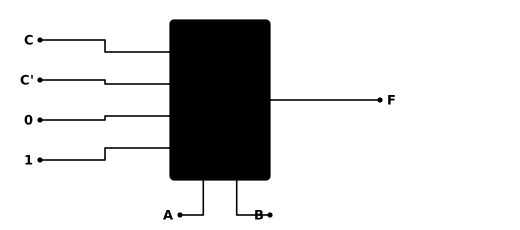
F(A, B, C) = Σm(1, 2, 6, 7) on a 4:1 MUX: A, B select; the data inputs are C, C', 0 and 1.
5 · Worked Examples
Example 1 Easy
A 2:1 MUX has S = A, I₀ = 0, I₁ = B. What function is Y?
Solution
A'·0 + A·B = AB.
Example 2 Medium
How many 2:1 MUXes make a 16:1 MUX?
Solution
2⁴ − 1 = 15.
Example 3 GATE
F(A, B, C) = Σm(1, 2, 6, 7) is built on a 4:1 MUX with B and C as selects (B is S₁). What goes on I₀, I₁, I₂, I₃ (A is the data variable)?
Solution
BC = 00: m₀ = 0, m₄ = 0 → 0; 01: m₁ = 1, m₅ = 0 → A'; 10: m₂ = 1, m₆ = 1 → 1; 11: m₃ = 0, m₇ = 1 → A.
6 · GATE Traps
⚠️
- Select bits are read as a binary number with S₁ as the MSB; the order matters.
- With a 2ⁿ⁻¹:1 MUX each data input is 0, 1, x or x' for the leftover variable x.
- A 2ⁿ:1 MUX tree needs 2ⁿ − 1 two-input MUXes (not 2ⁿ).
- When reading a MUX circuit, include every input's select minterm, even those with 0 (they contribute nothing).
7 · Memory Hook
🧠
"Selects pick the input: Y = Σ mₖ(S)·Iₖ. Spare variable on the data lines: 0, 1, x or x'."
8 · Connect the Dots
A multiplexer chooses one input. The next lesson covers its mirror images: a decoder activates one output for each input code, an encoder does the reverse, and a demultiplexer sends one input to a chosen output.
9 · Self-Test
GATE format. Try every question before opening the vault.
Q1MCQ1 markEquation
A 2:1 MUX with select S and inputs I₀, I₁ has output:
- (A) S(I₀ + I₁)
- (B) S'I₀ + SI₁
- (C) SI₀ + S'I₁
- (D) I₀ ⊕ I₁
Q2MCQ2 marksReading
A 4:1 MUX has selects S₁ = A, S₀ = B and data inputs I₀ = 0, I₁ = 1, I₂ = 1, I₃ = 0. The function is:
- (A) A ⊕ B
- (B) A ⊙ B
- (C) A + B
- (D) AB
Q3NAT1 markTree
How many 2:1 multiplexers are needed to build an 8:1 multiplexer?
Numerical answer: ________
Q4MCQ2 marksImplementation
F(A, B, C) = Σm(1, 2, 6, 7) on a 4:1 MUX with selects A (S₁) and B (S₀). The data inputs I₀, I₁, I₂, I₃ are:
- (A) C, C, 0, 1
- (B) C', C, 1, 0
- (C) C, C', 0, 1
- (D) 0, 1, C, C'
Q5NAT2 marksReading
A 2:1 MUX has S = C, I₀ = A, I₁ = B. How many of the 8 rows of (A, B, C) give output 1?
Numerical answer: ________
10 · Rule Card
- 2ⁿ:1 MUX: n selects; Y = Σ mₖ(S)·Iₖ. 2:1: Y = S'I₀ + SI₁.
- Any n-variable function: 2ⁿ:1 MUX with the truth table on the inputs, or 2ⁿ⁻¹:1 MUX with inputs from {0, 1, x, x'}.
- Reading a MUX: sum of select minterms times the inputs.
- 2ⁿ:1 MUX from 2:1 MUXes: 2ⁿ − 1 of them.
11 · Concept Ledger
Unlocked in this lesson. From here on, these terms may be used.
multiplexerselect linesdata inputsMUX equationfunction implementation with a 2ⁿ:1 MUXimplementation with a 2ⁿ⁻¹:1 MUXreading a MUX circuitMUX treesMUX as a universal element
12 · Answer Vault
Answer Vault
Try the questions first. Open when you are ready to check.
Recall Warm-up
- Pᵢ = Aᵢ ⊕ Bᵢ, Gᵢ = AᵢBᵢ.
- Its minterms (1-rows).
- No.
Self-Test
Q1 Answer: (B)1 mark
S = 0 picks I₀.
- (A) is wrong: No.
- (C) is wrong: Swapped.
- (D) is wrong: No.
Re-read: Lesson 5.2.1 — Multiplexers, and implementing functions with them
Q2 Answer: (A)2 marks
Y = A'B + AB'.
- (B) is wrong: Inverse.
- (C) is wrong: Includes AB.
- (D) is wrong: Only AB.
Re-read: Lesson 5.2.1 — Multiplexers, and implementing functions with them
Q3 Answer: 71 mark
2³ − 1.
Re-read: Lesson 5.2.1 — Multiplexers, and implementing functions with them
Q4 Answer: (C)2 marks
Rows 00: follows C; 01: opposite; 10: 0; 11: 1.
- (A) is wrong: Row 01 is C', not C.
- (B) is wrong: Inverted.
- (D) is wrong: Wrong rows.
Re-read: Lesson 5.2.1 — Multiplexers, and implementing functions with them
Q5 Answer: 42 marks
Y = C'A + CB: rows 4, 6 (C = 0, A = 1) and 3, 7 (C = 1, B = 1).
Re-read: Lesson 5.2.1 — Multiplexers, and implementing functions with them