0 · Recall Warm-up
Answer from memory first. Answers are in the Answer Vault at the bottom.
- Excitation of a T flip-flop for Q → Q⁺? from Lesson 6.1.2
- JK equation? from Lesson 6.1.2
- Delay of a circuit? from Lesson 5.1.1
1 · The Hook
🎣
A lab has only D flip-flops but the design calls for JK. A few gates in front of the D input fix that. And no matter which flip-flop you use, the signal must cross the logic between two flip-flops before the next clock edge: that sets the maximum clock frequency, a standard GATE numerical.
2 · Predict First
🤔
A flip-flop's output appears 4 ns after the clock edge; the logic after it takes 10 ns; the next flip-flop needs its input steady 2 ns before the next edge. What is the shortest safe clock period?
Make a guess in your head. The answer opens Section 3.
3 · Core Concept
💡
Predict First — the answer
4 + 10 + 2 = 16 ns (62.5 MHz).
🗣️
In plain words
To build flip-flop X from flip-flop Y, ask for every (Q, X-inputs) combination what Q⁺ should be, look up which Y-inputs give that transition (Y's excitation table), and simplify. For timing, the clock period must be long enough for the slowest signal to leave one flip-flop, pass through the logic and arrive early enough (setup time) at the next flip-flop.
1. Conversions (method)
- Write X's characteristic table: columns Q, X-inputs, Q⁺.
- For each row, use Y's excitation table to get Y's inputs.
- Minimise Y's inputs as functions of Q and X's inputs.
Standard results:
| Want | Have | Connect |
|---|---|---|
| D | JK | J = D, K = D' |
| T | JK | J = K = T |
| T | D | D = T ⊕ Q |
| JK | D | D = JQ' + K'Q |
| D | T | T = D ⊕ Q |
| JK | T | T = JQ' + KQ |
2. Timing parameters
- Setup time t_su: the input must be stable this long before the clock edge.
- Hold time t_h: the input must stay stable this long after the edge.
- Clock-to-Q (propagation) delay t_pd: time from the edge to the new output.
3. Maximum clock frequency
For a path from one flip-flop through combinational logic to another: T_min = t_pd(FF) + t_comb(max) + t_su (+ clock skew if given), f_max = 1 / T_min. Example: t_pd = 4 ns, t_comb = 10 ns, t_su = 2 ns → 16 ns → 62.5 MHz. Hold check: t_pd(FF) + t_comb(min) ≥ t_h, otherwise the new data overruns the old one too soon.
4 · Visual
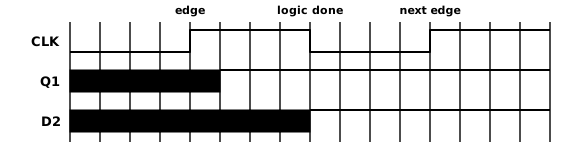
One clock period must cover: Q1 settling after the edge (t_pd), the logic computing D2 (t_comb), and D2 being stable for the setup time before the next edge.
5 · Worked Examples
Example 1 Easy
How do you make a T flip-flop from a JK flip-flop?
Solution
Tie J = K = T.
Example 2 Medium
Make a T flip-flop from a D flip-flop.
Solution
D = T ⊕ Q (T = 0 keeps Q, T = 1 gives Q').
Example 3 GATE
t_pd = 3 ns, worst logic delay 5 ns, setup 2 ns. Maximum clock frequency?
Solution
T = 10 ns → 100 MHz.
6 · GATE Traps
⚠️
- Setup time adds to the period; hold time does not (it constrains the minimum path).
- Use the longest logic path for f_max and the shortest for the hold check.
- D from JK: J = D, K = D' (not K = D).
- 1/(ns) gives GHz; 1000/(period in ns) gives MHz.
7 · Memory Hook
🧠
"Conversion: wanted next state → available excitation → K-map. Period ≥ t_pd + logic + setup."
8 · Connect the Dots
Chapter 6.1 is complete. Chapter 6.2 puts several flip-flops together: registers and shift registers first, then counters and finally general state machines.
9 · Self-Test
GATE format. Try every question before opening the vault.
Q1MCQ1 markConversion
To convert a JK flip-flop into a D flip-flop, connect:
- (A) J = D, K = D
- (B) J = 1, K = D
- (C) J = D', K = D
- (D) J = D, K = D'
Q2MCQ1 markConversion
A D flip-flop behaves as a T flip-flop if D is connected to:
- (A) T + Q
- (B) T
- (C) T ⊕ Q
- (D) TQ
Q3NAT1 markClock period
t_pd = 5 ns, logic delay 12 ns, setup 3 ns. Minimum clock period (ns)?
Numerical answer: ________
Q4NAT2 marksFrequency
t_pd = 2 ns, logic delay 6 ns, setup 1 ns, clock skew 1 ns. Maximum clock frequency in MHz?
Numerical answer: ________
Q5MCQ1 markHold
The hold-time condition compares the hold time with:
- (A) the shortest path delay from one flip-flop to the next
- (B) the clock period
- (C) the longest path delay
- (D) the setup time
10 · Rule Card
- Conversion: X's characteristic table → Y's excitation → minimise. D from JK: J = D, K = D'; T from JK: J = K = T; T from D: D = T ⊕ Q; JK from D: D = JQ' + K'Q.
- Setup before the edge, hold after, t_pd from edge to output.
- T_min = t_pd + t_comb(max) + t_su (+ skew); f_max = 1/T_min. Hold: t_pd + t_comb(min) ≥ t_h.
11 · Concept Ledger
Unlocked in this lesson. From here on, these terms may be used.
flip-flop conversion methodstandard conversionssetup timehold timeclock-to-Q delayminimum clock periodmaximum clock frequencyclock skewhold-time check
12 · Answer Vault
Answer Vault
Try the questions first. Open when you are ready to check.
Recall Warm-up
- T = Q ⊕ Q⁺.
- Q⁺ = JQ' + K'Q.
- The largest path delay (critical path).
Self-Test
Q1 Answer: (D)1 mark
Set when D = 1, reset when D = 0.
- (A) is wrong: D = 1 would toggle.
- (B) is wrong: No.
- (C) is wrong: Inverted.
Re-read: Lesson 6.1.3 — Converting flip-flops; timing and the maximum clock frequency
Q2 Answer: (C)1 mark
Toggle when T = 1.
- (A) is wrong: Can never reset.
- (B) is wrong: That is a D flip-flop.
- (D) is wrong: Can never set from 0.
Re-read: Lesson 6.1.3 — Converting flip-flops; timing and the maximum clock frequency
Q3 Answer: 201 mark
5 + 12 + 3.
Re-read: Lesson 6.1.3 — Converting flip-flops; timing and the maximum clock frequency
Q4 Answer: 1002 marks
Period 10 ns.
Re-read: Lesson 6.1.3 — Converting flip-flops; timing and the maximum clock frequency
Q5 Answer: (A)1 mark
Data must not arrive too early.
- (B) is wrong: No.
- (C) is wrong: That limits the period.
- (D) is wrong: No.
Re-read: Lesson 6.1.3 — Converting flip-flops; timing and the maximum clock frequency