0 · Recall Warm-up
Answer from memory first. Answers are in the Answer Vault at the bottom.
- How many distinct max-heaps can be built from 5 distinct keys? from Lesson 5.4
- After deleting the root of a heap, which element moves to the root first? from Lesson 5.2
- A tree has n nodes. How many edges? from Lesson 4.1
1 · The Hook
🎣
A metro map has stations and the lines between them; a social network has people and friendships; a course catalogue has subjects and “must be taken before” arrows. None of these has a single top or a unique parent, and you can go round in circles. The structure that models all of them is a graph.
2 · Predict First
🤔
Five friends each shake hands with every other friend exactly once. How many handshakes happen? Make a guess in your head. The answer opens Section 3.
3 · Core Concept
💡
Predict First — the answer
Each of 5 people shakes 4 hands: 5 × 4 = 20 hand-uses, but each handshake uses two hands: 10 = 5·4/2.
Graph, vertex, edge
A graph G = (V, E) is a set V of vertices and a set E of edges, each edge joining two vertices. With n = |V| and e = |E|:
- Undirected graph: edge {u, v} has no direction; u and v are adjacent (neighbours). Directed graph: edge (u, v) goes from u to v.
- Weighted graph: each edge carries a number (cost, length).
- Simple graph: no self-loops (edge from a vertex to itself) and no parallel edges. GATE assumes simple graphs unless told otherwise.
Degree and the handshake lemma
The degree of a vertex is the number of edges touching it. Every edge adds 1 to two degrees, so the handshake lemma holds: Σ deg(v) = 2e. Consequence: the number of odd-degree vertices is even. In a directed graph, each vertex has an in-degree and an out-degree, and Σ in-degree = Σ out-degree = e.
Walks, paths, cycles, connectivity
- A walk is a sequence of vertices joined by edges; a path repeats no vertex; a cycle is a closed path (length ≥ 3 in a simple undirected graph).
- An undirected graph is connected if every pair of vertices is joined by a path. The maximal connected pieces are its connected components. (A directed graph is strongly connected if every vertex can reach every other along the arrows.)
- A tree (Lesson 4.1) is a connected graph with no cycle; it has n − 1 edges. A forest is a graph with no cycle: with k trees it has n − k edges.
- A DAG is a directed acyclic graph: arrows but no directed cycle (e.g. prerequisites).
- The complete graph Kₙ has every pair adjacent: n(n − 1)/2 edges. A graph is dense if e is close to n², sparse if e is close to n.
Counting facts
| Question (simple graph, n vertices) | Answer |
|---|---|
| maximum edges, undirected | n(n − 1)/2 |
| maximum edges, directed | n(n − 1) |
| number of undirected graphs on n labelled vertices | 2^(n(n − 1)/2) |
| minimum edges to be connected | n − 1 |
| k components ⇒ edges at least | n − k |
| maximum edges if disconnected | (n − 1)(n − 2)/2 (K₍ₙ₋₁₎ plus an isolated vertex) |
| maximum edges with k components | (n − k)(n − k + 1)/2 |
4 · Visual
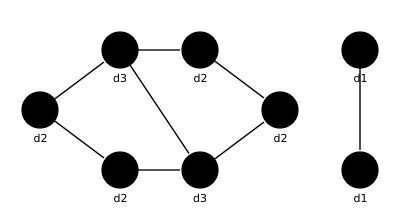
Running example: 8 vertices, 8 edges, two connected components.
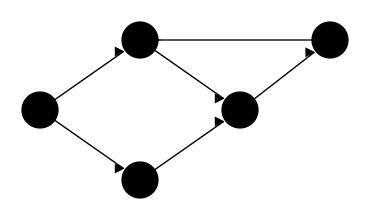
A directed graph: 2 → 4 → 5 → 2 is a directed cycle, so it is not a DAG.
Undirected example (degrees in brackets):

   1(3) ----- 3(2)
   /  \          \
0(2)   \          5(2)        6(1) ----- 7(1)
   \    \        /
   2(2) ----- 4(3)

sum of degrees = 2+3+2+2+3+2+1+1 = 16 = 2 x 8 edges
components: {0,1,2,3,4,5} and {6,7}
cycle: 0-1-4-2-0   path: 0-1-3-5
The handshake lemma checks any degree list: the sum must be twice the edge count.
5 · Worked Examples
Example 1 Easy
In the directed graph above, give the in-degree and out-degree of each vertex and check Σ in = Σ out = e.
Solution
Out: 1:2, 2:1, 3:1, 4:1, 5:1. In: 1:0, 2:2, 3:1, 4:2, 5:1. Both sums are 6 = e.
Example 2 Medium
Can a simple graph on 4 vertices have degrees 3, 3, 3, 1?
Solution
No. The sum is 10 (even, so the handshake lemma alone does not rule it out), but three vertices of degree 3 must each be adjacent to all three others, which forces the fourth vertex to have degree 3, not 1.
Example 3 GATE
What is the maximum number of edges in a simple undirected graph with 10 vertices and 3 connected components?
Solution
Put all edges in one component: one K₈ plus two isolated vertices: 8·7/2 = 28 = (n − k)(n − k + 1)/2 with n = 10, k = 3.
6 · GATE Traps
⚠️
- Handshake: Σ deg = 2e, not e.
- An even degree sum does not guarantee that a simple graph with those degrees exists.
- Directed maximum is n(n − 1); undirected is n(n − 1)/2.
- A connected graph needs at least n − 1 edges, but n − 1 edges do not guarantee connectivity.
- A path repeats no vertex; a walk may.
8 · Memory Hook
🧠
“Every handshake has two hands.” Σ deg = 2e; odd-degree vertices come in pairs.
9 · Connect the Dots
Lesson 6.1 gave the words; a program needs the graph in memory. Next lesson answers: what are the ways to store a graph in C, and which one makes each operation fast?
10 · Self-Test
GATE format. Try every question before opening the vault.
Q1NAT1 markHandshake
A simple undirected graph has 12 vertices, each of degree 4. How many edges?
Numerical answer: ________
Q2NAT1 markMaximum
Maximum edges in a simple undirected graph with 9 vertices?
Numerical answer: ________
Q3MCQ2 marksOdd degrees
A graph has 7 vertices with degrees 1, 2, 2, 3, 3, 3 and x. Which value of x is ruled out by the handshake lemma?
- (A) 2
- (B) 1
- (C) 6
- (D) 4
Q4MSQ1 markFacts
Which are true for every simple undirected graph?
- (A) The number of odd-degree vertices is even.
- (B) A graph with n − 1 edges is connected.
- (C) A forest with n vertices and k trees has n − k edges.
- (D) A connected graph on n vertices has at least n − 1 edges.
Q5NAT2 marksCounting
How many simple undirected graphs are there on 4 labelled vertices?
Numerical answer: ________
11 · Rule Card
- G = (V, E); undirected / directed; weighted; simple = no loops, no parallel edges.
- Σ deg = 2e; odd-degree vertices even in number; directed: Σ in = Σ out = e.
- Max edges: n(n − 1)/2 undirected, n(n − 1) directed; graphs on n labelled vertices: 2^(n(n−1)/2).
- Connected ⇒ e ≥ n − 1; k components ⇒ e ≥ n − k; max with k components (n − k)(n − k + 1)/2.
- Tree: connected, acyclic, n − 1 edges; forest: n − k edges; DAG: no directed cycle.
12 · Concept Ledger
Unlocked in this lesson. From here on, these terms may be used.
graph, vertex, edgedirected / undirected / weighted / simpledegree, in/out-degreehandshake lemmawalk, path, cycleconnected componentcomplete graph, forest, DAG
13 · Answer Vault
Answer Vault
Try the questions first. Open when you are ready to check.
Recall Warm-up
-
- The last element of the array.
- n − 1.
Self-Test
Q1 Answer: 241 mark
12 × 4 / 2 = 24.
Re-read: Lesson 6.1 — Graph vocabulary
Q2 Answer: 361 mark
9 · 8 / 2 = 36.
Re-read: Lesson 6.1 — Graph vocabulary
Q3 Answer: (B)2 marks
The other six degrees sum to 14, so 14 + x must be even: x cannot be odd.
- (A) is wrong: 14 + 2 = 16 is even.
- (C) is wrong: 14 + 6 = 20 is even.
- (D) is wrong: 14 + 4 = 18 is even.
Re-read: Lesson 6.1 — Graph vocabulary
Q4 Answer: (A) (C) (D)1 mark
n − 1 edges can still leave the graph disconnected (a triangle plus an isolated vertex has 3 edges on 4 vertices).
- (B) is wrong: Example: K₃ plus one isolated vertex.
Re-read: Lesson 6.1 — Graph vocabulary
Q5 Answer: 642 marks
2^(4·3/2) = 2⁶ = 64.
Re-read: Lesson 6.1 — Graph vocabulary