0 · Recall Warm-up
Answer from memory first. Answers are in the Answer Vault at the bottom.
- A binary tree has 12 leaves. How many nodes with two children? from Lesson 4.2.2
- How many edges does a tree with n nodes have? from Lesson 4.1
- How is a self-referential structure declared? from Lesson 1.6
1 · The Hook
🎣
A family tree can be kept as cards with arrows to each child, or as a numbered list where the children of person i are always persons 2i and 2i + 1. The first way handles any shape; the second needs no arrows at all, but only works well for trees without holes.
2 · Predict First
🤔
Store a complete binary tree in an array, level by level from index 0. Where are the children of the node at index 4? Its parent? Make a guess in your head. The answer opens Section 3.
3 · Core Concept
💡
Predict First — the answer
Children at 9 and 10 (2i + 1, 2i + 2); parent at 1 (⌊(i − 1)/2⌋).
Linked representation
Each node is a struct with the data and two pointers:
struct tnode {
    int data;
    struct tnode *left, *right;
};

struct tnode *mk(int x, struct tnode *l, struct tnode *r)
{
    struct tnode *t = malloc(sizeof(struct tnode));
    t->data = x;
    t->left = l;
    t->right = r;
    return t;
}
An empty subtree is NULL. The helper mk(x, l, r) builds a node with given subtrees, so a whole tree can be written as one nested expression:
int main(void)
{
    struct tnode *root = mk(1, mk(2, mk(4, NULL, NULL), mk(5, mk(7, NULL, NULL), NULL)), mk(3, NULL, mk(6, NULL, NULL)));
    printf("%d %d %d %d\n", root->data, root->left->right->data,
           root->left->right->left->data, root->right->right->data);
    return 0;
}
Output
1 5 7 6
Space: two pointers per node (n + 1 of them NULL). Works for any shape. Later programs in these notes use these helpers without repeating them.
Array representation, 0-based
Number the positions level by level, left to right, starting at 0. For the node at index i:
| 0-based (root at 0) | 1-based (root at 1) | |
|---|---|---|
| left child | 2i + 1 | 2i |
| right child | 2i + 2 | 2i + 1 |
| parent | ⌊(i − 1)/2⌋ | ⌊i/2⌋ |
| is i a valid node? | i < n (complete tree) | i ≤ n (complete tree) |
No pointers are stored; the formulas replace them.
When the array wastes space
For a complete tree the n nodes fill indices 0 … n − 1 with no holes. Other shapes leave empty slots: a tree of height h may need up to 2^h+1^ − 1 slots. A right-skewed tree of n nodes needs 2^n^ − 1 slots for n values.
The example tree of this phase (1 at the root, 2 and 3 below, …) stored this way, with – for empty slots:
1 2 3 4 5 – 6 – – 7
Which to choose
| Linked | Array | |
|---|---|---|
| any shape | yes | wastes space unless complete |
| memory per node | data + 2 pointers | data only |
| find parent | not stored (add a pointer) | O(1) formula |
| insert anywhere | O(1) once found | may need resizing |
| typical use | search trees (Lesson 4.5) | heaps (Phase 5) |
4 · Visual
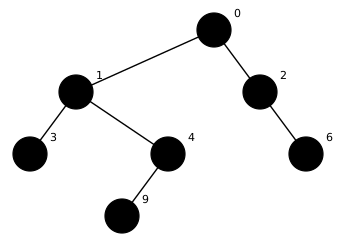
The phase’s example tree with each node’s 0-based array index (small number). Node 7 sits at index 9 even though the tree has only 7 nodes: the array needs 10 slots.

Array form (0-based). Empty slots (–) are wasted space.
1-based indexing of a complete tree with 6 nodes:

            [1]
          /     \
       [2]       [3]
       / \       /
    [4]   [5]  [6]

 children of i: 2i, 2i+1      parent of i: floor(i/2)
 node 3: children 6, 7 (7 > n, so only 6)   parent of 5: 2
1-based indices make the formulas shortest.
5 · Worked Examples
Example 1 Easy
In a 1-based array tree, where are the children and the parent of index 5?
Solution
Children 10 and 11; parent 2.
Example 2 Medium
A complete binary tree with 13 nodes is stored 0-based. Which indices hold leaves?
Solution
A node at i has a left child iff 2i + 1 ≤ 12, i.e. i ≤ 5. So indices 6 … 12 are leaves (7 leaves; check: n₂ = 6, n₁ = 0, n₀ = 7 = n₂ + 1).
Example 3 GATE
A binary tree of height 4 (edges) is stored in an array using 0-based level indexing. How many array slots must be reserved in the worst case? What if it is a complete tree with 20 nodes?
Solution
Worst case: all positions of a perfect tree of height 4: 2⁵ − 1 = 31 slots. A complete tree with 20 nodes uses exactly 20 slots (indices 0–19).
6 · GATE Traps
⚠️
- 0-based: children 2i + 1 and 2i + 2, parent ⌊(i − 1)/2⌋; 1-based: 2i, 2i + 1, parent ⌊i/2⌋. Do not mix them.
- Array storage is compact only for complete trees.
- A skewed tree with n nodes needs up to 2ⁿ − 1 array slots.
- In the linked form, n + 1 child pointers are NULL.
- The linked form has no parent pointer unless you add one.
8 · Memory Hook
🧠
“Double it to go down, halve it to go up.” In 1-based arrays children are 2i and 2i + 1 and the parent is i / 2.
9 · Connect the Dots
With a binary tree stored, the most basic task is visiting every node exactly once. Lists had one natural order; trees have several. Next lesson answers: in which orders can a binary tree be visited recursively, and what does each order produce?
10 · Self-Test
GATE format. Try every question before opening the vault.
Q1MCQ1 markIndexing
In a 0-based array representation, the parent of index 9 is at:
- (A) 5
- (B) 8
- (C) 4
- (D) 3
Q2NAT1 markIndexing
In a 1-based array representation, what is the index of the right child of node 7?
Numerical answer: ________
Q3MCQ2 marksOutput
What does this print?
int main(void)
{
    struct tnode *root = mk(1, mk(2, mk(4, NULL, NULL), mk(5, mk(7, NULL, NULL), NULL)), mk(3, NULL, mk(6, NULL, NULL)));
    printf("%d %d %d %d\n", root->data, root->left->right->data,
           root->left->right->left->data, root->right->right->data);
    return 0;
}
- (A)
1 5 4 3 - (B)
1 4 7 6 - (C)
1 5 7 6 - (D)
1 2 4 6
Q4NAT2 marksSpace
A right-skewed binary tree with 5 nodes is stored with 0-based level indexing. What is the largest index used?
Numerical answer: ________
Q5MSQ1 markRepresentations
Which are true?
- (A) The array form finds a parent in O(1).
- (B) The array form needs pointers to children.
- (C) A complete tree with n nodes fills array indices 0 … n − 1.
- (D) The linked form stores n + 1 NULL pointers.
11 · Rule Card
- Linked: struct tnode { data; *left; *right; }; empty subtree = NULL.
- 0-based: children 2i+1, 2i+2; parent ⌊(i−1)/2⌋.
- 1-based: children 2i, 2i+1; parent ⌊i/2⌋.
- Array form compact only for complete trees; height h may need 2ʰ⁺¹ − 1 slots.
- Heaps use arrays; search trees use links.
12 · Concept Ledger
Unlocked in this lesson. From here on, these terms may be used.
linked representation (struct tnode)array representation0-based child/parent formulas1-based child/parent formulas
13 · Answer Vault
Answer Vault
Try the questions first. Open when you are ready to check.
Recall Warm-up
-
- n − 1.
- A struct containing a pointer to its own type, e.g. struct node { int data; struct node *next; };
Self-Test
Q1 Answer: (C)1 mark
⌊(9 − 1)/2⌋ = 4.
- (A) is wrong: That is ⌊9/2⌋ + 1.
- (B) is wrong: Not the parent formula.
- (D) is wrong: Too small.
Re-read: Lesson 4.2.3 — Representations: linked nodes vs array indexing (both 0-based and 1-based formulas)
Q2 Answer: 151 mark
2 × 7 + 1 = 15.
Re-read: Lesson 4.2.3 — Representations: linked nodes vs array indexing (both 0-based and 1-based formulas)
Q3 Answer: (C)2 marks
root->left->right is 5; its left is 7; root->right->right is 6.
Output
1 5 7 6
- (A) is wrong: Follow left/right exactly.
- (B) is wrong: root->left->right is 5.
- (D) is wrong: root->left->right is 5, not 2.
Re-read: Lesson 4.2.3 — Representations: linked nodes vs array indexing (both 0-based and 1-based formulas)
Q4 Answer: 302 marks
Right children: 0 → 2 → 6 → 14 → 30.
Re-read: Lesson 4.2.3 — Representations: linked nodes vs array indexing (both 0-based and 1-based formulas)
Q5 Answer: (A) (C) (D)1 mark
Formulas replace pointers.
- (B) is wrong: Children are found by formula.
Re-read: Lesson 4.2.3 — Representations: linked nodes vs array indexing (both 0-based and 1-based formulas)