0 · Recall Warm-up
Answer from memory first. Answers are in the Answer Vault at the bottom.
- Why does a linear array queue waste space? from Lesson 3.3.1
- Evaluate the postfix
5 3 4 * + 2 -. from Lesson 3.2.2 - What is
-7 % 5in C, and what is(−7 + 5) % 5? from Lesson 1.1.2
1 · The Hook
🎣
A round table at a wedding seats guests in order; when the last chair is reached, seating continues at chair 0 if it has been freed. Bending the array into a ring lets a queue reuse every slot. The only puzzle left: when front and rear meet, is the ring full or empty?
2 · Predict First
🤔
A circular queue in an array of 5 slots uses the rule “full when (rear + 1) % 5 == front”. How many items can it hold? Make a guess in your head. The answer opens Section 3.
3 · Core Concept
💡
Predict First — the answer
4. One slot is always left empty so that “full” and “empty” look different.
Output
stored 4; 10 20 ; front=2 rear=1; enqueue(80) -> 0
Wrapping indices with %
Move an index forward with i = (i + 1) % N: after N − 1 comes 0. The array is now a ring.
The standard convention (one slot left empty)
front and rear start at 0. rear is the index of the last item; front is the slot just before the first item.
| Operation / test | Code |
|---|---|
| enqueue x | rear = (rear + 1) % N; q[rear] = x; |
| dequeue | front = (front + 1) % N; x = q[front]; |
| empty | front == rear |
| full | (rear + 1) % N == front |
| number of items | (rear - front + N) % N |
Capacity is N − 1: if the last slot were filled too, front == rear would hold for both full and empty.
#define N 5
int q[N];
int front = 0, rear = 0;   /* front: one slot BEFORE the first item; rear: last item */

int enqueue(int x)
{
    if ((rear + 1) % N == front) return 0;   /* full: N - 1 items */
    rear = (rear + 1) % N;
    q[rear] = x;
    return 1;
}

int dequeue(int *x)
{
    if (front == rear) return 0;             /* empty */
    front = (front + 1) % N;
    *x = q[front];
    return 1;
}

int main(void)
{
    int i, x, ok = 0;
    for (i = 1; i <= 5; i++) ok += enqueue(i * 10);
    printf("stored %d; ", ok);
    dequeue(&x); printf("%d ", x);
    dequeue(&x); printf("%d ", x);
    enqueue(60);
    enqueue(70);
    ok = enqueue(80);
    printf("; front=%d rear=%d; enqueue(80) -> %d\n", front, rear, ok);
    return 0;
}
The counter convention
Another common version keeps front = index of the first item and a separate count. Then full is count == N (all N slots usable), empty is count == 0, and rear = (front + count − 1) % N. Questions state which convention they use; check carefully.
Tracing
Keep a row per operation with front, rear and the ring’s contents. Watch the wrap: with N = 6, rear goes 4 → 5 → 0 → 1.
4 · Visual
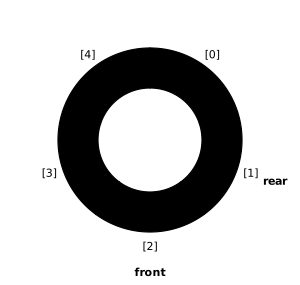
N = 5 after: enqueue 10, 20, 30, 40 (the 5th enqueue failed), dequeue 10, 20, enqueue 60, 70. front = 2 (the empty slot before 30), rear = 1. Now (1 + 1) % 5 == 2 == front: full with 4 items.
N = 6, front = rear = 0. Operations: enqueue 1 2 3 4, dequeue, dequeue, enqueue 5 6 7, dequeue

op        front rear   ring [0..5]            note
start       0    0     _ _ _ _ _ _            empty: front == rear
enq 1..4    0    4     _ 1 2 3 4 _
deq, deq    2    4     _ _ _ 3 4 _            removed 1, 2
enq 5       2    5     _ _ _ 3 4 5
enq 6       2    0     6 _ _ 3 4 5            rear wraps 5 -> 0
enq 7       2    1     6 7 _ 3 4 5            now (1+1)%6 == 2 == front: full
deq         3    1     6 7 _ _ 4 5            removed 3; items = (1-3+6)%6 = 4
One row per operation; rear and front wrap with % N.
5 · Worked Examples
Example 1 Easy
N = 8, front = 5, rear = 2 (standard convention). How many items are in the queue? Is it full?
Solution
(2 − 5 + 8) % 8 = 5 items. Full would need (2 + 1) % 8 == 5: no.
Example 2 Medium
Trace the table in the Visual section: N = 6, enqueue 1 2 3 4, dequeue ×2, enqueue 5 6 7, dequeue. Final front and rear?
Solution
front = 3, rear = 1, with 4 items (4, 5, 6, 7).
Example 3 GATE
What does this print?
#define N 5
int q[N];
int front = 0, rear = 0;   /* front: one slot BEFORE the first item; rear: last item */

int enqueue(int x)
{
    if ((rear + 1) % N == front) return 0;   /* full: N - 1 items */
    rear = (rear + 1) % N;
    q[rear] = x;
    return 1;
}

int dequeue(int *x)
{
    if (front == rear) return 0;             /* empty */
    front = (front + 1) % N;
    *x = q[front];
    return 1;
}

int main(void)
{
    int i, x, ok = 0;
    for (i = 1; i <= 5; i++) ok += enqueue(i * 10);
    printf("stored %d; ", ok);
    dequeue(&x); printf("%d ", x);
    dequeue(&x); printf("%d ", x);
    enqueue(60);
    enqueue(70);
    ok = enqueue(80);
    printf("; front=%d rear=%d; enqueue(80) -> %d\n", front, rear, ok);
    return 0;
}
Solution
The 5th enqueue fails (capacity 4). Dequeues give 10 and 20 (front = 2). 60 goes to index 0 and 70 to index 1 (rear wraps). Now (1 + 1) % 5 == 2 == front, so enqueue(80) returns 0.
Output
stored 4; 10 20 ; front=2 rear=1; enqueue(80) -> 0
6 · GATE Traps
⚠️
- With the one-empty-slot convention, capacity is N − 1, not N.
- Empty: front == rear; full: (rear + 1) % N == front — not rear == N − 1.
- Item count: (rear − front + N) % N; add N before % to avoid a negative result in C.
- In this convention front points to the slot before the first item; in others it points to the first item. Read the question.
- Increment with % N on both front and rear.
8 · Memory Hook
🧠
“Leave one chair empty at the round table.” Then the host can tell a full table (rear right behind front) from an empty one (rear standing on front).
9 · Connect the Dots
Lessons 3.3.1–3.3.2 built FIFO queues on arrays. Variations on the theme are common: adding and removing at both ends, serving by priority instead of arrival, and building one structure from another. Next lesson answers: what are deques and priority queues, and how can two stacks behave like a queue?
10 · Self-Test
GATE format. Try every question before opening the vault.
Q1MCQ1 markFull
In a circular queue of size N (front before first item, rear at last item), the full condition is:
- (A) rear == N − 1
- (B) front == rear
- (C) (front + 1) % N == rear
- (D) (rear + 1) % N == front
Q2NAT1 markCount
N = 10, front = 7, rear = 3 (standard convention). How many items?
Numerical answer: ________
Q3NAT1 markCapacity
An array of 12 slots implements a circular queue with the one-empty-slot rule. How many items can it hold?
Numerical answer: ________
Q4MCQ2 marksTrace
N = 5, front = rear = 0. Enqueue 1..5, dequeue twice, enqueue 6 and 7. What front and rear does the program of Example 3 print?
- (A) front 0, rear 2
- (B) front 2, rear 1
- (C) front 3, rear 1
- (D) front 2, rear 0
Q5MSQ2 marksConventions
Which are true?
- (A) With the one-empty-slot rule, front == rear means empty.
- (B) Indices advance with (i + 1) % N.
- (C) With a separate count, all N slots can be used.
- (D) (rear − front) % N always gives the item count in C.
11 · Rule Card
- Advance: i = (i + 1) % N.
- Standard: front = rear = 0 start; enqueue rear = (rear+1)%N; dequeue front = (front+1)%N.
- Empty: front == rear; full: (rear + 1) % N == front; capacity N − 1.
- Items: (rear − front + N) % N.
- Counter variant: full count == N, empty count == 0.
12 · Concept Ledger
Unlocked in this lesson. From here on, these terms may be used.
circular queuewrap-around index (% N)one-empty-slot conventionfull / empty conditionsitem count formula
13 · Answer Vault
Answer Vault
Try the questions first. Open when you are ready to check.
Recall Warm-up
- front and rear only move forward, so freed slots before front are never reused.
-
- −2, and −2 % 5 = −2 (so add n before taking % to stay non-negative).
Self-Test
Q1 Answer: (D)1 mark
One slot is kept empty.
- (A) is wrong: That is the linear queue.
- (B) is wrong: That means empty.
- (C) is wrong: Not the full test.
Re-read: Lesson 3.3.2 — Circular queue: full/empty conditions and index arithmetic
Q2 Answer: 61 mark
(3 − 7 + 10) % 10 = 6.
Re-read: Lesson 3.3.2 — Circular queue: full/empty conditions and index arithmetic
Q3 Answer: 111 mark
N − 1 = 11.
Re-read: Lesson 3.3.2 — Circular queue: full/empty conditions and index arithmetic
Q4 Answer: (B)2 marks
Same as the program in Example 3.
Output
stored 4; 10 20 ; front=2 rear=1; enqueue(80) -> 0
- (A) is wrong: front advances on dequeue.
- (C) is wrong: Only two dequeues: front = 2.
- (D) is wrong: Two enqueues move rear 4 → 0 → 1.
Re-read: Lesson 3.3.2 — Circular queue: full/empty conditions and index arithmetic
Q5 Answer: (A) (B) (C)2 marks
In C, (rear − front) % N can be negative; add N first.
- (D) is wrong: Use (rear − front + N) % N.
Re-read: Lesson 3.3.2 — Circular queue: full/empty conditions and index arithmetic