0 · Recall Warm-up
Answer from memory first. Answers are in the Answer Vault at the bottom.
- In a 1-based array tree, where are the children of node i? from Lesson 4.2.3
- Define a strict binary tree. from Lesson 4.2.1
- In recursion, when does code written after the recursive call run? from Lesson 2.1.2
1 · The Hook
🎣
A school inspector must visit every classroom in a building whose wings branch into sub-wings. She can note a wing’s name when she first enters it, after finishing its left part, or after finishing the whole wing. Each choice produces a different list, and each list is useful for something different.
2 · Predict First
🤔
For the example tree (1 at the root; 2 and 3 its children; 4, 5 under 2; 7 under 5 on the left; 6 under 3 on the right), what does printing “node, then left subtree, then right subtree” give? Make a guess in your head. The answer opens Section 3.
3 · Core Concept
💡
Predict First — the answer
1 2 4 5 7 3 6 (preorder). The root comes first, then the whole left side, then the whole right side.
Three recursive orders
Each visits the root and recursively both subtrees; they differ only in when the root is printed:
| Order | Rule | Example tree |
|---|---|---|
| preorder | root, left, right | 1 2 4 5 7 3 6 |
| inorder | left, root, right | 4 2 7 5 1 3 6 |
| postorder | left, right, root | 4 7 5 2 6 3 1 |
void pre(struct tnode *t)  { if (t == NULL) return; printf("%d ", t->data); pre(t->left); pre(t->right); }
void in(struct tnode *t)   { if (t == NULL) return; in(t->left); printf("%d ", t->data); in(t->right); }
void post(struct tnode *t) { if (t == NULL) return; post(t->left); post(t->right); printf("%d ", t->data); }

int main(void)
{
    struct tnode *root = mk(1, mk(2, mk(4, NULL, NULL), mk(5, mk(7, NULL, NULL), NULL)), mk(3, NULL, mk(6, NULL, NULL)));
    pre(root);  printf("\n");
    in(root);   printf("\n");
    post(root); printf("\n");
    return 0;
}
Output
1 2 4 5 7 3 6
4 2 7 5 1 3 6
4 7 5 2 6 3 1
Hand tracing trick
Walk around the tree outline counter-clockwise starting left of the root, touching every node three times: from the left side, from below, from the right side. Writing a node on its first touch gives preorder, on its second (from below) inorder, on its third postorder.
Facts worth remembering
- Preorder starts with the root; postorder ends with it.
- Inorder places the root between its left and right subtrees.
- Each traversal is O(n) time; the recursion depth is the height + 1 (O(n) for a skewed tree).
- The first node in inorder is the leftmost node; the last in preorder is the last leaf reached going right where possible.
Mixed traversals in code
GATE often mixes the orders inside one function. Treat each printf as before/between/after the calls, as in Lesson 2.1.2:
void f(struct tnode *t)
{
    if (t == NULL) return;
    printf("%d ", t->data);
    f(t->right);
    printf("%d ", t->data);
    f(t->left);
}

int main(void)
{
    struct tnode *root = mk(1, mk(2, NULL, NULL), mk(3, mk(4, NULL, NULL), NULL));
    f(root);
    printf("\n");
    return 0;
}
Output
1 3 3 4 4 1 2 2
4 · Visual
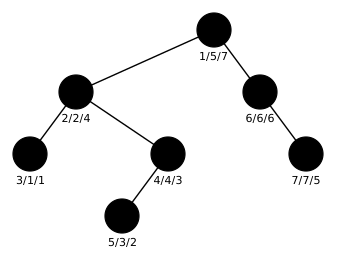
Under each node: its position in preorder / inorder / postorder.
Euler walk around the outline (touch each node 3 times):

             1
           /   \
          2     3
         / \     \
        4   5     6
           /
          7

 touches: 1 2 4 4 4 2 5 7 7 7 5 5 2 1 3 3 6 6 6 3 1
 first touch  (pre):  1 2 4 5 7 3 6
 second touch (in):   4 2 7 5 1 3 6
 third touch  (post): 4 7 5 2 6 3 1
One walk, three orders.
5 · Worked Examples
Example 1 Easy
Give the preorder, inorder and postorder of the tree below.
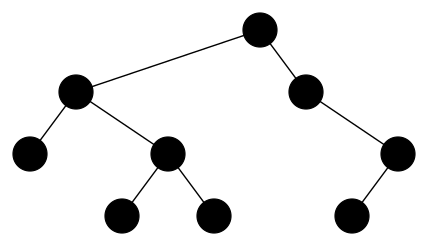
Tree for Example 1.
Solution
Pre: A B D E G H C F I. In: D B G E H A C I F. Post: D G H E B I F C A.
Example 2 Medium
In any binary tree, which node comes first in inorder, and which node comes last in preorder?
Solution
Inorder starts at the leftmost node: keep going left from the root until there is no left child. Preorder ends at the last node reached by preferring right children: from the root keep going right if possible, otherwise left, until a leaf. In the example tree: first in inorder 4, last in preorder 6.
Example 3 GATE
What does this print?
void f(struct tnode *t)
{
    if (t == NULL) return;
    printf("%d ", t->data);
    f(t->right);
    printf("%d ", t->data);
    f(t->left);
}

int main(void)
{
    struct tnode *root = mk(1, mk(2, NULL, NULL), mk(3, mk(4, NULL, NULL), NULL));
    f(root);
    printf("\n");
    return 0;
}
Solution
f(1): print 1, f(3): [print 3, f(NULL), print 3, f(4): [print 4, print 4]], print 1, f(2): [print 2, print 2]. Careful: f prints, goes right first, prints again, then goes left.
Output
1 3 3 4 4 1 2 2
6 · GATE Traps
⚠️
- Preorder = root first; postorder = root last; inorder = root in the middle.
- A modified traversal may visit right before left; read the code.
- When a printf appears twice, each node is printed twice.
- Traversals visit each node once: O(n); recursion depth = height + 1.
- The inorder sequence alone does not determine the tree.
8 · Memory Hook
🧠
“PRE: I speak first. IN: I speak between my children. POST: I speak last.”
9 · Connect the Dots
Lesson 4.3.1 visited trees branch by branch, using the call stack. Sometimes we need all nodes of level 0, then level 1, and so on — the order in which a building is evacuated floor by floor. Next lesson answers: which data structure from Phase 3 produces that floor-by-floor order?
10 · Self-Test
GATE format. Try every question before opening the vault.
Q1MCQ1 markPreorder
Preorder of the tree in Example 1 is:
- (A)
D G H E B I F C A - (B)
D B G E H A C I F - (C)
A B C D E F G H I - (D)
A B D E G H C F I
Q2MCQ2 marksOutput
What does this print? (the example tree, as in the lesson)
void pre(struct tnode *t)  { if (t == NULL) return; printf("%d ", t->data); pre(t->left); pre(t->right); }
void in(struct tnode *t)   { if (t == NULL) return; in(t->left); printf("%d ", t->data); in(t->right); }
void post(struct tnode *t) { if (t == NULL) return; post(t->left); post(t->right); printf("%d ", t->data); }

int main(void)
{
    struct tnode *root = mk(1, mk(2, mk(4, NULL, NULL), mk(5, mk(7, NULL, NULL), NULL)), mk(3, NULL, mk(6, NULL, NULL)));
    pre(root);  printf("\n");
    in(root);   printf("\n");
    post(root); printf("\n");
    return 0;
}
- (A) three lines: pre, in, post as in the table
- (B) in, pre, post
- (C) three identical lines
- (D) pre, post, in
Q3MCQ1 markRoot position
In which traversal is the root always the last node listed?
- (A) inorder
- (B) postorder
- (C) preorder
- (D) none
Q4NAT2 marksOutput
How many numbers does this print?
void f(struct tnode *t)
{
    if (t == NULL) return;
    printf("%d ", t->data);
    f(t->right);
    printf("%d ", t->data);
    f(t->left);
}

int main(void)
{
    struct tnode *root = mk(1, mk(2, NULL, NULL), mk(3, mk(4, NULL, NULL), NULL));
    f(root);
    printf("\n");
    return 0;
}
Numerical answer: ________
Q5MSQ1 markFacts
Which are true?
- (A) Inorder of any binary tree is sorted.
- (B) Preorder lists a node before all its descendants.
- (C) The recursion depth is at most height + 1.
- (D) Each traversal visits every node once.
11 · Rule Card
- Preorder: root, L, R. Inorder: L, root, R. Postorder: L, R, root.
- Euler walk: 1st touch pre, 2nd in, 3rd post.
- O(n) time; depth = height + 1.
- Read mixed traversals statement by statement (before/between/after calls).
12 · Concept Ledger
Unlocked in this lesson. From here on, these terms may be used.
tree traversalpreorderinorderpostorderEuler walk trickrecursive (branch-first) order
13 · Answer Vault
Answer Vault
Try the questions first. Open when you are ready to check.
Recall Warm-up
- 2i and 2i + 1.
- Every node has 0 or 2 children.
- On the way back up, in reverse order of the calls.
Self-Test
Q1 Answer: (D)1 mark
Root, left, right.
- (A) is wrong: That is postorder.
- (B) is wrong: That is inorder.
- (C) is wrong: That lists the nodes row by row.
Re-read: Lesson 4.3.1 — Preorder, inorder, postorder (recursive code and hand tracing)
Q2 Answer: (A)2 marks
Output
1 2 4 5 7 3 6
4 2 7 5 1 3 6
4 7 5 2 6 3 1
- (B) is wrong: pre is called first.
- (C) is wrong: The orders differ.
- (D) is wrong: in is called second.
Re-read: Lesson 4.3.1 — Preorder, inorder, postorder (recursive code and hand tracing)
Q3 Answer: (B)1 mark
Left, right, root.
- (A) is wrong: Root in the middle.
- (C) is wrong: Root first.
- (D) is wrong: Postorder always ends with the root.
Re-read: Lesson 4.3.1 — Preorder, inorder, postorder (recursive code and hand tracing)
Q4 Answer: 82 marks
Every node is printed twice: 4 nodes × 2 = 8.
Re-read: Lesson 4.3.1 — Preorder, inorder, postorder (recursive code and hand tracing)
Q5 Answer: (B) (C) (D)1 mark
Sorted inorder needs a special ordering of keys (Lesson 4.5).
- (A) is wrong: Only for specially ordered trees (Lesson 4.5).
Re-read: Lesson 4.3.1 — Preorder, inorder, postorder (recursive code and hand tracing)