0 · Recall Warm-up
Answer from memory first. Answers are in the Answer Vault at the bottom.
- What does an abstract data type describe? from Lesson 3.1
- With a static variable inside a recursive function, how must you trace it? from Lesson 2.1.4
- In what order do function calls return? from Lesson 1.3.3
1 · The Hook
🎣
In a canteen, clean plates are stacked: a new plate goes on top, and you always take the top plate. Your browser’s Back button, the Undo command of a text editor, and the call stack from Lesson 1.3.3 all work the same way. That behaviour is important enough to get its own data type.
2 · Predict First
🤔
Starting empty: push A, push B, pop, push C, push D, pop, pop, push E, pop, pop. In what order do the items come out? Make a guess in your head. The answer opens Section 3.
3 · Core Concept
💡
Predict First — the answer
B D C E A. Each pop takes whatever is on top at that moment.
The stack ADT
A stack is a collection where items are added and removed at one end only, the top: LIFO, last in first out.
| Operation | Meaning |
|---|---|
push(x) | put x on top |
pop() | remove and return the top item |
peek() / top() | return the top item without removing it |
isEmpty() | are there no items? |
isFull() | is there no room (array version)? |
Every operation is O(1).
Array implementation
Keep the items in an array and an index top of the current top item. Empty: top == −1. Push: st[++top] = x. Pop: return st[top--]. Full: top == MAX − 1.
#define MAX 4
int st[MAX];
int top = -1;

int push(int x)
{
    if (top == MAX - 1) { printf("overflow "); return 0; }
    st[++top] = x;
    return 1;
}

int pop(void)
{
    if (top == -1) { printf("underflow "); return -1; }
    return st[top--];
}

int main(void)
{
    push(10); push(20); push(30);
    printf("%d ", pop());
    push(40); push(50); push(60);
    printf("%d ", pop());
    printf("%d ", pop());
    printf("%d ", pop());
    printf("%d ", pop());
    pop();
    printf("\n");
    return 0;
}
Output
30 overflow 50 40 20 10 underflow
Overflow and underflow
Overflow: pushing onto a full stack (no room in the array). Underflow: popping (or peeking) an empty stack. A correct implementation checks both and reports them instead of writing outside the array.
Why stacks matter
Whenever work must be undone or finished in reverse order of starting, a stack fits: function calls (the call stack), matching brackets, evaluating expressions (next lesson), backtracking and undo.
4 · Visual
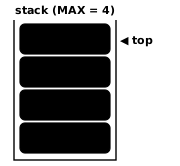
After push 10, 20, 30, pop (30), push 40, 50: top is 50. The next push (60) overflows a stack of size 4.
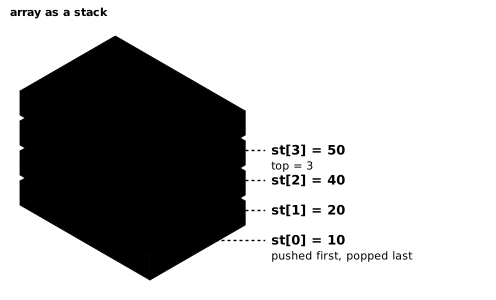
The same stack in 3D: the array grows upward and top marks the highest filled slot.
operation   stack (bottom -> top)   top   output
push 10     10                       0
push 20     10 20                    1
push 30     10 20 30                 2
pop         10 20                    1     30
push 40     10 20 40                 2
push 50     10 20 40 50              3
push 60     (full)                   3     overflow
pop x4      ...                     -1     50 40 20 10
pop         (empty)                 -1     underflow
Trace of the program above.
5 · Worked Examples
Example 1 Easy
Starting with an empty stack: push 1, push 2, push 3, pop, push 4, pop, pop. What is popped, in order, and what is left?
Solution
Popped: 3, 4, 2. Left: 1.
Example 2 Medium
What does this print?
#define MAX 4
int st[MAX];
int top = -1;

int push(int x)
{
    if (top == MAX - 1) { printf("overflow "); return 0; }
    st[++top] = x;
    return 1;
}

int pop(void)
{
    if (top == -1) { printf("underflow "); return -1; }
    return st[top--];
}

int main(void)
{
    push(10); push(20); push(30);
    printf("%d ", pop());
    push(40); push(50); push(60);
    printf("%d ", pop());
    printf("%d ", pop());
    printf("%d ", pop());
    printf("%d ", pop());
    pop();
    printf("\n");
    return 0;
}
Solution
See the trace table: 30 is popped, then the push of 60 overflows, then 50 40 20 10 are popped and the last pop underflows.
Output
30 overflow 50 40 20 10 underflow
Example 3 GATE
A stack of capacity 5 starts empty. The sequence is push ×4, pop ×2, push ×4, pop ×1. Does an overflow occur, and how many items remain?
Solution
After push×4 and pop×2: 2 items. Push ×4 → 3, 4, 5, then the fourth push finds the stack full: overflow (that item is rejected). Then pop ×1: 4 items remain.
6 · GATE Traps
⚠️
- top == −1 means empty in the usual array version; top == MAX − 1 means full.
- pop on an empty stack is underflow, push on a full stack is overflow.
- peek does not remove the item.
- Do not put two pops in one printf call: the order of evaluating the arguments is unspecified.
- All stack operations are O(1); searching inside a stack is not a stack operation.
8 · Memory Hook
🧠
“Plates in a canteen.” On top, off the top. Nobody pulls a plate from the middle.
9 · Connect the Dots
Lesson 1.3.3 used a stack for function calls; now it is a general data type with an array behind it. Stacks shine when things must be matched or undone in reverse order. Next lesson answers: how does a stack check brackets, and how does it let a computer evaluate an expression like a + b * c without worrying about precedence?
10 · Self-Test
GATE format. Try every question before opening the vault.
Q1MCQ1 markOrder
Push P, Q, R; pop; push S; pop; pop. What is popped, in order?
- (A) R Q S
- (B) S R Q
- (C) R S Q
- (D) P Q R
Q2MCQ2 marksOutput
What does this print?
#define MAX 4
int st[MAX];
int top = -1;

int push(int x)
{
    if (top == MAX - 1) { printf("overflow "); return 0; }
    st[++top] = x;
    return 1;
}

int pop(void)
{
    if (top == -1) { printf("underflow "); return -1; }
    return st[top--];
}

int main(void)
{
    push(10); push(20); push(30);
    printf("%d ", pop());
    push(40); push(50); push(60);
    printf("%d ", pop());
    printf("%d ", pop());
    printf("%d ", pop());
    printf("%d ", pop());
    pop();
    printf("\n");
    return 0;
}
- (A)
30 60 50 40 20 - (B)
30 overflow 60 50 40 20 - (C)
30 overflow 50 40 20 10 underflow - (D)
30 50 40 20 10
Q3NAT1 markIndex
In an array stack with top starting at −1, after 7 pushes and 3 pops, what is top?
Numerical answer: ________
Q4MSQ1 markStack facts
Which are true for a stack?
- (A) popping an empty stack is underflow
- (B) peek returns the top without removing it
- (C) the first item pushed is the first popped
- (D) push and pop take O(1)
Q5NAT2 marksCapacity
A stack of capacity 6 starts empty. Operations: push ×5, pop ×3, push ×5. How many pushes fail with overflow?
Numerical answer: ________
11 · Rule Card
- Stack = LIFO: push, pop, peek, isEmpty, isFull — all O(1).
- Array version: top = −1 empty; st[++top] = x; return st[top--]; full when top == MAX − 1.
- Overflow: push when full; underflow: pop/peek when empty.
- Uses: call stack, undo, bracket matching, expression evaluation, backtracking.
12 · Concept Ledger
Unlocked in this lesson. From here on, these terms may be used.
stack ADTLIFOtoppeekisEmpty / isFullstack overflow (full)underflow
13 · Answer Vault
Answer Vault
Try the questions first. Open when you are ready to check.
Recall Warm-up
- Operations and their behaviour, not the memory layout.
- Call by call in execution order, because all calls share it.
- Last called, first to return (last in, first out).
Self-Test
Q1 Answer: (C)1 mark
R comes off first, then S (pushed after), then Q.
- (A) is wrong: S is pushed before the second pop.
- (B) is wrong: R is popped before S is pushed.
- (D) is wrong: That is first-in, first-out order.
Re-read: Lesson 3.2.1 — Stack ADT; push/pop/peek; array implementation; overflow and underflow
Q2 Answer: (C)2 marks
After popping 30 the stack holds 10 20; pushing 40, 50 fills it, so pushing 60 overflows.
Output
30 overflow 50 40 20 10 underflow
- (A) is wrong: 60 was never stored.
- (B) is wrong: 60 was rejected.
- (D) is wrong: Both messages are printed.
Re-read: Lesson 3.2.1 — Stack ADT; push/pop/peek; array implementation; overflow and underflow
Q3 Answer: 31 mark
7 − 3 = 4 items: indices 0..3, top = 3.
Re-read: Lesson 3.2.1 — Stack ADT; push/pop/peek; array implementation; overflow and underflow
Q4 Answer: (A) (B) (D)1 mark
Stacks are LIFO.
- (C) is wrong: That describes first-in, first-out.
Re-read: Lesson 3.2.1 — Stack ADT; push/pop/peek; array implementation; overflow and underflow
Q5 Answer: 12 marks
5 − 3 = 2 items; room for 4 more; the fifth push fails: 1.
Re-read: Lesson 3.2.1 — Stack ADT; push/pop/peek; array implementation; overflow and underflow