0 · Recall Warm-up
Answer from memory first. Answers are in the Answer Vault at the bottom.
- Why is 3 1 2 impossible as a stack permutation of 1 2 3? from Lesson 3.2.3
- In an array stack, what are the empty and full conditions? from Lesson 3.2.1
- Why can a function change the elements of an array argument? from Lesson 1.5.1
1 · The Hook
🎣
At a railway ticket counter, people join at the back and are served at the front. Nobody who arrived later is served earlier. Printers, call centres and network routers all serve their work this way: first come, first served.
2 · Predict First
🤔
A linear array queue of size 5 is filled with 5 items, then 2 are served. Can a new item be added? Make a guess in your head. The answer opens Section 3.
3 · Core Concept
💡
Predict First — the answer
With the naive version, no: rear has reached the last index, so the queue reports “full” even though 2 slots at the front are now empty.
Output
10 20 full | front=2 rear=4
The queue ADT
A queue adds at one end (the rear) and removes at the other (the front): FIFO, first in first out.
| Operation | Meaning |
|---|---|
enqueue(x) | add x at the rear |
dequeue() | remove and return the front item |
front()/peek | look at the front item |
isEmpty / isFull | test for no items / no room |
All operations are O(1) in a good implementation.
Linear array implementation
Keep two indices: front (first item) and rear (last item). Start with front = 0, rear = −1. Enqueue: q[++rear] = x. Dequeue: return q[front++]. Empty when front > rear; full when rear == MAX − 1.
#define MAX 5
int q[MAX];
int front = 0, rear = -1;          /* front: first item, rear: last item */

int enqueue(int x)
{
    if (rear == MAX - 1) { printf("full "); return 0; }
    q[++rear] = x;
    return 1;
}

int dequeue(void)
{
    if (front > rear) { printf("empty "); return -1; }
    return q[front++];
}

int main(void)
{
    int i;
    for (i = 1; i <= 5; i++) enqueue(i * 10);
    printf("%d ", dequeue());
    printf("%d ", dequeue());
    enqueue(60);                   /* two slots are free, yet ... */
    printf("| front=%d rear=%d\n", front, rear);
    return 0;
}
The wasted-space problem
Both indices only move forward. After some dequeues, the slots before front are empty but can never be used again: rear hits the end and the queue reports full while it has free room. Shifting all items back to the start on every dequeue fixes it but makes dequeue O(n). The real fix is to let the indices wrap around — the next lesson.
4 · Visual
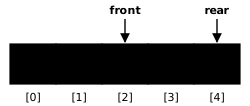
After enqueue 10…50 and two dequeues: slots 0 and 1 are free, yet rear = 4 = MAX − 1, so the linear queue says “full”.
Ticket counter (FIFO):

   served <- [ 10 | 20 | 30 | 40 | 50 ] <- join
             front                rear

operation      array               front  rear
start          _  _  _  _  _          0    -1
enqueue x5     10 20 30 40 50         0     4
dequeue        __ 20 30 40 50         1     4   -> 10
dequeue        __ __ 30 40 50         2     4   -> 20
enqueue 60     rear == MAX-1  -> "full", although two slots are free
Indices that only move forward waste the slots behind front.
5 · Worked Examples
Example 1 Easy
Starting empty: enqueue A, B, C; dequeue; enqueue D; dequeue. What has been dequeued, and what is at the front?
Solution
Dequeued A then B. Front is C (queue: C, D).
Example 2 Medium
What does this print?
#define MAX 5
int q[MAX];
int front = 0, rear = -1;          /* front: first item, rear: last item */

int enqueue(int x)
{
    if (rear == MAX - 1) { printf("full "); return 0; }
    q[++rear] = x;
    return 1;
}

int dequeue(void)
{
    if (front > rear) { printf("empty "); return -1; }
    return q[front++];
}

int main(void)
{
    int i;
    for (i = 1; i <= 5; i++) enqueue(i * 10);
    printf("%d ", dequeue());
    printf("%d ", dequeue());
    enqueue(60);                   /* two slots are free, yet ... */
    printf("| front=%d rear=%d\n", front, rear);
    return 0;
}
Solution
Five enqueues fill indices 0–4. Two dequeues return 10 and 20 (front = 2). The next enqueue sees rear == 4 and reports full.
Output
10 20 full | front=2 rear=4
Example 3 GATE
A linear array queue of size 8 (front = 0, rear = −1 at start) performs: enqueue ×6, dequeue ×4, enqueue ×3. How many of the last three enqueues succeed, and how many items are in the queue?
Solution
After 6 enqueues rear = 5; after 4 dequeues front = 4 (2 items). Enqueues can use indices 6 and 7 only: 2 succeed, the third fails although 4 slots are free. Items: 4.
6 · GATE Traps
⚠️
- FIFO: the oldest item leaves first (unlike a stack).
- In the linear version a “full” queue may have free slots before front.
- Empty condition for front = 0, rear = −1 start: front > rear.
- Number of items = rear − front + 1 in the linear version.
- Different books start front/rear differently; read the question’s convention.
8 · Memory Hook
🧠
“Ticket counter: join at the back, leave from the front.” In a straight corridor the queue slowly walks towards the wall and gets stuck, even with the corridor behind it empty.
9 · Connect the Dots
Lesson 3.2.1 built a stack with one index; a queue needs two, and in a plain array they waste space. Next lesson answers: how can the array be treated as a ring so that freed slots at the front are reused, and how do we tell a full ring from an empty one?
10 · Self-Test
GATE format. Try every question before opening the vault.
Q1MCQ1 markFIFO
Enqueue 5, 7, 9; dequeue; enqueue 11; dequeue. Which value is dequeued second?
- (A) 7
- (B) 5
- (C) 11
- (D) 9
Q2NAT1 markCount
In a linear queue with front = 3 and rear = 7 (front = first item, rear = last item), how many items are there?
Numerical answer: ________
Q3MCQ2 marksOutput
What does this print?
#define MAX 5
int q[MAX];
int front = 0, rear = -1;          /* front: first item, rear: last item */

int enqueue(int x)
{
    if (rear == MAX - 1) { printf("full "); return 0; }
    q[++rear] = x;
    return 1;
}

int dequeue(void)
{
    if (front > rear) { printf("empty "); return -1; }
    return q[front++];
}

int main(void)
{
    int i;
    for (i = 1; i <= 5; i++) enqueue(i * 10);
    printf("%d ", dequeue());
    printf("%d ", dequeue());
    enqueue(60);                   /* two slots are free, yet ... */
    printf("| front=%d rear=%d\n", front, rear);
    return 0;
}
- (A)
10 20 | front=2 rear=5 - (B)
10 20 full | front=2 rear=4 - (C)
40 50 full | front=2 rear=4 - (D)
10 20 | front=2 rear=0
Q4MSQ1 markQueue facts
Which are true?
- (A) Enqueue adds at the front.
- (B) Dequeue removes the oldest item.
- (C) A linear array queue can report full while having free slots.
- (D) A queue is first-in, first-out.
Q5NAT2 marksWasted space
Linear queue of size 10 (front = 0, rear = −1): enqueue ×10, dequeue ×7. How many more enqueues succeed before it reports full?
Numerical answer: ________
11 · Rule Card
- Queue = FIFO: enqueue at rear, dequeue at front.
- Linear array: front = 0, rear = −1; q[++rear] = x; q[front++]; empty front > rear; full rear == MAX − 1.
- Items = rear − front + 1.
- Problem: slots before front are wasted; the next lesson bends the array into a ring.
12 · Concept Ledger
Unlocked in this lesson. From here on, these terms may be used.
queue ADTFIFOenqueuedequeuefrontrearlinear array queue
13 · Answer Vault
Answer Vault
Try the questions first. Open when you are ready to check.
Recall Warm-up
- After 3 leaves, 2 is on top of 1, so 1 cannot come next.
- top == −1 and top == MAX − 1.
- The array decays to a pointer to its first element.
Self-Test
Q1 Answer: (A)1 mark
Order of arrival: 5 then 7.
- (B) is wrong: 5 is dequeued first.
- (C) is wrong: 11 arrived last.
- (D) is wrong: 9 is still waiting.
Re-read: Lesson 3.3.1 — Queue ADT; linear array queue and its wasted-space problem
Q2 Answer: 51 mark
7 − 3 + 1 = 5.
Re-read: Lesson 3.3.1 — Queue ADT; linear array queue and its wasted-space problem
Q3 Answer: (B)2 marks
The linear queue cannot reuse index 0.
Output
10 20 full | front=2 rear=4
- (A) is wrong: rear cannot exceed MAX − 1.
- (C) is wrong: FIFO: 10 and 20 leave first.
- (D) is wrong: rear does not wrap in the linear version.
Re-read: Lesson 3.3.1 — Queue ADT; linear array queue and its wasted-space problem
Q4 Answer: (B) (C) (D)1 mark
Enqueue adds at the rear.
- (A) is wrong: Items join at the rear.
Re-read: Lesson 3.3.1 — Queue ADT; linear array queue and its wasted-space problem
Q5 Answer: 02 marks
rear is already 9 = MAX − 1: 0.
Re-read: Lesson 3.3.1 — Queue ADT; linear array queue and its wasted-space problem