0 · Recall Warm-up
Answer from memory first. Answers are in the Answer Vault at the bottom.
- When a function returns, what happens to its automatic locals? from Lesson 1.3.3
- Can
void f(int x) { x = 9; }change the caller’s variable passed to it? from Lesson 1.3.1 - What is
12 & 10? from Lesson 1.1.2
1 · The Hook
🎣
Instead of carrying a heavy parcel to a friend, you give them a slip with your house address. With the address they can walk to the parcel, look at it, even repack it. A pointer is that slip: a variable that holds the memory address of another variable.
2 · Predict First
🤔
What does this print?
int x = 10;
int *p = &x;
*p = 20;
printf("%d %d\n", x, *p);
Make a guess in your head. The answer opens Section 3.
3 · Core Concept
💡
Predict First — the answer
Output
20 20
p holds the address of x, so *p is x. Storing 20 through *p changes x itself.
The address-of operator &
Every variable lives at some address (Lesson 0.1.2). &x gives that address. (Do not confuse it with the bitwise & between two values.)
Pointer variables
int *p; declares p as a pointer to int: a variable whose value is the address of an int. p = &x; stores x’s address in p; we say p points to x.
The pointer’s type matters: an int * knows that the thing at the address is an int (4 bytes). A pointer itself is an address, so all pointers here have the same size, 4 bytes on our 32-bit machine (8 on a 64-bit one).
int x = 7;
double d = 2.5;
char c = 'A';
int *pi = &x;
double *pd = &d;
char *pc = &c;
printf("%u %u %u\n", sizeof(pi), sizeof(pd), sizeof(pc));
printf("%d %f %c\n", *pi, *pd, *pc);
Output
4 4 4
7 2.500000 A
Dereferencing with *
In an expression, *p means “the variable p points to”. Reading *p reads x; assigning *p = 20 changes x. The star in a declaration (int *p) says “p is a pointer”; the star in an expression (*p) follows the pointer.
Two pointers, one variable
Copying a pointer copies the address, so both pointers then refer to the same variable:
int a = 1, b = 2;
int *p = &a, *q = &b;
*p = *p + *q;
q = p;
*q = *q * 10;
printf("%d %d\n", a, b);
Output
30 2
*p + *q = 1 + 2 = 3 is stored into a. Then q = p makes q point to a too, so *q = *q × 10 sets a to 30; b is untouched.
NULL and bad pointers
NULL is a special pointer value meaning “points to nothing” (it compares equal to 0). Following a NULL pointer, an uninitialized pointer, or a pointer to a variable that no longer exists, is undefined behavior (typically a crash). Always give a pointer a valid address or NULL before use.
Pointer to pointer
A pointer is a variable too, so it has an address. int **q = &p; makes q a pointer to a pointer to int. Then *q is p and **q is the int that p points to.
int a = 5;
int *p = &a;
int **q = &p;
**q = *p + 10;
printf("%d %d %d\n", a, *p, **q);
Output
15 15 15
Printing addresses
printf("%p", (void *)p) prints an address (in hexadecimal). Its value changes from run to run and machine to machine, which is why GATE questions draw addresses as given numbers instead.
4 · Visual
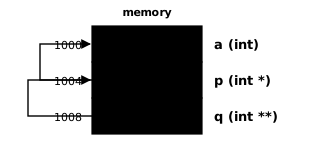
int a = 5; int *p = &a; int **q = &p; **q = *p + 10; — p holds a’s address, q holds p’s address. Follow the arrows: **q reaches a.
q                p                a
+------+         +------+         +------+
| 1008 | ------> | 1000 | ------> |  15  |
+------+         +------+         +------+
 at 1008          at 1004          at 1000          (address under each box)

 q  = 1004        *q  = p = 1000         **q = a = 15
 &a = 1000        &p  = 1004             &q  = 1008
One star follows one arrow.
5 · Worked Examples
Example 1 Easy
What does this print?
int a = 3, b = 7;
int *p = &a;
*p = b;
p = &b;
*p = 1;
printf("%d %d\n", a, b);
Solution
p → a: *p = b stores 7 in a. Then p → b: *p = 1 stores 1 in b.
Output
7 1
Example 2 Medium
On our 32-bit machine, what does this print, and what changes on a 64-bit machine?
int x = 3;
int *p, q;
p = &x;
q = 4;
printf("%u %u\n", sizeof(p), sizeof(q));
Solution
In int *p, q; the star belongs to p only: p is a pointer, q is a plain int. Here both are 4 bytes.
Output
4 4
Compiled for 64-bit, pointers grow to 8 bytes but int stays 4: the output becomes 8 4.
Example 3 GATE
What does this print?
int x = 2, y = 9;
int *p = &x, *q = &y;
int **r = &p;
*r = q;
**r = **r + 1;
printf("%d %d %d\n", x, y, *p);
Solution
r points to p. *r = q changes p itself: now p points to y. Then **r = **r + 1 adds 1 to what p points to: y becomes 10. x is untouched, and *p is y = 10.
Output
2 10 10
6 · GATE Traps
⚠️
int *p, q;makes only p a pointer; q is an int.- The * in a declaration says “pointer”; the * in an expression follows the pointer.
- Following NULL or an uninitialized pointer is undefined behavior.
- Pointer size depends on the machine (4 bytes here, 8 on 64-bit), not on what it points to.
- Assigning one pointer to another makes them point to the same variable; it does not copy the variable.
*r = qwith r of type int ** changes the pointer that r points to, not an int.
8 · Memory Hook
🧠
“& asks where, * goes there.” &x is the house address; *p is walking to the house. Two stars = two walks.
9 · Connect the Dots
Lesson 1.3.1 showed that a function only gets copies, and Lesson 1.3.3 that the caller’s variables live in a different frame. A pointer is an address that reaches any variable, wherever it lives. Next lesson answers: by passing addresses instead of values, can a function finally change its caller’s variables?
10 · Self-Test
GATE format. Try every question before opening the vault.
Q1MCQ1 markOutput
What does this print?
int x = 4;
int *p = &x;
*p = *p * *p;
printf("%d\n", x);
- (A)
4 - (B) an address
- (C)
16 - (D)
8
Q2MCQ1 markDeclarations
In int *a, b, *c; which are pointers?
- (A) a and c
- (B) a, b and c
- (C) b only
- (D) a only
Q3NAT1 markSizes
On a machine with 8-byte pointers and 4-byte ints, what is sizeof(int *)?
Numerical answer: ________
Q4MSQ2 marksPointers
With int a = 1; int *p = &a; int **q = &p;, which expressions have the value 1?
- (A)
*q == p - (B)
*p - (C)
**q - (D)
q == &a
Q5MCQ2 marksOutput
What does this print?
int a = 1, b = 2;
int *p = &a, *q = &b;
*p = *p + *q;
q = p;
*q = *q * 10;
printf("%d %d\n", a, b);
- (A)
3 2 - (B)
3 20 - (C)
30 2 - (D)
30 20
11 · Rule Card
- &x = address of x; int *p = &x; p points to x.
- *p in an expression is the variable p points to (read or write).
- Declaration star belongs to one name: int *p, q; → q is int.
- All pointers have the same size (4 here, 8 on 64-bit).
- NULL = points to nothing; dereferencing NULL/garbage = undefined.
- int **q = &p; *q is p; **q is *p.
12 · Concept Ledger
Unlocked in this lesson. From here on, these terms may be used.
address-of &pointerpointer type (int *)dereference *points toNULLpointer to pointer%p
13 · Answer Vault
Answer Vault
Try the questions first. Open when you are ready to check.
Recall Warm-up
- Its frame is popped and they disappear.
- No: x is a copy (call by value).
-
Self-Test
Q1 Answer: (C)1 mark
*p is x: x = 4 × 4 = 16.
Output
16
- (A) is wrong: x is changed through p.
- (B) is wrong: x is printed, not p.
- (D) is wrong: It multiplies, not adds.
Re-read: Lesson 1.4.1 — & and *; pointer declaration; NULL; pointer to pointer
Q2 Answer: (A)1 mark
The * attaches to each name separately.
- (B) is wrong: b has no *.
- (C) is wrong: b is a plain int.
- (D) is wrong: c has its own *.
Re-read: Lesson 1.4.1 — & and *; pointer declaration; NULL; pointer to pointer
Q3 Answer: 81 mark
All pointers are addresses: 8.
Re-read: Lesson 1.4.1 — & and *; pointer declaration; NULL; pointer to pointer
Q4 Answer: (A) (B) (C)2 marks
q holds p’s address, not a’s.
- (D) is wrong: q == &p, not &a.
Re-read: Lesson 1.4.1 — & and *; pointer declaration; NULL; pointer to pointer
Q5 Answer: (C)2 marks
a = 3, then q points to a and a becomes 30.
Output
30 2
- (A) is wrong: a is multiplied by 10 through q.
- (B) is wrong: q no longer points to b.
- (D) is wrong: b is never changed.
Re-read: Lesson 1.4.1 — & and *; pointer declaration; NULL; pointer to pointer