0 · Recall Warm-up
Answer from memory first. Answers are in the Answer Vault at the bottom.
- Postorder of a tree always ends with which node? from Lesson 4.3.1
- What is the minimum height of a binary tree with n nodes? from Lesson 4.2.2
- What does FIFO mean, and which structure follows it? from Lesson 3.3.1
1 · The Hook
🎣
A fire drill empties a building floor by floor, starting at the top. A news story spreads from the source to their friends, then to friends of friends. Both process things in “waves” by distance from the start. In a tree, that is level order: all nodes at depth 0, then depth 1, then depth 2.
2 · Predict First
🤔
Which structure should hold the nodes waiting to be printed, so that level-order comes out: a stack or a queue? Make a guess in your head. The answer opens Section 3.
3 · Core Concept
💡
Predict First — the answer
A queue. Children of the current level are discovered first and must be printed before their own children, which are discovered later: first discovered, first printed.
The algorithm
- Enqueue the root.
- While the queue is not empty: dequeue a node, print it, enqueue its left child and then its right child (if they exist).
void levelOrder(struct tnode *root)
{
    struct tnode *q[100];
    int front = 0, rear = 0;            /* simple array queue: q[front..rear-1] */
    if (root == NULL) return;
    q[rear++] = root;
    while (front < rear) {
        struct tnode *t = q[front++];   /* dequeue */
        printf("%d ", t->data);
        if (t->left)  q[rear++] = t->left;   /* enqueue children */
        if (t->right) q[rear++] = t->right;
    }
    printf("\n");
}

int main(void)
{
    levelOrder(mk(1, mk(2, mk(4, NULL, NULL), mk(5, mk(7, NULL, NULL), NULL)), mk(3, NULL, mk(6, NULL, NULL))));
    return 0;
}
Output
1 2 3 4 5 6 7
Each node is enqueued and dequeued once: O(n) time; the queue holds at most one level plus part of the next, up to about n/2 nodes for a complete tree.
Why not recursion?
The recursive traversals of Lesson 4.3.1 go deep along one branch before returning: the call stack is LIFO. Level order needs FIFO, so it is written with an explicit queue instead of recursion.
Variations
- Levels on separate lines: record the queue size at the start of each level and dequeue exactly that many.
- Height: count the number of levels − 1.
- Right to left: enqueue the right child first.
- For a tree stored in a 0-based array with no holes, level order is simply index order 0, 1, 2, … .
4 · Visual
| Dequeued (printed) | Queue after enqueuing its children |
|---|---|
1 | 2 3 |
2 | 3 4 5 |
3 | 4 5 6 |
4 | 5 6 |
5 | 6 7 |
6 | 7 |
7 | ∅ |
Level-order trace on the example tree (computed).
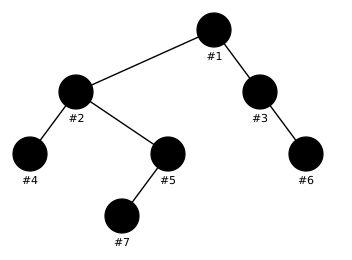
Level-order positions on the example tree.
levels of the example tree:
 depth 0:  1
 depth 1:  2 3
 depth 2:  4 5 6
 depth 3:  7

queue snapshots:  [1] -> [2 3] -> [3 4 5] -> [4 5 6] -> [5 6] -> [6 7] -> [7] -> []
The queue always holds the frontier: the rest of one level and the start of the next.
5 · Worked Examples
Example 1 Easy
Level order of the Example 1 tree from Lesson 4.3.1 (A at the root)?
Solution
A B C D E F G H I.
Example 2 Medium
During level order of a perfect binary tree of height 3, what is the largest number of nodes in the queue at one time?
Solution
When the last node of level 2 is dequeued, the queue holds all of level 3: 8 nodes (just before that, 7 nodes of level 3 plus... at most 8).
Example 3 GATE
Write the nodes of the example tree level by level, and give the tree height from the number of levels.
Solution
depth 0: 1; depth 1: 2 3; depth 2: 4 5 6; depth 3: 7. 4 levels → height 3 (edges).
6 · GATE Traps
⚠️
- Level order uses a queue, not a stack (a stack would give a branch-first order).
- Enqueue the left child before the right child for left-to-right order.
- Level order is not any of pre/in/postorder.
- For a 0-based array without holes, level order is the index order.
- Number of levels = height + 1 (edges convention).
8 · Memory Hook
🧠
“Floor-by-floor fire drill: the queue is the stairwell.”
9 · Connect the Dots
Lessons 4.3.1–4.3.2 produced sequences from a tree. GATE often runs this backwards: given two of the sequences, draw the tree, or count how many trees fit. Next lesson answers: which pairs of traversals pin down a binary tree exactly, and how many different binary trees with n nodes exist?
10 · Self-Test
GATE format. Try every question before opening the vault.
Q1MCQ1 markStructure
Level-order traversal is implemented with:
- (A) a queue
- (B) recursion only
- (C) a stack
- (D) sorting
Q2MCQ2 marksOutput
What does this print?
void levelOrder(struct tnode *root)
{
    struct tnode *q[100];
    int front = 0, rear = 0;            /* simple array queue: q[front..rear-1] */
    if (root == NULL) return;
    q[rear++] = root;
    while (front < rear) {
        struct tnode *t = q[front++];   /* dequeue */
        printf("%d ", t->data);
        if (t->left)  q[rear++] = t->left;   /* enqueue children */
        if (t->right) q[rear++] = t->right;
    }
    printf("\n");
}

int main(void)
{
    levelOrder(mk(1, mk(2, mk(4, NULL, NULL), mk(5, mk(7, NULL, NULL), NULL)), mk(3, NULL, mk(6, NULL, NULL))));
    return 0;
}
- (A)
1 3 2 6 5 4 7 - (B)
4 2 7 5 1 3 6 - (C)
1 2 3 4 5 6 7 - (D)
1 2 4 5 7 3 6
Q3NAT1 markLevels
A binary tree’s level-order traversal shows 5 distinct levels. What is its height (edges)?
Numerical answer: ________
Q4MCQ1 markArray
For a complete binary tree stored in a 0-based array, level order equals:
- (A) no simple order
- (B) inorder
- (C) reverse index order
- (D) index order 0, 1, 2, …
Q5MSQ2 marksFacts
Which are true about level-order traversal?
- (A) It uses the call stack for its order.
- (B) It visits each node once.
- (C) It can compute the height.
- (D) The first node printed is the root.
11 · Rule Card
- Level order: enqueue root; repeat: dequeue, print, enqueue left then right.
- O(n) time; queue holds at most about one level (≤ n/2 for complete trees).
- Stack → branch-first; queue → level order.
- Separate levels by recording the queue size; height = levels − 1.
- Array without holes: level order = index order.
12 · Concept Ledger
Unlocked in this lesson. From here on, these terms may be used.
level-order traversalbreadth by levels (queue-based)frontier
13 · Answer Vault
Answer Vault
Try the questions first. Open when you are ready to check.
Recall Warm-up
- The root.
- ⌊log₂ n⌋.
- First in, first out: a queue.
Self-Test
Q1 Answer: (A)1 mark
FIFO gives level order.
- (B) is wrong: Recursion follows one branch first.
- (C) is wrong: A stack follows one branch to the bottom first.
- (D) is wrong: No sorting is involved.
Re-read: Lesson 4.3.2 — Level-order traversal using a queue
Q2 Answer: (C)2 marks
The example tree’s nodes happen to be numbered level by level.
Output
1 2 3 4 5 6 7
- (A) is wrong: Left is enqueued before right.
- (B) is wrong: That is inorder.
- (D) is wrong: That is preorder.
Re-read: Lesson 4.3.2 — Level-order traversal using a queue
Q3 Answer: 41 mark
4.
Re-read: Lesson 4.3.2 — Level-order traversal using a queue
Q4 Answer: (D)1 mark
Levels are stored left to right.
- (A) is wrong: It is exactly index order.
- (B) is wrong: Inorder differs.
- (C) is wrong: Reverse would be bottom-up.
Re-read: Lesson 4.3.2 — Level-order traversal using a queue
Q5 Answer: (B) (C) (D)2 marks
It uses an explicit queue.
- (A) is wrong: A queue, not the call stack.
Re-read: Lesson 4.3.2 — Level-order traversal using a queue