0 · Recall Warm-up
Answer from memory first. Answers are in the Answer Vault at the bottom.
- In iterative list reversal, what is returned as the new head? from Lesson 3.4.2
- Queue from two stacks: what is the amortized cost per operation? from Lesson 3.3.3
- What does inserting at index 0 of an n-element array cost, and why? from Lesson 3.1
1 · The Hook
🎣
A metro train can be driven from either end: the driver walks to the other cab and goes back the way she came. A ring road has no end at all: keep driving and you return to the start. Linked lists come in both shapes, and each shape makes some operations cheaper.
2 · Predict First
🤔
In a singly linked list you are given a pointer to a node in the middle (not the head). Can you delete that node in O(1)? What changes if every node also points to its previous node? Make a guess in your head. The answer opens Section 3.
3 · Core Concept
💡
Predict First — the answer
Singly linked: no, because the previous node’s next must change and you cannot find the previous node without walking from the head (O(n)). With a prev pointer, the neighbours are at hand: delete in O(1).
Doubly linked list
Each node has prev and next. You can walk both ways, and delete or insert next to a given node in O(1). The cost: one more pointer per node and twice as many pointer updates.
struct dnode {
    int data;
    struct dnode *prev, *next;
};

struct dnode *dnew(int x)
{
    struct dnode *n = malloc(sizeof(struct dnode));
    n->data = x;
    n->prev = n->next = NULL;
    return n;
}

void insertAfterD(struct dnode *p, int x)       /* 4 pointer updates */
{
    struct dnode *n = dnew(x);
    n->prev = p;
    n->next = p->next;
    if (p->next != NULL) p->next->prev = n;
    p->next = n;
}

void removeD(struct dnode **head, struct dnode *p)  /* no search for the previous node */
{
    if (p->prev != NULL) p->prev->next = p->next; else *head = p->next;
    if (p->next != NULL) p->next->prev = p->prev;
    free(p);
}

int main(void)
{
    struct dnode *head = dnew(1), *tail, *p;
    insertAfterD(head, 3);
    insertAfterD(head, 2);
    tail = head->next->next;
    insertAfterD(tail, 4);
    tail = tail->next;
    removeD(&head, head->next);             /* remove 2 */
    for (p = head; p != NULL; p = p->next) printf("%d ", p->data);
    printf("| backwards: ");
    for (p = tail; p != NULL; p = p->prev) printf("%d ", p->data);
    printf("\n");
    return 0;
}
Output
1 3 4 | backwards: 4 3 1
Inserting after p updates four pointers (n->prev, n->next, p->next->prev, p->next); deleting p updates two (its neighbours’ links), with care at the ends.
Circular singly linked list
The last node’s next points back to the first. There is no NULL, so a traversal must stop when it returns to its start (use do-while). Keeping a pointer to the last node gives O(1) access to both ends (first = last->next): useful for round-robin scheduling and queues.
int main(void)
{
    int a[] = {7, 14, 21, 28};
    struct node *head = build(a, 4), *last = head, *p;
    while (last->next != NULL) last = last->next;
    last->next = head;                     /* make it circular */
    p = head;
    do {                                   /* visit each node once */
        printf("%d ", p->data);
        p = p->next;
    } while (p != head);
    printf("| after last: %d\n", last->next->data);
    return 0;
}
Output
7 14 21 28 | after last: 7
Circular doubly linked list
Combine both: first->prev is the last node and last->next is the first. Often built with a sentinel (dummy header) node so that the list is never truly empty and insertions need no special cases.
Costs compared
| Operation | Array | Singly linked (head only) | Doubly linked (head + tail) |
|---|---|---|---|
| access i-th | O(1) | O(i) | O(i) |
| insert at front | O(n) | O(1) | O(1) |
| insert at end | O(1) (if room) | O(n) | O(1) |
| delete a given node (pointer known) | O(n) | O(n) (need previous) | O(1) |
| delete last node | O(1) | O(n) | O(1) |
| walk backwards | O(1) per step | impossible | O(1) per step |
| extra memory per item | 0 | 1 pointer | 2 pointers |
4 · Visual

The doubly linked list after the program: arrows both ways; head->prev and tail->next are NULL.
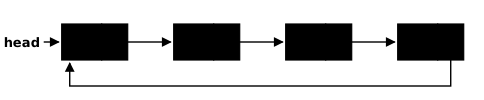
Circular singly linked list: the last node points back to the first.
Insert x after p in a doubly linked list (p <-> q):

   p <----> q            n = new node
   n->prev = p           p <- n
   n->next = q           p <- n -> q
   q->prev = n           p <- n <-> q
   p->next = n           p <-> n <-> q        (4 pointer writes)
Doubly linked insertion touches four pointers.
5 · Worked Examples
Example 1 Easy
What does this print?
int main(void)
{
    int a[] = {7, 14, 21, 28};
    struct node *head = build(a, 4), *last = head, *p;
    while (last->next != NULL) last = last->next;
    last->next = head;                     /* make it circular */
    p = head;
    do {                                   /* visit each node once */
        printf("%d ", p->data);
        p = p->next;
    } while (p != head);
    printf("| after last: %d\n", last->next->data);
    return 0;
}
Solution
The do-while prints each node once and stops when p returns to head. last->next is the first node, 7.
Output
7 14 21 28 | after last: 7
Example 2 Medium
How many pointer fields change when a node is inserted between two existing nodes of a doubly linked list? When it is deleted from between two nodes?
Solution
Insert: 4 (two in the new node, one in each neighbour). Delete: 2 (the previous node’s next and the next node’s prev).
Example 3 GATE
Which list type makes all of these O(1): insert at front, insert at end, delete at front, delete at end?
Solution
A doubly linked list with head and tail pointers (or a circular doubly linked list). A singly linked list with a tail pointer still needs O(n) to delete the last node, because the new last node must be found.
6 · GATE Traps
⚠️
- Doubly linked insertion needs 4 pointer updates; forgetting q->prev is the classic bug.
- Deleting the last node of a singly linked list is O(n) even with a tail pointer.
- Traversing a circular list with while (p != NULL) never ends; stop at the start node.
- In a circular list, the last node’s next is the head; keeping a last pointer gives both ends.
- Check the ends: prev of the first node and next of the last node are NULL in a non-circular doubly linked list.
8 · Memory Hook
🧠
“Two cabs, one ring.” A doubly linked list is a train with a cab at each end; a circular list is the ring road with no last exit.
9 · Connect the Dots
Lessons 3.2 and 3.3 built stacks and queues on arrays with fixed capacity. Linked lists grow without a limit and insert at the ends in O(1). Next lesson answers: how are a stack and a queue built from linked nodes, and which end of the list should each operation use?
10 · Self-Test
GATE format. Try every question before opening the vault.
Q1MCQ1 markDoubly
Given a pointer to a node in a doubly linked list, deleting it costs:
- (A) O(log n)
- (B) O(1)
- (C) O(n²)
- (D) O(n)
Q2NAT1 markPointers
How many pointer fields are written when a new node is inserted between two nodes of a doubly linked list?
Numerical answer: ________
Q3MCQ2 marksOutput
What does this print?
struct dnode {
    int data;
    struct dnode *prev, *next;
};

struct dnode *dnew(int x)
{
    struct dnode *n = malloc(sizeof(struct dnode));
    n->data = x;
    n->prev = n->next = NULL;
    return n;
}

void insertAfterD(struct dnode *p, int x)       /* 4 pointer updates */
{
    struct dnode *n = dnew(x);
    n->prev = p;
    n->next = p->next;
    if (p->next != NULL) p->next->prev = n;
    p->next = n;
}

void removeD(struct dnode **head, struct dnode *p)  /* no search for the previous node */
{
    if (p->prev != NULL) p->prev->next = p->next; else *head = p->next;
    if (p->next != NULL) p->next->prev = p->prev;
    free(p);
}

int main(void)
{
    struct dnode *head = dnew(1), *tail, *p;
    insertAfterD(head, 3);
    insertAfterD(head, 2);
    tail = head->next->next;
    insertAfterD(tail, 4);
    tail = tail->next;
    removeD(&head, head->next);             /* remove 2 */
    for (p = head; p != NULL; p = p->next) printf("%d ", p->data);
    printf("| backwards: ");
    for (p = tail; p != NULL; p = p->prev) printf("%d ", p->data);
    printf("\n");
    return 0;
}
- (A)
1 2 3 4 | backwards: 4 3 2 1 - (B)
1 3 4 | backwards: 4 3 1 - (C)
1 3 4 | backwards: 4 3 - (D)
1 4 3 | backwards: 3 4 1
Q4MCQ1 markCircular
In a circular singly linked list with a pointer last to the last node, the first node is:
- (A) last
- (B) last->next
- (C) last->prev
- (D) NULL
Q5MSQ2 marksCosts
For a singly linked list with head and tail pointers, which are O(1)?
- (A) insert at end
- (B) delete at front
- (C) delete at end
- (D) insert at front
11 · Rule Card
- Doubly linked: prev + next; delete/insert beside a known node O(1); 4 writes to insert, 2 to delete.
- Circular: last->next = head; traverse with do-while until back at the start.
- A last pointer on a circular list gives O(1) access to both ends.
- Singly linked + tail: insert at end O(1), delete at end O(n).
- Price of doubly linked: one more pointer per node.
12 · Concept Ledger
Unlocked in this lesson. From here on, these terms may be used.
doubly linked listprev pointercircular linked listcircular doubly linked listsentinel (dummy header) node
13 · Answer Vault
Answer Vault
Try the questions first. Open when you are ready to check.
Recall Warm-up
- prev (cur is NULL at the end).
- O(1).
- O(n): every element shifts one place.
Self-Test
Q1 Answer: (B)1 mark
Both neighbours are reachable.
- (A) is wrong: No search is needed.
- (C) is wrong: Far too much.
- (D) is wrong: No walk from the head.
Re-read: Lesson 3.4.3 — Doubly and circular linked lists; operation costs compared with arrays
Q2 Answer: 41 mark
4.
Re-read: Lesson 3.4.3 — Doubly and circular linked lists; operation costs compared with arrays
Q3 Answer: (B)2 marks
2 is removed; prev links let us walk back.
Output
1 3 4 | backwards: 4 3 1
- (A) is wrong: Node 2 was removed.
- (C) is wrong: The backward walk reaches 1.
- (D) is wrong: 2 was inserted after 1 and 3 after it.
Re-read: Lesson 3.4.3 — Doubly and circular linked lists; operation costs compared with arrays
Q4 Answer: (B)1 mark
The ring closes there.
- (A) is wrong: last is the last node.
- (C) is wrong: There is no prev in a singly linked list.
- (D) is wrong: No NULL in a circular list.
Re-read: Lesson 3.4.3 — Doubly and circular linked lists; operation costs compared with arrays
Q5 Answer: (A) (B) (D)2 marks
Deleting the last node needs its predecessor: O(n).
- (C) is wrong: Finding the new last node takes a walk.
Re-read: Lesson 3.4.3 — Doubly and circular linked lists; operation costs compared with arrays