0 · Recall Warm-up
Answer from memory first. Answers are in the Answer Vault at the bottom.
- In an AVL tree, what range of balance factors is allowed? from Lesson 4.6
- In a BST, where is the maximum key? from Lesson 4.5.1
- In a 0-based array layout of a binary tree, what are the children of index i? from Lesson 4.2.3
1 · The Hook
🎣
In a hospital emergency room, patients are not treated in arrival order but by urgency: the most critical patient is always next. Lesson 3.3.3 called this a priority queue. Keeping the patients fully sorted would be wasted effort — we only ever need the top one. A heap keeps just enough order to have the maximum at the front, and lives in a plain array.
2 · Predict First
🤔
If every parent is larger than its children, where in the tree is the largest key? Where could the smallest key be? Make a guess in your head. The answer opens Section 3.
3 · Core Concept
💡
Predict First — the answer
The largest is at the root (every path from it goes downward in value). The smallest has no smaller child, so it is a leaf — but it can be any leaf.
Two rules
A binary heap is a binary tree that satisfies:
- Shape: it is a complete binary tree (all levels full except possibly the last, which is filled from the left).
- Order (heap property): in a max-heap every parent ≥ its children; in a min-heap every parent ≤ its children.
Unlike a BST, there is no left–right ordering between siblings or cousins.
Array storage
Because the tree is complete, it is stored level by level in an array with no gaps (Lesson 4.2.3):
| 0-based (this course’s default) | 1-based | |
|---|---|---|
| root | a[0] | a[1] |
| children of i | 2i + 1, 2i + 2 | 2i, 2i + 1 |
| parent of i | ⌊(i − 1)/2⌋ | ⌊i/2⌋ |
| leaves (n keys) | ⌊n/2⌋ … n − 1 | ⌊n/2⌋ + 1 … n |
A heap with n keys has height ⌊log₂ n⌋.
Checking an array
An array is a max-heap iff every element is ≤ its parent: one comparison per non-root element, O(n).
int isMaxHeap(int a[], int n)
{
    int i;
    for (i = 1; i < n; i++)
        if (a[(i - 1) / 2] < a[i]) return 0;
    return 1;
}

int main(void)
{
    int p[] = {25, 14, 16, 13, 10, 8, 12};
    int q[] = {25, 12, 16, 13, 10, 8, 14};
    printf("%d %d\n", isMaxHeap(p, 7), isMaxHeap(q, 7));
    return 0;
}
Output
1 0
In q, 12 at index 1 has the child 13 at index 3, which is larger: not a heap.
What a heap gives
| Operation | Max-heap |
|---|---|
| find maximum | O(1) — the root |
| insert, delete maximum | O(log n) (Lesson 5.2) |
| find minimum | O(n) — scan the leaves |
| search for an arbitrary key | O(n) |
4 · Visual
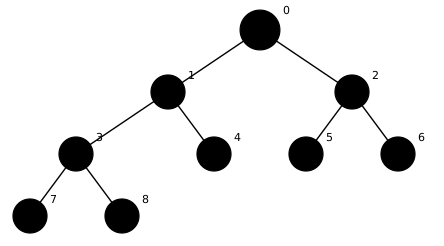

Max-heap 100 80 90 50 60 70 40 30 20: the tree and the same keys in the array (0-based indices). Leaves are indices 4…8.
index:   0    1    2    3    4    5    6    7    8
key:   100   80   90   50   60   70   40   30   20

                 100 [0]
              /        \
          80 [1]       90 [2]
          /   \        /   \
      50 [3] 60 [4] 70 [5] 40 [6]
       /  \
   30 [7] 20 [8]

children of 1: 2*1+1 = 3, 2*1+2 = 4      parent of 8: (8-1)/2 = 3
The array is the level order of a complete tree; index arithmetic replaces pointers.
5 · Worked Examples
Example 1 Easy
In the heap above, what are the parent of index 6 and the children of index 3? Which indices are leaves?
Solution
Parent of 6: ⌊5/2⌋ = 2 (key 90). Children of 3: 7 and 8 (keys 30, 20). Leaves: indices ⌊9/2⌋ = 4 to 8.
Example 2 Medium
Is 89 19 50 17 12 15 2 5 7 11 6 9 100 a max-heap?
Solution
No. 100 at index 12 has parent ⌊11/2⌋ = 5 (key 15) and 100 > 15. Checker: false.
Example 3 GATE
A max-heap has n = 1000 distinct keys. In which index range must the minimum key lie (0-based)? How many keys must be examined to find it?
Solution
The minimum is a leaf: indices ⌊1000/2⌋ = 500 to 999, i.e. 500 keys (499 comparisons). Finding the minimum is O(n), not O(log n).
6 · GATE Traps
⚠️
- A heap is complete: no gaps in the array; a non-complete tree is never a heap.
- Heap order is only parent–child; siblings are unordered, and inorder is not sorted.
- Check which indexing (0-based or 1-based) the question uses before applying formulas.
- Minimum of a max-heap: any leaf; search is O(n).
- A sorted (descending) array is always a max-heap, but most heaps are not sorted.
8 · Memory Hook
🧠
“Boss above, no gaps.” Every parent beats its children (order), and the tree is filled left to right (shape).
9 · Connect the Dots
Lesson 5.1 defined a heap and its array layout. A static heap is not useful: patients arrive and leave. Next lesson answers: how do we add a key or remove the maximum while keeping both heap rules, in O(log n)?
10 · Self-Test
GATE format. Try every question before opening the vault.
Q1MCQ1 markShape
Which must a binary heap be?
- (A) a complete binary tree
- (B) an AVL tree with sorted inorder
- (C) a BST
- (D) a perfect binary tree
Q2NAT1 markIndex
In a 0-based max-heap array, what is the index of the parent of index 13?
Numerical answer: ________
Q3MCQ2 marksOutput
What does this print?
int isMaxHeap(int a[], int n)
{
    int i;
    for (i = 1; i < n; i++)
        if (a[(i - 1) / 2] < a[i]) return 0;
    return 1;
}

int main(void)
{
    int p[] = {25, 14, 16, 13, 10, 8, 12};
    int q[] = {25, 12, 16, 13, 10, 8, 14};
    printf("%d %d\n", isMaxHeap(p, 7), isMaxHeap(q, 7));
    return 0;
}
- (A)
1 1 - (B)
0 0 - (C)
1 0 - (D)
0 1
Q4MSQ1 markCosts
For a max-heap of n keys, which are O(1)?
- (A) finding the minimum
- (B) reading the left child index of i
- (C) searching for a given key
- (D) finding the maximum
Q5NAT2 marksLeaves
A heap has 37 keys. How many of them are leaves?
Numerical answer: ________
11 · Rule Card
- Heap = complete binary tree + heap order (max: parent ≥ children; min: parent ≤ children).
- 0-based: children 2i + 1, 2i + 2; parent ⌊(i − 1)/2⌋. 1-based: 2i, 2i + 1; ⌊i/2⌋.
- Leaves: last n − ⌊n/2⌋ positions; height ⌊log₂ n⌋.
- Max at root O(1); min among leaves O(n); search O(n).
12 · Concept Ledger
Unlocked in this lesson. From here on, these terms may be used.
binary heapmax-heap / min-heapheap propertyheap array indexing
13 · Answer Vault
Answer Vault
Try the questions first. Open when you are ready to check.
Recall Warm-up
- −1, 0, +1.
- At the rightmost node.
- 2i + 1 and 2i + 2; the parent is ⌊(i − 1)/2⌋.
Self-Test
Q1 Answer: (A)1 mark
Shape rule.
- (B) is wrong: Heaps have no inorder ordering.
- (C) is wrong: No left–right ordering.
- (D) is wrong: The last level may be partial.
Re-read: Lesson 5.1 — The heap idea: a complete binary tree in an array; max-heap and min-heap
Q2 Answer: 61 mark
⌊12/2⌋ = 6.
Re-read: Lesson 5.1 — The heap idea: a complete binary tree in an array; max-heap and min-heap
Q3 Answer: (C)2 marks
In q, 13 (index 3) exceeds its parent 12 (index 1).
Output
1 0
- (A) is wrong: q fails at index 3.
- (B) is wrong: p is a heap.
- (D) is wrong: p is a heap.
Re-read: Lesson 5.1 — The heap idea: a complete binary tree in an array; max-heap and min-heap
Q4 Answer: (B) (D)1 mark
Root access and index arithmetic.
- (A) is wrong: O(n): scan the leaves.
- (C) is wrong: O(n).
Re-read: Lesson 5.1 — The heap idea: a complete binary tree in an array; max-heap and min-heap
Q5 Answer: 192 marks
n − ⌊n/2⌋ = 37 − 18 = 19.
Re-read: Lesson 5.1 — The heap idea: a complete binary tree in an array; max-heap and min-heap