0 · Recall Warm-up
Answer from memory first. Answers are in the Answer Vault at the bottom.
- How many pointers are written when inserting into the middle of a doubly linked list? from Lesson 3.4.3
- Which list operations are O(1) with only a head pointer? from Lesson 3.4.1
- In the array stack, what are the empty and full tests? from Lesson 3.2.1
1 · The Hook
🎣
The array stack and the array queue had a fixed capacity: one more item than planned and they overflowed. Built from linked nodes, they grow as long as memory lasts. The design question is only: which end of the list does each operation use, so that every operation stays O(1)?
2 · Predict First
🤔
A stack is built on a singly linked list with only a head pointer. Should push add at the head or at the tail? Make a guess in your head. The answer opens Section 3.
3 · Core Concept
💡
Predict First — the answer
At the head: inserting and deleting at the head are both O(1). Popping from the tail would need the second-to-last node, O(n).
Linked stack
The head is the top. push = insert at head; pop = delete at head; empty when top == NULL. No overflow (until malloc fails).
struct node *top = NULL;

void push(int x)
{
    struct node *n = newNode(x);
    n->next = top;
    top = n;
}

int pop(void)
{
    struct node *t = top;
    int x;
    if (top == NULL) { printf("underflow "); return -1; }
    x = t->data;
    top = t->next;
    free(t);
    return x;
}

int main(void)
{
    push(1); push(2); push(3);
    printf("%d ", pop());
    push(4);
    printf("%d ", pop());
    printf("%d ", pop());
    printf("%d ", pop());
    pop();
    printf("\n");
    return 0;
}
Output
3 4 2 1 underflow
Linked queue
Keep front (head, where we delete) and rear (last node, where we insert). Enqueue: link the new node after rear; dequeue: remove the front node. Special cases: enqueue into an empty queue sets both pointers; dequeuing the last item must reset rear to NULL.
struct node *front = NULL, *rear = NULL;

void enqueue(int x)
{
    struct node *n = newNode(x);
    if (rear == NULL) front = rear = n;   /* first item */
    else { rear->next = n; rear = n; }
}

int dequeue(void)
{
    struct node *t = front;
    int x;
    if (front == NULL) { printf("empty "); return -1; }
    x = t->data;
    front = front->next;
    if (front == NULL) rear = NULL;       /* queue became empty */
    free(t);
    return x;
}

int main(void)
{
    enqueue(10); enqueue(20); enqueue(30);
    printf("%d ", dequeue());
    enqueue(40);
    printf("%d ", dequeue());
    printf("%d ", dequeue());
    printf("%d ", dequeue());
    dequeue();
    printf("\n");
    return 0;
}
Output
10 20 30 40 empty
Why not insert at the front and delete at the rear? Deleting the last node of a singly linked list is O(n).
Array vs linked implementations
| Array (stack / circular queue) | Linked list | |
|---|---|---|
| each operation | O(1) | O(1) |
| capacity | fixed (overflow possible) | grows (until memory runs out) |
| memory per item | just the value | value + pointer |
| memory locality | contiguous (cache-friendly) | scattered |
| extra work | none | malloc and free per item |
4 · Visual
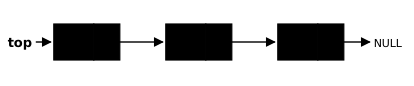
Linked stack after push 1, 2, 3, pop, push 4: the top is the head.
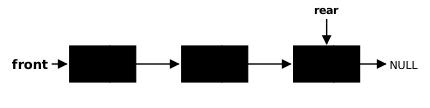
Linked queue after enqueue 10, 20, 30, dequeue, enqueue 40: delete at front, insert after rear.
Linked queue, special cases:

enqueue into empty:   front = rear = n
dequeue last item:    front = front->next (= NULL)  ->  also set rear = NULL
                      otherwise rear would dangle on the freed node
The two special cases of the linked queue.
5 · Worked Examples
Example 1 Easy
What does this print?
struct node *top = NULL;

void push(int x)
{
    struct node *n = newNode(x);
    n->next = top;
    top = n;
}

int pop(void)
{
    struct node *t = top;
    int x;
    if (top == NULL) { printf("underflow "); return -1; }
    x = t->data;
    top = t->next;
    free(t);
    return x;
}

int main(void)
{
    push(1); push(2); push(3);
    printf("%d ", pop());
    push(4);
    printf("%d ", pop());
    printf("%d ", pop());
    printf("%d ", pop());
    pop();
    printf("\n");
    return 0;
}
Solution
push 1, 2, 3; pop → 3; push 4; pops → 4, 2, 1; the next pop underflows.
Output
3 4 2 1 underflow
Example 2 Medium
What does this print?
struct node *front = NULL, *rear = NULL;

void enqueue(int x)
{
    struct node *n = newNode(x);
    if (rear == NULL) front = rear = n;   /* first item */
    else { rear->next = n; rear = n; }
}

int dequeue(void)
{
    struct node *t = front;
    int x;
    if (front == NULL) { printf("empty "); return -1; }
    x = t->data;
    front = front->next;
    if (front == NULL) rear = NULL;       /* queue became empty */
    free(t);
    return x;
}

int main(void)
{
    enqueue(10); enqueue(20); enqueue(30);
    printf("%d ", dequeue());
    enqueue(40);
    printf("%d ", dequeue());
    printf("%d ", dequeue());
    printf("%d ", dequeue());
    dequeue();
    printf("\n");
    return 0;
}
Solution
FIFO: 10, then 20, 30, 40; the fifth dequeue finds an empty queue.
Output
10 20 30 40 empty
Example 3 GATE
A queue is implemented with a singly linked list, insertion at the head and deletion at the tail, keeping both a head and a tail pointer. What are the costs of enqueue and dequeue?
Solution
Enqueue at the head: O(1). Dequeue at the tail: the new tail is the node before the old tail, found only by walking from the head: O(n). Swapping the ends (insert at tail, delete at head) makes both O(1).
6 · GATE Traps
⚠️
- Linked stack: push and pop at the head, never at the tail.
- Linked queue: insert at the rear, delete at the front.
- Dequeuing the last item must also set rear = NULL.
- Enqueue into an empty queue must set front as well as rear.
- A linked structure can still fail when malloc returns NULL; it just has no fixed capacity.
8 · Memory Hook
🧠
“Stacks live at the head; queues enter at the tail and leave at the head.”
9 · Connect the Dots
Phase 3 has now built every linear structure from both arrays and linked nodes. GATE tests linked lists mostly by giving a short function full of p->next->next and asking what list or value results. Next lesson answers: how do we trace such pointer code quickly and without mistakes?
10 · Self-Test
GATE format. Try every question before opening the vault.
Q1MCQ1 markDesign
For a linked stack with only a head pointer, push should:
- (A) insert at the head
- (B) replace the head’s data
- (C) insert in the middle
- (D) insert at the tail
Q2MCQ2 marksOutput
What does this print?
struct node *front = NULL, *rear = NULL;

void enqueue(int x)
{
    struct node *n = newNode(x);
    if (rear == NULL) front = rear = n;   /* first item */
    else { rear->next = n; rear = n; }
}

int dequeue(void)
{
    struct node *t = front;
    int x;
    if (front == NULL) { printf("empty "); return -1; }
    x = t->data;
    front = front->next;
    if (front == NULL) rear = NULL;       /* queue became empty */
    free(t);
    return x;
}

int main(void)
{
    enqueue(10); enqueue(20); enqueue(30);
    printf("%d ", dequeue());
    enqueue(40);
    printf("%d ", dequeue());
    printf("%d ", dequeue());
    printf("%d ", dequeue());
    dequeue();
    printf("\n");
    return 0;
}
- (A)
10 20 30 40 empty - (B)
40 30 20 10 empty - (C)
30 40 20 10 empty - (D)
10 20 30 40
Q3MCQ1 markSpecial case
In a linked queue, after dequeuing the only remaining item, which pointer must also be reset?
- (A) none
- (B) rear
- (C) both front->next and rear
- (D) front
Q4MCQ2 marksOutput
What does this print?
struct node *top = NULL;

void push(int x)
{
    struct node *n = newNode(x);
    n->next = top;
    top = n;
}

int pop(void)
{
    struct node *t = top;
    int x;
    if (top == NULL) { printf("underflow "); return -1; }
    x = t->data;
    top = t->next;
    free(t);
    return x;
}

int main(void)
{
    push(1); push(2); push(3);
    printf("%d ", pop());
    push(4);
    printf("%d ", pop());
    printf("%d ", pop());
    printf("%d ", pop());
    pop();
    printf("\n");
    return 0;
}
- (A)
3 4 2 1 - (B)
3 4 2 1 underflow - (C)
3 2 1 4 underflow - (D)
1 2 3 4 underflow
Q5MSQ1 markComparison
Compared with array versions, linked stacks and queues:
- (A) make each operation O(n)
- (B) allocate memory per item
- (C) use extra memory for pointers
- (D) have no fixed capacity
11 · Rule Card
- Linked stack: top = head; push/pop at head; empty top == NULL.
- Linked queue: front = head (delete), rear = last (insert); both O(1).
- Empty enqueue sets front = rear = n; last dequeue sets rear = NULL.
- No fixed capacity; extra pointer per item; malloc/free per operation.
12 · Concept Ledger
Unlocked in this lesson. From here on, these terms may be used.
linked stacklinked queuefront and rear pointers (linked)
13 · Answer Vault
Answer Vault
Try the questions first. Open when you are ready to check.
Recall Warm-up
-
- Insert at the front and delete at the front.
- top == −1 and top == MAX − 1.
Self-Test
Q1 Answer: (A)1 mark
O(1) at the head.
- (B) is wrong: That loses data.
- (C) is wrong: No reason to.
- (D) is wrong: Pop would then be O(n).
Re-read: Lesson 3.4.4 — Stack and queue built on linked lists
Q2 Answer: (A)2 marks
FIFO, then empty.
Output
10 20 30 40 empty
- (B) is wrong: That would be a stack.
- (C) is wrong: Queues are FIFO.
- (D) is wrong: The fifth dequeue prints empty.
Re-read: Lesson 3.4.4 — Stack and queue built on linked lists
Q3 Answer: (B)1 mark
Otherwise rear dangles.
- (A) is wrong: rear would point to freed memory.
- (C) is wrong: front is NULL; there is no front->next.
- (D) is wrong: front becomes NULL naturally.
Re-read: Lesson 3.4.4 — Stack and queue built on linked lists
Q4 Answer: (B)2 marks
LIFO.
Output
3 4 2 1 underflow
- (A) is wrong: The fifth pop prints underflow.
- (C) is wrong: 4 is pushed after 3 is popped.
- (D) is wrong: Stacks are LIFO.
Re-read: Lesson 3.4.4 — Stack and queue built on linked lists
Q5 Answer: (B) (C) (D)1 mark
Operations stay O(1).
- (A) is wrong: All operations are O(1).
Re-read: Lesson 3.4.4 — Stack and queue built on linked lists