🧭
One line has travelled through these notes since Lesson 0.1.3: total = price * qty + 50; with total and price of type float and qty of type int. Here it makes the whole trip in one place, every output recomputed by the same code that checked the lessons. In the second half the line is put inside a loop and a function, so that the back-end phases (flow graphs, data-flow, runtime) have something to work on.
1 · Word Desk — lexical analysis
8 tokens. The lexemes total, price and qty become ⟨id, 1⟩, ⟨id, 2⟩, ⟨id, 3⟩ with entries in the symbol table; 50 becomes ⟨num, 50⟩.
| Entry | Name | Type | Filled in by |
|---|---|---|---|
| 1 | total | float | lexer (name), semantic analysis (type) |
| 2 | price | float | same |
| 3 | qty | int | same |
2 · Sentence Desk — syntax analysis (SLR(1))
Grammar (Lesson 3.4):
S → id = E
E → E + T | T
T → T * F | F
F → ( E ) | id | num
The SLR(1) automaton has 16 states and no conflicts. The parse of id = id * id + num takes 17 steps:
| Stack | Input | Action |
|---|---|---|
0 | id = id * id + num $ | shift 2 |
0 id 2 | = id * id + num $ | shift 3 |
0 id 2 = 3 | id * id + num $ | shift 8 |
0 id 2 = 3 id 8 | * id + num $ | reduce F → id |
0 id 2 = 3 F 6 | * id + num $ | reduce T → F |
0 id 2 = 3 T 5 | * id + num $ | shift 11 |
0 id 2 = 3 T 5 * 11 | id + num $ | shift 8 |
0 id 2 = 3 T 5 * 11 id 8 | + num $ | reduce F → id |
0 id 2 = 3 T 5 * 11 F 14 | + num $ | reduce T → T * F |
0 id 2 = 3 T 5 | + num $ | reduce E → T |
0 id 2 = 3 E 4 | + num $ | shift 10 |
0 id 2 = 3 E 4 + 10 | num $ | shift 9 |
0 id 2 = 3 E 4 + 10 num 9 | $ | reduce F → num |
0 id 2 = 3 E 4 + 10 F 6 | $ | reduce T → F |
0 id 2 = 3 E 4 + 10 T 13 | $ | reduce E → E + T |
0 id 2 = 3 E 4 | $ | reduce S → id = E |
0 S 1 | $ | accept |
Shift-reduce trace (computed). Each reduce pops a handle and pushes the left side.

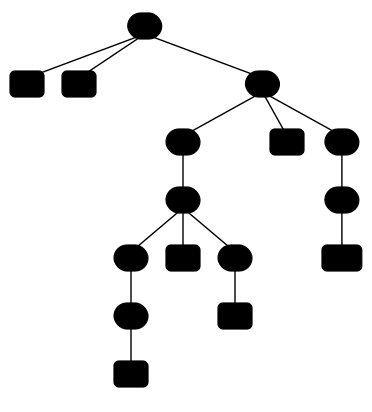
Parse tree: 16 nodes. * sits below +, so price * qty is grouped first.
3 · Meaning Desk — semantic analysis
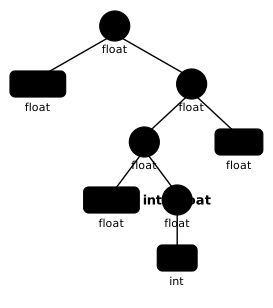
Syntax tree with types: qty is int, so the type checker inserts inttofloat(qty); 50 is converted to 50.0 at compile time. Every node is float.
4 · Drafting Room — three-address code
t1 = inttofloat(qty)
t2 = price * t1
t3 = t2 + 50.0
total = t3
| # | op | arg1 | arg2 | result |
|---|---|---|---|---|
| (0) | inttofloat | qty | `` | t1 |
| (1) | * | price | t1 | t2 |
| (2) | + | t2 | 50.0 | t3 |
| (3) | = | t3 | `` | total |
Quadruples.
| # | op | arg1 | arg2 |
|---|---|---|---|
| (0) | inttofloat | qty | `` |
| (1) | * | price | (0) |
| (2) | + | (1) | 50.0 |
| (3) | = | total | (2) |
Triples refer to earlier results by position.
5 · The line inside a loop: basic blocks and the flow graph
Now the line runs n times inside a function (types left out for brevity):
total = 0;
i = 0;
while (i < n) {
  total = total + price * qty + 50;
i = i + 1;
} print(total);
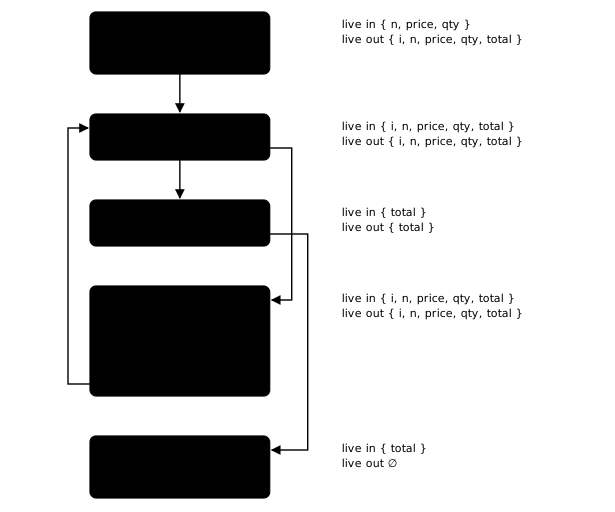
Jumping code (Lesson 4.2.3) gives 11 instructions; the leader rules (Lesson 4.4) cut them into 5 blocks:
5 basic blocks and 5 edges (computed). B2 → B4 → B2 is the loop.
6 · Optimization Room
- Liveness (Lesson 6.4, computed above): n, price and qty are live on entry (they are inputs); total is live on exit from the loop because it is printed.
- Loop-invariant code motion (Lesson 6.6): t1 = price * qty uses only values that never change in the loop, so it moves to a preheader. Operations inside the loop drop from 4 to 3 per iteration:
total = 0
i = 0
t1 = price * qty
L1: if i < n goto L2
goto L3
L2: t2 = total + t1
total = t2 + 50
i = i + 1
goto L1
L3: param total
call print, 1
- Constant propagation (Lesson 6.3) finds nothing to fold: total and i are NAC at the loop header, because the back edge brings new values.
- Inside B4, local optimization (Lesson 6.1) finds no common subexpression: every operation is different.
7 · Records Room — the activation record at run time
Calling bill(10, 2, 3) (Lesson 5.2) creates one activation record on the stack. The interpreter’s snapshot just before return:
Output: 210 = 3 × (10 × 2 + 50) (computed by running the program).
8 · Printing Room — target code (as in Lesson 0.1.3)
LD   R2, qty
ITOF R2, R2
LDF  R1, price
MULF R1, R1, R2
ADDF R1, R1, #50.0
STF  total, R1
🔗
One line, every phase: 8 tokens → a 16-node parse tree → a 7-node typed syntax tree with one conversion → 4 three-address instructions → (inside a loop) 5 basic blocks, liveness sets, a hoisted multiplication → one activation record → six machine instructions.
Practice set
Q1NAT1 markLexical
How many tokens does the journey line total = price * qty + 50; have?
Numerical answer: ________
Q2NAT2 marksParsing
How many reduce actions does the SLR(1) parse of id = id * id + num (grammar above) perform?
Numerical answer: ________
Q3MCQ1 markSemantic
Which conversion does the type checker insert for the journey line?
- (A) floattoint(price)
- (B) inttofloat(qty)
- (C) inttofloat(total)
- (D) none
Q4NAT1 markBlocks
How many basic blocks does the loop version have?
Numerical answer: ________
Q5MCQ2 marksOptimization
Which instruction of the loop body can be moved to a preheader?
- (A) t2 = total + t1
- (B) t1 = price * qty
- (C) total = t2 + 50
- (D) i = i + 1
Answer Vault
Try the questions first. Open when you are ready to check.
Q1 Answer: 81 mark
total, =, price, *, qty, +, 50, ; → 8.
Re-read: Lesson 1.1.2 — Counting tokens in C code: whitespace, comments, string literals, ++ and >=
Q2 Answer: 92 marks
Counted from the trace: 9.
Re-read: Lesson 2.4.3 — SLR(1)
Q3 Answer: (B)1 mark
qty is the only int operand in a float expression.
- (A) is wrong: price is already float.
- (C) is wrong: total is float.
- (D) is wrong: qty must be widened.
Re-read: Lesson 3.4 — Applications: building syntax trees; basic type checking (brief)
Q4 Answer: 51 mark
Leaders 1, 3, 4, 5, 10: 5.
Re-read: Lesson 4.4 — Basic blocks: leader rules and partitioning; control flow graphs (the second meaning of “CFG”); counting blocks and edges
Q5 Answer: (B)2 marks
price and qty never change inside the loop.
- (A) is wrong: total changes every iteration.
- (C) is wrong: Depends on t2.
- (D) is wrong: i changes.
Re-read: Lesson 6.6 — Loop optimizations: code motion, induction variables (brief, low weight)