0 · Recall Warm-up
Answer from memory first. Answers are in the Answer Vault at the end of this lesson.
- Which area holds the local variables of a function call? from Lesson 5.1
- How many distinct names does the SSA form of
x = a; x = x + 1have? from Lesson 4.3 - What is the preorder of a tree with root A whose children are B and C, and B has a child D? from Lesson 0.2.4
1 · The Story
📖
A tray per speaking turn
During Mr. Patel’s evening, speakers interrupt each other. Mr. Patel starts; he calls on Mrs. Shah for a figure; she in turn asks the accountant. Each time someone starts, Rhea puts a new tray on the pile with: the questions handed to them, a space for their answer, a note of who asked them and where that person should resume, and room for their own scribbles.
When the accountant answers, his tray comes off, his answer goes into Mrs. Shah’s hands, and she resumes exactly where she left off.
After the evening, Rhea draws a chart of who called on whom, in order: Mr. Patel at the top, below him everyone he called, below them everyone they called. The tray pile at any moment is just one path down that chart: from Mr. Patel to whoever is speaking now.
2 · Predict First
🤔
For fib(4) with fib(n) = fib(n − 1) + fib(n − 2) and fib(0) = 0, fib(1) = 1, how many calls to fib happen in total, and what is the largest number of fib records on the stack at once?
Write your guess down. The answer is in the vault.
3 · Core Concept
Activations and the activation tree
Each execution of a procedure body is an activation. Activations are nested in time: if p calls q, q’s activation ends before p’s. The activation tree has a node per activation, with the activations a procedure calls as its children, left to right in call order.
- The sequence of calls is a preorder walk of the tree; the sequence of returns is a postorder walk.
- At any moment, the stack holds exactly the activations on the path from the root to the current node.
The activation record (stack frame)
Each live activation has an activation record (stack frame) on the run-time stack. A typical layout (Dragon book order):
| Field | Purpose |
|---|---|
| actual parameters | values supplied by the caller (often in registers) |
| returned value | space for the result |
| control link | points to the caller’s activation record (dynamic link) |
| static link | used by nested procedures (Lesson 5.3) |
| saved machine status | return address and saved registers |
| local data | the procedure’s local variables |
| temporaries | compiler-generated temporaries |
The formal parameters are the names in the procedure’s declaration; the actual parameters (arguments) are the expressions written in the call.
Calling and return sequences
- Calling sequence (split between caller and callee): the caller evaluates the actual parameters, stores the return address and the old stack top (control link) in the new record, and jumps to the callee; the callee saves registers, sets up its locals, and runs.
- Return sequence: the callee places the return value, restores the saved registers and stack top, and jumps to the return address; the caller copies the returned value.
Fields of fixed size (links, saved status) sit in the middle of the record so both sides know their offsets; variable-size data goes at the ends.
Recursion
Every recursive call gets its own record, so each call has its own locals and parameters. The maximum stack depth equals the height of the activation tree (plus the records above it, like main).
Story → compiler term
| In the story | In the compiler |
|---|---|
| a speaking turn | an activation |
| a tray | an activation record (stack frame) |
| questions handed to the speaker | actual parameters |
| the space for the answer | returned value |
| who asked them | control link |
| where to resume | return address (saved machine status) |
| own scribbles | local data and temporaries |
| the chart of who called whom | activation tree |
| the pile at one moment | path from the root to the current activation |
4 · Visual
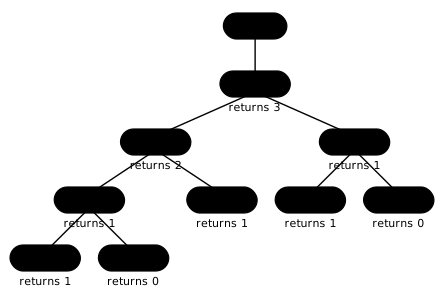
Activation tree of fib(4) (from running the program): 9 calls to fib, returns shown under each node.
The stack while fib(1) runs for the first time: exactly the path main → fib(4) → fib(3) → fib(2) → fib(1).
5 · Worked Examples
Example 1 Easy
Draw the activation tree of fib(4) and list the calls in order.
Solution
Calls in preorder: fib(4), fib(3), fib(2), fib(1), fib(0), fib(1), fib(2), fib(1), fib(0): 9 calls. Returns come in postorder. Rhea’s chart after the evening.
Example 2 Medium
For int f(int n) { if (n <= 1) return 1; return f(n − 1) + f(n − 2); }, how many calls does f(5) make, and what is the largest number of f records on the stack at once?
Solution
calls(n) = 1 + calls(n − 1) + calls(n − 2), with calls(0) = calls(1) = 1: calls(2) = 3, calls(3) = 5, calls(4) = 9, calls(5) = 15. The deepest path is f(5) → f(4) → f(3) → f(2) → f(1): 5 records. f(5) returns 8. All confirmed by running it.
Example 3 GATE
For int t(int n) { if (n <= 0) return 1; return t(n − 1) + t(n − 1) + t(n − 2); }, find the value of t(3), the number of calls and the maximum stack depth of t.
Solution
Values: t(0) = 1, t(−1) = 1, t(1) = 1 + 1 + 1 = 3, t(2) = 3 + 3 + 1 = 7, t(3) = 7 + 7 + 3 = 17. Calls: c(n) = 1 + 2c(n − 1) + c(n − 2) with c(0) = c(−1) = 1 → c(1) = 4, c(2) = 10, c(3) = 25. Depth: t(3) → t(2) → t(1) → t(0): 4.
6 · Shortcuts
⚡
Count calls with a recurrence: calls(n) = 1 + Σ calls(arguments of the recursive calls), base cases = 1. Valid when: call-count questions on recursive functions.
⚡
Maximum stack depth = longest root-to-leaf path in the activation tree (count records, add main if asked). Valid when: stack-depth questions.
7 · GATE Traps
⚠️
- The number of calls is the number of nodes in the activation tree, not its height.
- Max stack depth is the height (+1), not the number of calls.
- The control link points to the caller; the static link has a different job, explained in Lesson 5.3.
- Formal parameters are declared names; actual parameters are the arguments.
- Calls happen in preorder, returns in postorder.
8 · Memory Hook
🧠
One tray per turn; the pile is a path; the chart is a tree.
9 · Connect the Dots
A record’s locals are easy to find. But a procedure can also use names it does not declare. Which declaration does such a name refer to: the one in the surrounding program text, or the one in whoever called it? That is the next lesson, and a GATE favourite.
10 · Self-Test
GATE format. Try every question before opening the vault.
Q1NAT1 markCalls
How many calls to g does g(48, 18) make, where int g(int a, int b) { if (b == 0) return a; return g(b, a % b); }?
Numerical answer: ________
Q2NAT2 marksCalls
How many calls to h does h(6) make, where int h(int n) { if (n == 0) return 0; return 1 + h(n − 1); }?
Numerical answer: ________
Q3MCQ1 markLinks
The control link of an activation record points to:
- (A) the lexically enclosing procedure’s record
- (B) the caller’s record
- (C) the heap
- (D) the code of the procedure
Q4MSQ1 markDuties
Which are usually done by the caller in the calling sequence?
- (A) evaluating the actual parameters
- (B) storing the return address
- (C) initialising the callee’s local variables
- (D) saving the old stack top as the control link
Q5MCQ1 markActivation tree
The order in which procedures are called corresponds to which walk of the activation tree?
- (A) preorder
- (B) postorder
- (C) level order
- (D) reverse postorder
11 · Rule Card
- Activation tree: node per activation, children in call order; calls = preorder, returns = postorder.
- Stack holds the root-to-current path.
- Record: actual parameters, returned value, control link, static link, saved status (return address, registers), locals, temporaries.
- Caller: evaluates actuals, saves return address and control link. Callee: saves registers, sets up locals; on return restores and jumps back.
- calls(n) via recurrence; max depth = tree height.
12 · Concept Ledger
activationactivation treeactivation record (stack frame)control link (dynamic link)return addresssaved machine statusformal parameteractual parametercaller / calleecalling sequence / return sequence
13 · Answer Vault
Answer Vault
Try the questions first. Open when you are ready to check.
Warm-up
- The stack (in that call’s record).
- Three: a, x₁, x₂.
- A B D C.
Predict First
9 calls, at most 4 fib records at once (fib(4), fib(3), fib(2), fib(1)). Computed by running the program.
Self-Test
Q1 Answer: 41 mark
g(48,18) → g(18,12) → g(12,6) → g(6,0): 4 (result 6).
Re-read: Lesson 5.2 — Activation records, activation trees, the call stack; caller vs callee duties; recursion
Q2 Answer: 72 marks
h(6), h(5), …, h(0): 7.
Re-read: Lesson 5.2 — Activation records, activation trees, the call stack; caller vs callee duties; recursion
Q3 Answer: (B)1 mark
It is the dynamic link back to the caller.
- (A) is wrong: That is the static link of Lesson 5.3.
- (C) is wrong: No.
- (D) is wrong: The return address points into code; the control link points to a record.
Re-read: Lesson 5.2 — Activation records, activation trees, the call stack; caller vs callee duties; recursion
Q4 Answer: (A) (B) (D)1 mark
Initialising locals is the callee’s job.
Re-read: Lesson 5.2 — Activation records, activation trees, the call stack; caller vs callee duties; recursion
Q5 Answer: (A)1 mark
A node is visited (called) before its children.
- (B) is wrong: That is the order of returns.
- (C) is wrong: No.
- (D) is wrong: No.
Re-read: Lesson 5.2 — Activation records, activation trees, the call stack; caller vs callee duties; recursion