0 · Recall Warm-up
Answer from memory first. Answers are in the Answer Vault at the end of this lesson.
- What makes a grammar not LR(0)? from Lesson 2.4.2
- Where does A → ε go in an LL(1) table? from Lesson 2.3.3
- How many steps does a derivation of a sentence take, in terms of its parse tree? from Lesson 2.1.1
1 · The Story
📖
A smarter fold
Kabir’s bundle I2 for expressions holds two cards: “E → T •” (fold now) and “T → T • * F” (wait for *). LR(0) Kabir panics: fold or wait?
He remembers Chetan’s follower lists. If he folds T into E, the next word must be something that can come right after an E: a +, a closing bracket, or the end. A * can never follow an E. So when the next word is *, folding is pointless: wait. When it is +, ) or $, fold.
This one look at the next word, checked against the follower list, removes the panic in most rulebooks. Not in all of them.
2 · Predict First
🤔
In the grammar S → L = R | R, L → * R | id, R → L, a state holds S → L • = R and R → L •. Is = in FOLLOW(R)? Write your guess down. The answer is in the vault.
3 · Core Concept
The SLR(1) rule
SLR(1) (simple LR) uses the LR(0) automaton but places reductions more carefully:
- shift entries: as in LR(0);
- for a complete item A → α• in state Iᵢ: ACTION[i, a] = reduce A → α only for a ∈ FOLLOW(A);
- accept and GOTO: as in LR(0).
A grammar is SLR(1) if this table has no multiple entries.
Conflict conditions
In a state I, an SLR conflict occurs if
- (S/R) A → α• ∈ I and B → β•aγ ∈ I with a ∈ FOLLOW(A);
- (R/R) A → α• and B → β• in I with FOLLOW(A) ∩ FOLLOW(B) ≠ ∅.
What SLR gains and what it misses
Every LR(0) grammar is SLR(1); SLR fixes the expression grammar. But FOLLOW(A) collects every token that can follow A anywhere in the grammar, not only after this particular state. In S → L = R | R, L → * R | id, R → L, = follows R in some contexts (after * R inside L = R) but not when R was reached from S → R. SLR cannot tell these apart, so it reports a conflict the grammar does not really have.
Story → compiler term
| In the story | In the compiler |
|---|---|
| bundle I2 with “E → T •” and “T → T • * F” | an LR(0) state with a shift/reduce clash |
| the follower list of E | FOLLOW(E) |
| fold only when the next word is a follower | reduce only on FOLLOW(A) |
| “not in all of them” | grammars that are not SLR(1), e.g. L = R |
4 · Visual
(0) E' → E
(1) E → E + T
(2) E → T
(3) T → T * F
(4) T → F
(5) F → ( E )
(6) F → id
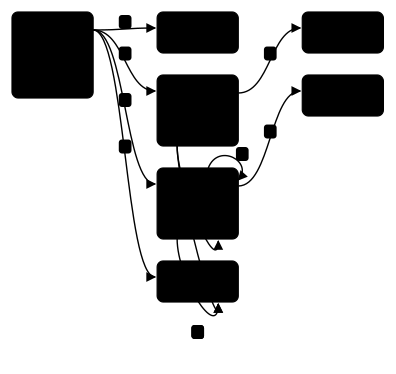
The LR(0) automaton of the expression grammar (12 states). SLR uses the same states.
| State | + | * | ( | ) | id | $ | E | T | F |
|---|---|---|---|---|---|---|---|---|---|
| I0 | s4 | s5 | 1 | 2 | 3 | ||||
| I1 | s6 | acc | |||||||
| I2 | r2 | s7 | r2 | r2 | |||||
| I3 | r4 | r4 | r4 | r4 | |||||
| I4 | s4 | s5 | 8 | 2 | 3 | ||||
| I5 | r6 | r6 | r6 | r6 | |||||
| I6 | s4 | s5 | 9 | 3 | |||||
| I7 | s4 | s5 | 10 | ||||||
| I8 | s6 | s11 | |||||||
| I9 | r1 | s7 | r1 | r1 | |||||
| I10 | r3 | r3 | r3 | r3 | |||||
| I11 | r5 | r5 | r5 | r5 |
SLR(1) table: reductions only under FOLLOW. FOLLOW(E) = { ), +, $ }, FOLLOW(T) = { ), *, +, $ }, FOLLOW(F) = { ), *, +, $ }.
5 · Worked Examples
Example 1 Easy
How does SLR resolve state I2 = { E → T•, T → T•*F } of the expression grammar?
Solution
Shift on * (from T → T•*F). Reduce E → T only on FOLLOW(E) = { ), +, $ }. Since * ∉ FOLLOW(E), the clash disappears: Kabir waits when * comes, folds when +, ) or $ comes.
Example 2 Medium
Parse id * id + id with the SLR table.
Solution
| Stack | Input | Action |
|---|---|---|
0 | id * id + id $ | shift 5 |
0 id 5 | * id + id $ | reduce F → id |
0 F 3 | * id + id $ | reduce T → F |
0 T 2 | * id + id $ | shift 7 |
0 T 2 * 7 | id + id $ | shift 5 |
0 T 2 * 7 id 5 | + id $ | reduce F → id |
0 T 2 * 7 F 10 | + id $ | reduce T → T * F |
0 T 2 | + id $ | reduce E → T |
0 E 1 | + id $ | shift 6 |
0 E 1 + 6 | id $ | shift 5 |
0 E 1 + 6 id 5 | $ | reduce F → id |
0 E 1 + 6 F 3 | $ | reduce T → F |
0 E 1 + 6 T 9 | $ | reduce E → E + T |
0 E 1 | $ | accept |
14 rows: 5 shifts (one per token), 8 reduces (one per interior node), 1 accept.
Example 3 GATE
Show that S → L = R | R, L → * R | id, R → L is not SLR(1).
Solution
State I2 = GOTO(I0, L) = { S → L • = R, R → L • }. Shift on = from S → L•=R; reduce R → L on FOLLOW(R) = { =, $ }. Since = ∈ FOLLOW(R): shift/reduce conflict on =. Yet the grammar is unambiguous: in I2 the R can only be a whole statement, which is followed by $, never by =. The follower list is too coarse here.
6 · Shortcuts
⚡
SLR test: for each state with a complete item A → α•: (1) no terminal after a dot in that state may lie in FOLLOW(A); (2) any two complete items must have disjoint FOLLOW sets. Valid when: deciding SLR(1) once the LR(0) states and FOLLOW sets are known.
⚡
States(SLR) = states(LR(0)); only the reduce entries differ. Valid when: questions about table sizes.
7 · GATE Traps
⚠️
- SLR uses the LR(0) items (no lookaheads inside items); only the table is different.
- FOLLOW is grammar-wide, so SLR can report false conflicts (the L = R grammar).
- Every LR(0) grammar is SLR(1), not the other way round.
- Unambiguous does not imply SLR(1).
- An SLR table never has more states than the LR(0) automaton.
8 · Memory Hook
🧠
SLR = LR(0) states + FOLLOW-filtered reduces. “Fold only if the next word may follow.”
9 · Connect the Dots
FOLLOW is too coarse when the right next token depends on how the parser reached a state. The next lesson builds a finer automaton whose items carry their own lookahead.
10 · Self-Test
GATE format. Try every question before opening the vault.
Q1MCQ1 markSLR
In an SLR(1) table, a complete item A → α• in state i produces reduce entries in columns:
- (A) all terminals and $
- (B) FIRST(A)
- (C) FOLLOW(A)
- (D) only $
Q2MCQ2 marksConflicts
For S → L = R | R, L → * R | id, R → L, the SLR(1) table has:
- (A) no conflicts
- (B) a shift/reduce conflict on =
- (C) a reduce/reduce conflict on $
- (D) conflicts in every state
Q3NAT1 markTrace
An SLR parser parses id * id + id with the expression grammar. How many shift moves does it make?
Numerical answer: ________
Q4MSQ2 marksClassification
Which grammars are SLR(1)?
- (A) E → E + T | T, T → T * F | F, F → ( E ) | id
- (B) S → L = R | R, L → * R | id, R → L
- (C) S → x A y | x B z, A → q, B → q
- (D) S → a S | a
Q5MCQ1 markStates
Compared with the LR(0) automaton, the SLR(1) parser for the same grammar has:
- (A) more states
- (B) the same number of states
- (C) fewer states
- (D) twice as many states
11 · Rule Card
- SLR(1) = LR(0) automaton + reduce A → α only on FOLLOW(A).
- S/R conflict: A → α• and B → β•aγ with a ∈ FOLLOW(A).
- R/R conflict: A → α•, B → β• with FOLLOW(A) ∩ FOLLOW(B) ≠ ∅.
- LR(0) ⊂ SLR(1); same number of states.
- Weakness: FOLLOW is global (false conflicts, e.g. L = R).
12 · Concept Ledger
SLR(1)SLR parsing tableFOLLOW-based reduceSLR conflict
13 · Answer Vault
Answer Vault
Try the questions first. Open when you are ready to check.
Warm-up
- A state with a complete item plus another complete item (R/R) or plus an item expecting a terminal (S/R).
- Under every token in FOLLOW(A), including $.
- One per interior node.
Predict First
Yes. S → L = R puts FOLLOW(L) ⊇ {=}, and R → L gives FOLLOW(L) ⊆ FOLLOW(R)… more directly, L → * R puts FOLLOW(L) into FOLLOW(R), and = ∈ FOLLOW(L). So SLR still has a conflict on =. Example 3 shows it.
Self-Test
Q1 Answer: (C)1 mark
SLR reduces only on FOLLOW(A).
- (A) is wrong: That is LR(0).
- (B) is wrong: FIRST describes how A starts, not what follows it.
- (D) is wrong: Too restrictive.
Re-read: Lesson 2.4.3 — SLR(1)
Q2 Answer: (B)2 marks
State { S → L•=R, R → L• } and = ∈ FOLLOW(R) (computed).
- (A) is wrong: The table has one conflict.
- (C) is wrong: The conflict is S/R on =.
- (D) is wrong: Only one state is affected.
Re-read: Lesson 2.4.3 — SLR(1)
Q3 Answer: 51 mark
One shift per token: id, *, id, +, id → 5.
Re-read: Lesson 2.4.3 — SLR(1)
Q4 Answer: (A) (C) (D)2 marks
All computed: (B) has the S/R conflict on =. (C): FOLLOW(A) = {y} and FOLLOW(B) = {z} separate the two complete items. (D): FOLLOW(S) = {$} separates S → a• from shifting a.
Re-read: Lesson 2.4.3 — SLR(1)
Q5 Answer: (B)1 mark
SLR reuses the LR(0) automaton.
- (A) is wrong: SLR builds no new states.
- (C) is wrong: Nothing is merged.
- (D) is wrong: No.
Re-read: Lesson 2.4.3 — SLR(1)