0 · Recall Warm-up
Answer from memory first. Answers are in the Answer Vault at the end of this lesson.
- State the two rules a lexer uses to choose among overlapping patterns. from Lesson 1.2.2
- How many tokens are in
printf("%d", x);? from Lesson 1.1.2 - In the regular expression
a | bc*, which operator binds tightest? from Lesson 0.2.2
1 · The Story
📖
When no card fits
One speech arrives with smudged text: “Aaje dud#h no bhaav”. Mira reaches “#” and no card fits anything starting with “#”. She has two choices.
Skip ahead: throw away characters until she reaches something that some card fits, report one complaint to the Complaints Desk, and carry on. Quick and safe, but a little text is lost.
Repair: try one small fix (delete the “#”, or swap two letters, or insert one) and see whether the word then fits a card. Careful, but it can guess wrong.
Meanwhile Mrs. Desai buys a Word Desk Builder: you feed it Mira’s cards, each with an instruction (“stamp NAME”, “skip”), and it builds the complete flowchart and a working desk clerk automatically, using the same two house rules.
2 · Predict First
🤔
A lexer meets @ in the middle of C code. Should the whole compilation stop at once?
Write your guess down. The answer is in the vault.
3 · Core Concept
Lexical errors
A lexical error occurs when no pattern matches any prefix of the remaining input. Typical cases:
- an illegal character (
@, a stray backtick); - an unterminated string literal or comment;
- an identifier or number that exceeds a length limit;
- in some definitions, a malformed constant.
Many “errors” are not lexical: a misspelled keyword is a valid id; 12.34.5 splits by longest match into 12.34 and .5 or similar, and the trouble is reported by the parser.
Error recovery
- Panic mode: delete characters from the input until a well-formed token can begin. Simple and the most common.
- Local repairs: delete one character, insert one, replace one, or transpose two adjacent characters, then try again.
- Minimum-distance correction: find the fewest such edits that make the input valid. Rarely used: expensive, and the closest valid text is not always what the programmer meant.
Lex and Flex
Lex (and its modern version Flex) is a lexer generator: you describe tokens, it writes the lexer.
%{  C declarations, e.g. #include "tokens.h"  %}
digit   [0-9]
id      [a-z][a-z0-9]*
%%
if              { return IF; }
{id}            { yylval = install_id(); return ID; }
{digit}+        { yylval = atoi(yytext); return NUM; }
[ \t\n]+        { /* skip whitespace */ }
.               { error("illegal character"); }
%%
int install_id() { … }   /* auxiliary functions */
- Three sections separated by
%%: declarations, translation rules (pattern + action), auxiliary functions. - Lex turns all patterns into one NFA, then a DFA, then a C file
lex.yy.ccontainingyylex(). yytextis the matched lexeme,yylengits length,yylvalthe attribute passed to the parser.- Conflicts: longest match first, then the earliest rule. That is why
ifis listed before{id}, and why the catch-all.rule comes last.
The pipeline
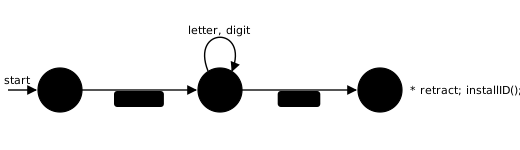
From a specification to a working lexer.
Story → compiler term
| In the story | In the compiler |
|---|---|
| no card fits “#” | lexical error (no pattern matches) |
| throwing away characters until a card fits | panic-mode recovery |
| trying one small fix | local repair (delete, insert, replace, transpose) |
| the Complaints Desk | error handler |
| the Word Desk Builder | Lex / Flex lexer generator |
| cards with instructions | translation rules: pattern { action } |
| the clerk the machine builds | yylex() in lex.yy.c |
4 · Visual
| Input | What happens |
|---|---|
a = b @ c; | lexical error at @; panic mode deletes @ and continues with c |
"hello | unterminated string literal: lexical error |
whlie (x) | not a lexical error: whlie is an id |
/* comment | unterminated comment: lexical error at end of file |
5 · Worked Examples
Example 1 Easy
Classify: (a) x = 5 $ 3; (b) s = "abc; (c) retrun 0;
Solution
(a) Lexical error at $ (in standard C; some compilers allow $ in names). (b) Lexical error: the string literal never closes. (c) Not lexical: retrun is an id; the parser reports it. Mira complains only when no card fits.
Example 2 Medium
A Lex specification has the rules, in order: if → print IF; [a-z]+ → print ID; [0-9]+ → print NUM; [ \t\n]+ → nothing; . → print ?. What is printed for if ifx 42 x9?
Solution
if: IF (ties with [a-z]+ at length 2; the earlier rule wins). ifx: ID (longest match). 42: NUM. x9: [a-z]+ takes only x → ID, then 9 → NUM. Output: IF ID NUM ID NUM, verified by simulating the rules.
Example 3 GATE
With the same specification, what is printed for x@1 if, and which rule recovers from the error?
Solution
x → ID; @ matches only the catch-all . → ?; 1 → NUM; if → IF. Output: ID ? NUM IF. The . rule is a built-in panic mode of length 1: it consumes the bad character and lets the lexer continue, like Mira skipping one smudge.
6 · Shortcuts
⚡
Lex conflict rules = lexer rules: longest match, then earliest rule. Simulate position by position. Valid when: any “what does this Lex program print” question.
⚡
Lexical error only if no pattern matches. If some pattern matches a prefix (even a strange one), the error, if any, belongs to a later phase. Valid when: error-classification questions.
7 · GATE Traps
⚠️
- A misspelled keyword is never a lexical error.
- Lex picks the longest match even if an earlier rule matches a shorter prefix.
- Put the catch-all
.rule last, or it would beat specific single-character rules by priority. - yytext is the lexeme; yylval is the attribute passed to the parser.
- Panic mode loses input; it trades precision for simplicity.
8 · Memory Hook
🧠
Lex = “Longest, Earliest, eXecute”: longest match, earliest rule, run its action.
9 · Connect the Dots
Phase 1 is complete: the lexer turns characters into tokens. Phase 2 opens the Sentence Desk: how to describe which token sequences form valid programs, using a tool more powerful than regular expressions.
10 · Self-Test
GATE format. Try every question before opening the vault.
Q1MCQ1 markLexical error
Which is a lexical error in C?
- (A) a missing semicolon
- (B) an unterminated string literal
- (C) an undeclared variable
- (D) calling a function with too many arguments
Q2MCQ1 markRecovery
Panic-mode recovery in a lexer:
- (A) stops compilation
- (B) deletes input characters until a valid token can start
- (C) rewrites the whole program
- (D) asks the user
Q3MCQ2 marksLex simulation
Rules in order: if → IF; [a-z]+ → ID; [0-9]+ → NUM; blanks skipped; . → ?. Output for iff if9 7a?
- (A) ID IF NUM NUM ID
- (B) IF ID IF NUM NUM ID
- (C) ID ID NUM ID
- (D) IF ID IF NUM ID
Q4MSQ1 markLex
Which are true about Lex?
- (A) It generates C code for a lexical analyzer.
- (B) It resolves conflicts by longest match, then the earliest rule.
- (C) yytext holds the current lexeme.
- (D) It builds a parser for the whole language.
Q5MCQ1 markRepairs
Which is not one of the single-character local repairs?
- (A) delete one character
- (B) insert one character
- (C) transpose two adjacent characters
- (D) reverse the whole line
11 · Rule Card
- Lexical error: no pattern matches a prefix of the remaining input (illegal char, unterminated string/comment, over-long name).
- Recovery: panic mode (delete until a token can start); local repairs (delete, insert, replace, transpose); minimum-distance (rare).
- Lex file: declarations %% rules (pattern {action}) %% functions.
- lex.l → Lex → lex.yy.c → C compiler → lexer; yylex(), yytext, yyleng, yylval.
- Conflicts: longest match, then earliest rule; catch-all . last.
12 · Concept Ledger
lexical errorpanic-mode recoverylocal repairminimum-distance correctionLex / Flexlexer generatortranslation rule (pattern { action })lex.yy.cyylex()yytext / yyleng / yylval
13 · Answer Vault
Answer Vault
Try the questions first. Open when you are ready to check.
Warm-up
- Longest match first; then priority (the earlier pattern, keywords before id).
- 7: printf · ( · "%d" · , · x · ) · ;
- The star: it reads a | (b(c*)).
Predict First
No. The lexer reports the error and recovers (for example by deleting characters until a valid token can start), so that the compiler can go on and find more errors in one run.
Self-Test
Q1 Answer: (B)1 mark
No pattern can match a string literal that never closes.
- (A) is wrong: Syntax.
- (C) is wrong: Semantic.
- (D) is wrong: Semantic.
Re-read: Lesson 1.3 — Lexical errors and recovery; how a lexer generator (Lex/Flex) is structured
Q2 Answer: (B)1 mark
It skips characters and continues.
- (A) is wrong: Recovery exists to avoid stopping.
- (C) is wrong: Far too drastic.
- (D) is wrong: Compilers do not stop to ask.
Re-read: Lesson 1.3 — Lexical errors and recovery; how a lexer generator (Lex/Flex) is structured
Q3 Answer: (A)2 marks
iff: ID (longest); if9: IF then NUM; 7a: NUM then ID. Verified: ID(iff) IF(if) NUM(9) NUM(7) ID(a).
- (B) is wrong: iff is one ID by longest match.
- (C) is wrong: if9 splits into IF and NUM.
- (D) is wrong: iff is one ID, and 7a is NUM then ID.
Re-read: Lesson 1.3 — Lexical errors and recovery; how a lexer generator (Lex/Flex) is structured
Q4 Answer: (A) (B) (C)1 mark
Lex builds lexers; parsers are generated by other tools.
Re-read: Lesson 1.3 — Lexical errors and recovery; how a lexer generator (Lex/Flex) is structured
Q5 Answer: (D)1 mark
Local repairs change one character (or swap two neighbours).
- (A) is wrong: A standard repair.
- (B) is wrong: A standard repair.
- (C) is wrong: A standard repair.
Re-read: Lesson 1.3 — Lexical errors and recovery; how a lexer generator (Lex/Flex) is structured