0 · Recall Warm-up
Answer from memory first. Answers are in the Answer Vault at the end of this lesson.
- How many tokens are in
x+++y, and why? from Lesson 1.1.2 - Give the postorder of a tree with root R and children A and B (in that order). from Lesson 0.2.4
- Which phase reports an illegal character such as @? from Lesson 0.1.3
1 · The Story
📖
Cards for every kind of word
Mira moves to a new project: speeches about software, full of C words. She writes one card per kind of word, building cards from smaller cards so that nothing is written twice.
First the small cards: digit (0 to 9), letter (A to Z, a to z, and the underscore). Then name: a letter, then letters or digits. Then number: digits, optionally a dot and more digits, optionally an exponent part. One card for the comparison marks, one for blanks.
Her assistant Asha notices a problem: the word while fits the name card and also the keyword card. “Both cards fit. Which stamp do I use?” Mira writes a note on the catalogue: check the order of the cards. That note becomes the next lesson.
2 · Predict First
🤔
Is 1.E5 a number under the definition “digits, optionally (. digits), optionally (E [+−]? digits)”?
Write your guess down. The answer is in the vault.
3 · Core Concept
From kinds of words to regular definitions
Each token name gets one pattern, written as a regular definition (Primer 0.2.2). Smaller names are defined first and reused:
digit    → [0-9]
digits   → digit+
letter   → [A-Za-z_]
id       → letter ( letter | digit )*
number   → digits ( . digits )? ( E [+-]? digits )?
relop    → <  |  <=  |  ==  |  !=  |  >  |  >=
if       → if        else → else        while → while
ws       → ( blank | tab | newline )+
From pattern to token
| Lexemes | Token name | Attribute |
|---|---|---|
| any ws | — (no token) | — |
if | if | — |
while | while | — |
| any id | id | pointer to symbol table entry |
| any number | number | its value |
< | relop | LT |
<= | relop | LE |
== | relop | EQ |
!= | relop | NE |
> | relop | GT |
>= | relop | GE |
More C patterns
hex       → 0 [xX] [0-9a-fA-F]+
char      → ' ( [^'\\] | \\ . ) '
string    → " ( [^"\\\n] | \\ . )* "
comment   → // [^\n]*    |    /* ( anything not containing */ ) */
The string pattern reads: a quote, then any number of either ordinary characters (not a quote, backslash or newline) or a backslash followed by any character (escapes like \n, \"), then a closing quote.
When patterns overlap
Patterns are written independently, so they overlap: while matches both while and id; <= starts like <. A list of patterns alone does not say which token to produce. The lexer needs two extra rules, longest match and priority, taught next.
Story → compiler term
| In the story | In the compiler |
|---|---|
| a card per kind of word | a pattern per token name |
| small cards reused by bigger cards | regular definitions (digit, letter, then id) |
| the name card | id → letter (letter |
| the number card | number → digits (. digits)? (E [+-]? digits)? |
| while fits two cards | overlapping patterns (keyword vs id) |
| “check the order of the cards” | priority rule (next lesson) |
4 · Visual
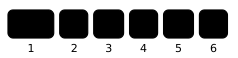
The number pattern as three parts; only the first is required.
| Lexeme | number? | Why |
|---|---|---|
| 12 | ✔ | digits only |
| 3.14 | ✔ | fraction present |
| 6.02E23 | ✔ | fraction and exponent |
| 2e-3 | ✔ | exponent with sign (lower-case e shown for C; the card uses E) |
| 1.E5 | ✘ | a dot needs digits after it |
| .5 | ✘ | must start with digits |
Checked against the regular expression by running it.
5 · Worked Examples
Example 1 Easy
Which of 12, 3.14, 6.02E23, 1.E5, .5 match number?
Solution
12, 3.14 and 6.02E23 match. 1.E5 fails (no digit after the dot) and .5 fails (no leading digits). Mira’s number card is strict about digits on both sides of the dot.
Example 2 Medium
Write a pattern for C hexadecimal constants such as 0x1F and 0XabC.
Solution
0 [xX] [0-9a-fA-F]+. It accepts 0x1F and 0XabC and rejects 0X (no digits) and 0xg1 (g is not a hex digit). Checked by running the expression.
Example 3 GATE
Which of _tmp9, 9lives, max_val, a-b, int match the id pattern [A-Za-z_][A-Za-z0-9_]*? Which of the matching ones still does not become an id token?
Solution
_tmp9, max_val and int match the pattern. 9lives starts with a digit; a-b contains a minus (it is three tokens). int matches the id pattern but becomes the keyword token int, the overlap Asha found, resolved by priority in the next lesson.
6 · Shortcuts
⚡
Test a lexeme against a pattern from left to right, ticking off each required part; optional parts (?) can be skipped, starred parts can repeat or vanish. Valid when: membership questions on number, id, string patterns.
⚡
Keywords match id. Whenever an id pattern is given, check whether the lexeme is reserved. Valid when: questions mixing keywords and identifiers.
7 · GATE Traps
⚠️
digitsmeans digit+ (at least one).- Under the textbook number pattern, 1.E5 and .5 are not numbers, even though real C accepts them; follow the definition in the question.
- The id pattern also matches keywords; the pattern alone does not decide the token.
- Escapes inside a string (") do not end the string.
8 · Memory Hook
🧠
Small cards build big cards: digit → digits → number; letter → id.
9 · Connect the Dots
Patterns describe each token kind, but they overlap and can be matched in several lengths. The next lesson draws a pattern as a flowchart of states and adds the two rules that make the lexer’s choice unique: longest match and priority.
10 · Self-Test
GATE format. Try every question before opening the vault.
Q1MSQ1 markPatterns
Which lexemes match [A-Za-z_][A-Za-z0-9_]*?
- (A) _tmp9
- (B) 9lives
- (C) max_val
- (D) a-b
Q2MCQ1 markNumber pattern
Under digits (. digits)? (E [+-]? digits)?, which lexeme is a number?
- (A) 1.E5
- (B) .5
- (C) 6.02E23
- (D) E5
Q3MCQ1 markHex
Which pattern describes C hexadecimal constants?
- (A) [0-9a-f]+
- (B) 0[xX][0-9a-fA-F]+
- (C) 0x[0-9]+
- (D) [xX][0-9a-fA-F]*
Q4MCQ1 markOverlap
The lexeme while matches the id pattern. In a C lexer it becomes:
- (A) an id token
- (B) the keyword token while
- (C) two tokens wh and ile
- (D) a lexical error
Q5MSQ2 marksString pattern
Given string → " ( [^"\\\n] | \\. )* ", which lexemes are complete string literals?
- (A) "abc"
- (B) "a"b"
- (C) "x
- (D) ""
11 · Rule Card
- digit → [0-9]; digits → digit+; letter → [A-Za-z_].
- id → letter (letter | digit)*.
- number → digits (. digits)? (E [+-]? digits)?.
- relop → | = | == | != | > | >=.
- ws → (blank | tab | newline)+ gives no token.
- Patterns overlap (keywords match id): resolve by rules, not by the patterns.
12 · Concept Ledger
regular definition for tokensdigit / digits / letterid patternnumber patternrelopwshex patternstring patternoverlapping patterns
13 · Answer Vault
Answer Vault
Try the questions first. Open when you are ready to check.
Warm-up
- 4: x, ++, +, y, by longest match from the left.
- A B R: children first, then the node.
- The lexical analyzer.
Predict First
No. After the dot the definition requires at least one digit, so 1. must be followed by a digit. 1.0E5 and 1E5 are numbers; 1.E5 and .5 are not, under this definition (real C accepts both; the exam follows the definition it gives).
Self-Test
Q1 Answer: (A) (C)1 mark
9lives starts with a digit; a-b contains a minus.
Re-read: Lesson 1.2.1 — Writing token definitions as regular expressions
Q2 Answer: (C)1 mark
6.02E23 has digits, a fraction and an exponent.
- (A) is wrong: A dot must be followed by digits.
- (B) is wrong: It must begin with digits.
- (D) is wrong: It must begin with digits.
Re-read: Lesson 1.2.1 — Writing token definitions as regular expressions
Q3 Answer: (B)1 mark
A leading 0, an x or X, then at least one hex digit.
- (A) is wrong: Misses the 0x prefix.
- (C) is wrong: Misses A–F and capital X.
- (D) is wrong: Misses the leading 0 and allows no digits.
Re-read: Lesson 1.2.1 — Writing token definitions as regular expressions
Q4 Answer: (B)1 mark
Keywords are reserved; the overlap is resolved in favour of the keyword.
- (A) is wrong: Keywords cannot be used as names in C.
- (C) is wrong: Longest match takes the whole word.
- (D) is wrong: It is a perfectly valid lexeme.
Re-read: Lesson 1.2.1 — Writing token definitions as regular expressions
Q5 Answer: (A) (B) (D)2 marks
"x is not closed. "a"b" is fine: " is an escape. "" is the empty string literal.
Re-read: Lesson 1.2.1 — Writing token definitions as regular expressions