0 · Recall Warm-up
Answer from memory first. Answers are in the Answer Vault at the end of this lesson.
- Is liveness a forward or a backward problem, and what is its meet? from Lesson 6.4
- What are gen[B] and kill[B] for reaching definitions? from Lesson 6.2
- How does the block DAG find a local common subexpression? from Lesson 4.1
1 · The Story
📖
Already worked out?
Inside one chapter, Ishaan already reuses repeated phrases. Across chapters it is harder. Chapter 3 says “sales plus tax”. Was that total already worked out earlier on every route into chapter 3, with sales and tax unchanged since? If yes, chapter 3 can reuse it. If even one route reaches chapter 3 without computing it, or after changing sales, it must be worked out again.
So this time, where routes join, a total counts only if it is known on all of them.
2 · Predict First
🤔
B1 computes b + c and a − e and branches to B2 and B3. B2 computes b + c again and then changes b; B3 does nothing to b, c, a, e. Both go to B4, which computes b + c. Is b + c available at B4? Write your guess down. The answer is in the vault.
3 · Core Concept
Available expressions
An expression x op y is available at point p if every path from the entry to p evaluates x op y, and after the last such evaluation on each path, neither x nor y is redefined. If x op y is available at a use, that use can reuse the earlier result instead of recomputing it.
gen and kill
- e_gen[B]: expressions computed in B whose operands are not redefined later in B.
- e_kill[B]: all expressions in the program that use a variable defined in B (and are not regenerated after that definition in B).
Example: in the block e = b + c; b = d * 2, the expression b + c is computed, but b is then redefined, so b + c is killed, not generated.
Equations (forward, intersection)
OUT[B] = e_gen[B] ∪ (IN[B] − e_kill[B])
IN[B]  = ∩ over predecessors P of OUT[P]
IN[ENTRY block] = ∅; all other OUT start as the universal set U of expressions
Intersection, because the expression must have been computed on all paths. Starting with U lets the intersection shrink to the largest correct answer.
Eliminating global common subexpressions
For a statement z = x op y in B where x op y is available at that point: find the evaluations of x op y that reach it (going backwards along all paths), store their result in a new temporary t (t = x op y; w = t), and replace the statement by z = t. Copy propagation can then clean up.
Local vs global
Local CSE (block DAG, Lesson 6.1) handles repeats inside one block; available expressions extend it across blocks, including around loops.
Story → compiler term
| In the story | In the compiler |
|---|---|
| a total worked out earlier on every route | an available expression |
| sales or tax changed since | operand redefined: expression killed |
| “on all routes” | meet = intersection |
| reusing the earlier total | global common-subexpression elimination |
4 · Visual
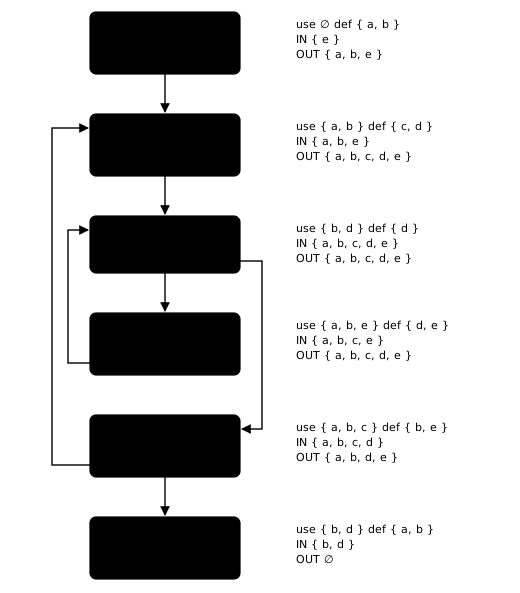
Available expressions, computed. At B3 both b + c and a − e are available; at B4 nothing is, because the path through B2 kills both.
5 · Worked Examples
Example 1 Easy
Compute e_gen and e_kill for each block above.
Solution
B1 (a = b + c; d = a − e): gen = { b + c, a − e } (a is redefined by the first statement before a − e is computed, so a − e survives). B2 (e = b + c; b = d * 2): gen = { d * 2 }; it defines e and b, so it kills a − e and b + c. B3 (f = b + c; g = a − e): gen = { b + c, a − e }, kills nothing. B4: gen = { b + c }.
Example 2 Medium
Which expressions are available at the start of B3 and B4, and what can be eliminated?
Solution
IN[B3] = OUT[B1] = { a - e, b + c }: both f = b + c and g = a − e in B3 can reuse B1’s results (store them in temporaries in B1: t1 = b + c; a = t1; t2 = a − e; d = t2; then f = t1; g = t2). IN[B4] = OUT[B2] ∩ OUT[B3] = ∅: h = b + c must be recomputed.
Example 3 GATE
B1: p = a * b, q = a + c; B2: r = a * b; B3: c = 7, s = a * b; B2 and B3 both go to B4: t = a * b, w = a + c. Which of B4’s expressions can be eliminated?
Solution
a * b: computed on both paths with a, b unchanged → available at B4: IN[B4] = { a * b }, so t = a * b reuses it. a + c: killed in B3 (c = 7), so w = a + c must be recomputed.
6 · Shortcuts
⚡
Available at B ⇔ computed on every incoming path and not killed afterwards. Check each path separately, then intersect. Valid when: small flow graphs in exam questions.
⚡
Kill = assignment to any operand after (or without) the computation in the block. Valid when: computing e_kill quickly.
7 · GATE Traps
⚠️
- Meet is intersection: one path without the expression makes it unavailable.
- Non-entry blocks start with OUT = U, not ∅ (otherwise loops lose everything).
- An expression computed and then having an operand redefined in the same block is killed, not generated.
- Available expressions look backward in time but the analysis runs forward.
- Global CSE needs a temporary to carry the value to the later use.
8 · Memory Hook
🧠
Available = computed on all roads, untouched since. Forward, intersect.
9 · Connect the Dots
The last lesson of the phase looks at loops, where a program spends most of its time: moving work that does not change out of the loop, and simplifying variables that step by a fixed amount.
10 · Self-Test
GATE format. Try every question before opening the vault.
Q1MCQ1 markMeet
Available-expressions analysis uses which meet?
- (A) union
- (B) intersection
- (C) difference
- (D) none
Q2MCQ1 markKill
In the block x = y + z; y = 4, the expression y + z is:
- (A) generated
- (B) killed
- (C) both generated and available at the end
- (D) unaffected
Q3MCQ2 marksAvailability
B1: t = x * y → B2 (self-loop): u = x * y, x = 1 → B3: v = x * y (edges B1→B2, B2→B2, B2→B3). Is x * y available at the start of B2?
- (A) yes
- (B) no, because the back edge brings OUT[B2], where x * y is killed
- (C) only on the first iteration
- (D) yes, because B1 computes it
Q4NAT1 markCount
In the B1–B4 graph of the GATE example (p = a * b, q = a + c; …; c = 7 in B3), how many expressions are available at the start of B4?
Numerical answer: ________
Q5MSQ1 markFacts
Which are true?
- (A) Available expressions is a forward problem.
- (B) Non-entry OUT sets start as the universal set.
- (C) It enables global common-subexpression elimination.
- (D) It is a backward may problem.
11 · Rule Card
- x op y available at p: computed on every path to p, operands unchanged since.
- e_gen: computed in B, operands not redefined later in B. e_kill: expressions using a variable B defines.
- Forward, ∩: IN = ∩ OUT[preds]; OUT = e_gen ∪ (IN − e_kill); IN[entry] = ∅; other OUT start = U.
- Global CSE: save earlier results in a temporary; replace the later computation by a copy.
12 · Concept Ledger
available expressione_gen / e_killuniversal set Uglobal common-subexpression elimination
13 · Answer Vault
Answer Vault
Try the questions first. Open when you are ready to check.
Warm-up
- Backward, union.
- gen: last definitions in B; kill: all other definitions of the variables B defines.
- Value numbering: a node with the same operator and the same operand nodes already exists.
Predict First
No. On the path through B2, b changed after b + c was computed, so b + c is not available at B4: IN[B4] = ∅. It is available at B3.
Self-Test
Q1 Answer: (B)1 mark
The expression must be available on all paths.
- (A) is wrong: That would be “some path”.
- (C) is wrong: Not a meet.
- (D) is wrong: Joins need a meet.
Re-read: Lesson 6.5 — Global common-subexpression elimination via available expressions
Q2 Answer: (B)1 mark
y is redefined after the computation.
- (A) is wrong: It does not survive to the end.
- (C) is wrong: Not available at the end.
- (D) is wrong: It is affected.
Re-read: Lesson 6.5 — Global common-subexpression elimination via available expressions
Q3 Answer: (B)2 marks
IN[B2] = OUT[B1] ∩ OUT[B2] = ∅ (computed).
- (A) is wrong: The loop path kills it.
- (C) is wrong: The analysis covers all paths.
- (D) is wrong: Not on the back edge.
Re-read: Lesson 6.5 — Global common-subexpression elimination via available expressions
Q4 Answer: 11 mark
Only a * b: 1.
Re-read: Lesson 6.5 — Global common-subexpression elimination via available expressions
Q5 Answer: (A) (B) (C)1 mark
It is a forward must problem.
Re-read: Lesson 6.5 — Global common-subexpression elimination via available expressions