0 · Recall Warm-up
Answer from memory first. Answers are in the Answer Vault at the bottom.
- Prim's key[v] holds? from Lesson 6.2.3
- BFS solves shortest paths when? from Lesson 6.1.1
- Binary heap insert and extract cost? from Lesson 0.2.2
1 · The Hook
🎣
Maps apps need the cheapest route when roads have different lengths, so BFS (which counts edges) is not enough. Dijkstra's algorithm is Prim with one change: a vertex's key is the length of the best known path from the source, not of one edge. It is the most asked graph algorithm in GATE.
2 · Predict First
🤔
Six towns, road lengths as given. What is the shortest distance from A to D?
Make a guess in your head. The answer opens Section 3.
3 · Core Concept
💡
Predict First — the answer
A–C–B–D = 2 + 1 + 5 = 8 (A–B–D is 9, A–C–D is 10).
Relaxation
dist[v] is the best path length known so far (∞ at the start, 0 for the source).
RELAX(u, v): if dist[u] + w(u, v) < dist[v]:
                 dist[v] = dist[u] + w(u, v); parent[v] = u
Every single-source shortest-path algorithm is relaxation in some order.
Dijkstra (non-negative weights only)
dist[s] = 0; all others ∞
repeat V times:
    u = the unfinished vertex with the smallest dist     // finalise it
    for each edge u → v: RELAX(u, v)
Once a vertex is finalised its distance never changes: any other route would pass through an unfinished vertex that is already at least as far, and with non-negative weights the rest of that route cannot make it cheaper.
Six-town trace from A
| Finalise | dist A | B | C | D | E | F |
|---|---|---|---|---|---|---|
| start | 0 | ∞ | ∞ | ∞ | ∞ | ∞ |
| A (0) | · | 4 | 2 | ∞ | ∞ | ∞ |
| C (2) | · | 3 | · | 10 | 12 | ∞ |
| B (3) | · | · | · | 8 | 12 | ∞ |
| D (8) | · | · | · | · | 10 | 14 |
| E (10) | · | · | · | · | · | 13 |
| F (13) | · | · | · | · | · | · |
Order A, C, B, D, E, F; distances B 3, C 2, D 8, E 10, F 13.
Why negative edges break it
Directed: A → B 2, A → C 3, C → B −2, B → D 1. Dijkstra finalises B at 2 and sets D = 3 through B. When C (3) is finalised, the edge C → B (−2) comes too late: B is already finished, so the saving never reaches D. Dijkstra reports dist[D] = 3, but A → C → B → D costs 2.
Cost
| Priority structure | Time |
|---|---|
| Array | Θ(V²) |
| Binary heap | O((V + E) log V) |
| Fibonacci heap (named only) | O(E + V log V) |
4 · Visual
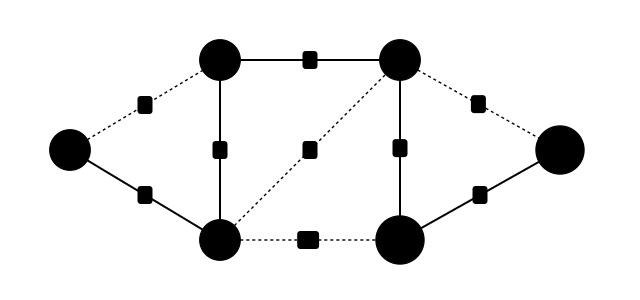
Dijkstra from A: final distances inside the nodes, shortest-path tree in red. Here it happens to equal the MST; in general it does not.
5 · Worked Examples
Example 1 Easy
Dijkstra from C on the six-town graph: distance to F?
Solution
C–B–D–E–F = 1 + 5 + 2 + 3 = 11.
Example 2 Medium
Dijkstra from D on the six-town graph (ties by name): order of finalisation?
Solution
D 0; E 2; B 5 and F 5 (B first by name); C 6; A 8: D, E, B, F, C, A.
Example 3 GATE
Dijkstra with a binary heap on a graph with V = 1,000 and E = 5,000: order of the running time?
Solution
O((V + E) log V) ≈ 6,000 × 10 = about 60,000 basic steps.
6 · GATE Traps
⚠️
- Dijkstra needs non-negative weights; a negative edge can give wrong answers even with no negative cycle.
- Finalised in non-decreasing order of distance.
- Prim's key = one edge; Dijkstra's key = whole path.
- Shortest-path tree ≠ MST in general.
7 · Memory Hook
🧠
"Take the closest unfinished vertex; relax its edges."
8 · Connect the Dots
Dijkstra fails with negative edges. The next lesson's Bellman–Ford handles them (and detects negative cycles) by relaxing every edge V − 1 times; on a DAG one pass in topological order is enough.
9 · Self-Test
GATE format. Try every question before opening the vault.
Q1NAT1 markDijkstra
Dijkstra from A on the six-town graph: distance to F?
Numerical answer: ________
Q2NAT2 marksDijkstra
Dijkstra from F on the six-town graph: distance to C?
Numerical answer: ________
Q3MCQ1 markOrder
Dijkstra from A on the six-town graph finalises vertices in which order?
- (A) A, B, C, D, E, F
- (B) A, C, B, E, D, F
- (C) A, C, B, D, E, F
- (D) A, C, D, B, E, F
Q4NAT2 marksNegative edge
Directed graph A → B 2, A → C 3, C → B −2, B → D 1. What distance does Dijkstra from A report for D?
Numerical answer: ________
Q5MCQ1 markCost
Dijkstra with a binary heap and adjacency lists runs in:
- (A) O(VE)
- (B) O(V + E)
- (C) O(V³)
- (D) O((V + E) log V)
10 · Rule Card
- Relax: dist[v] = min(dist[v], dist[u] + w).
- Dijkstra: finalise the closest unfinished vertex; non-negative weights only.
- Θ(V²) array; O((V + E) log V) binary heap; O(E + V log V) Fibonacci heap.
- Shortest-path tree ≠ MST in general.
11 · Concept Ledger
Unlocked in this lesson. From here on, these terms may be used.
relaxationDijkstra's algorithmfinalised verticesnon-negative weight requirementDijkstra cost by priority structureshortest-path tree
12 · Answer Vault
Answer Vault
Try the questions first. Open when you are ready to check.
Recall Warm-up
- The cheapest single edge from the tree to v.
- Every edge has the same weight (unweighted).
- O(log n) each.
Self-Test
Q1 Answer: 131 mark
A–C–B–D–E–F.
Re-read: Lesson 6.3.1 — Relaxation and Dijkstra's algorithm
Q2 Answer: 112 marks
F–E–D–B–C = 3 + 2 + 5 + 1.
Re-read: Lesson 6.3.1 — Relaxation and Dijkstra's algorithm
Q3 Answer: (C)1 mark
Distances 0, 2, 3, 8, 10, 13.
- (A) is wrong: C (2) is closer than B (3).
- (B) is wrong: D (8) before E (10).
- (D) is wrong: B (3) before D (8).
Re-read: Lesson 6.3.1 — Relaxation and Dijkstra's algorithm
Q4 Answer: 32 marks
D is finalised before the cheaper route is found; the true distance is 2.
Re-read: Lesson 6.3.1 — Relaxation and Dijkstra's algorithm
Q5 Answer: (D)1 mark
Each relaxation may be a heap operation.
- (A) is wrong: That is Bellman–Ford.
- (B) is wrong: That is BFS.
- (C) is wrong: That is Floyd–Warshall.
Re-read: Lesson 6.3.1 — Relaxation and Dijkstra's algorithm