0 · Recall Warm-up
Answer from memory first. Answers are in the Answer Vault at the bottom.
- BFS uses which data structure? from Lesson 6.1.1
- Stack order? from Lesson 0.2.1
- Number of edges of a tree on n vertices? from Lesson 0.2.3
1 · The Hook
🎣
Solving a maze, you walk down one corridor as far as it goes and back up only at a dead end. That is depth-first search (DFS). Recording when each vertex is first reached and when it is finished turns DFS into a tool that detects cycles, sorts tasks and finds components, which is why GATE asks for discovery and finish times and edge types.
2 · Predict First
🤔
DFS from A on the six-town graph, always going to the alphabetically first unvisited neighbour. In what order are the towns discovered?
Make a guess in your head. The answer opens Section 3.
3 · Core Concept
💡
Predict First — the answer
A → B (first neighbour of A) → C (B's first unvisited) → D (C's first unvisited) → E → F: A, B, C, D, E, F, a single long path.
The algorithm (with times)
DFS(G):
    for each vertex u (alphabetical): if u is white: VISIT(u)
VISIT(u):
    time = time + 1; d[u] = time; colour u grey      // discovered
    for each neighbour v of u (alphabetical):
        if v is white: parent[v] = u; VISIT(v)
    time = time + 1; f[u] = time; colour u black     // finished
White = not yet discovered, grey = discovered but not finished (on the recursion stack), black = finished. Times run 1 … 2V. Cost Θ(V + E) with lists.
Parenthesis theorem
For any two vertices, the intervals [d, f] are either nested or disjoint. v is a descendant of u in the DFS forest exactly when d[u] < d[v] < f[v] < f[u].
Edge classification (directed graph), edge u → v when explored
| Type | v's colour when the edge is explored | Times |
|---|---|---|
| Tree | white | v becomes u's child |
| Back | grey (an ancestor, or u itself) | d[v] ≤ d[u] < f[u] ≤ f[v] |
| Forward | black, a descendant | d[u] < d[v] |
| Cross | black, not a descendant | d[v] < d[u] |
- A directed graph has a cycle exactly when DFS finds a back edge.
- In an undirected graph DFS produces only tree and back edges.
Worked example (directed graph below, alphabetical order)
u: 1/8, v: 2/7, y: 3/6, x: 4/5, w: 9/12, z: 10/11. Tree: u→v, v→y, y→x, w→z. Back: x→v, z→z (self-loop). Forward: u→x. Cross: w→y.
4 · Visual
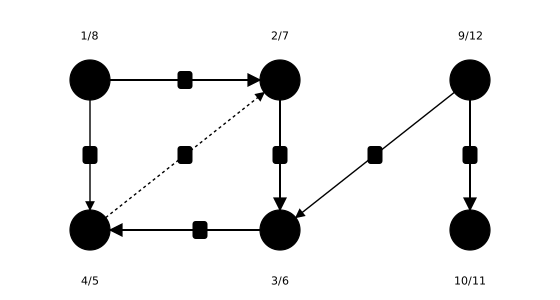
DFS of a directed graph with d/f times. T tree (red), B back (dashed), F forward, C cross. z also has a self-loop z→z, a back edge (not drawn).
5 · Worked Examples
Example 1 Easy
In the six-town DFS from A, what are d[C] and f[C]?
Solution
Discovery order A, B, C, D, E, F gives d = 1 … 6; F finishes at 7, E 8, D 9, C 10: d[C] = 3, f[C] = 10.
Example 2 Medium
In the six-town DFS, how many back edges are there?
Solution
Tree edges A–B, B–C, C–D, D–E, E–F (5 of the 9); the other 4 (A–C, B–D, C–E, D–F) are back edges.
Example 3 GATE
In a DFS of a directed graph, d[p] = 3, f[p] = 10, d[q] = 5, f[q] = 8. Edge p → q is not a tree edge. Its type?
Solution
3 < 5 < 8 < 10: q is a descendant of p, so p → q is a forward edge.
6 · GATE Traps
⚠️
- d and f together use times 1 … 2V; each vertex gets two stamps.
- Back edge ⇔ cycle (directed). A self-loop counts as a back edge.
- Undirected graphs: only tree and back edges, never forward or cross.
- Cross edges go from a later-discovered vertex to an earlier finished one (d[v] < d[u]).
7 · Memory Hook
🧠
"Grey means on the stack: an edge to grey closes a cycle."
8 · Connect the Dots
DFS times are not just bookkeeping. The next lesson sorts a DAG by finish time, detects cycles, and counts connected and strongly connected components.
9 · Self-Test
GATE format. Try every question before opening the vault.
Q1NAT1 markFinish time
In the lesson's directed DFS, what is f[v]?
Numerical answer: ________
Q2NAT1 markBack edges
In the lesson's directed DFS, how many back edges are there (count the self-loop)?
Numerical answer: ________
Q3MCQ1 markCycle test
A directed graph contains a cycle exactly when its DFS finds:
- (A) a forward edge
- (B) a tree edge
- (C) a back edge
- (D) a cross edge
Q4NAT2 marksTimes
In the six-town DFS from A (alphabetical), what is f[A]?
Numerical answer: ________
Q5MSQ2 marksUndirected DFS
In a DFS of an undirected graph, which edge types can occur?
- (A) Tree
- (B) Cross
- (C) Back
- (D) Forward
10 · Rule Card
- DFS: d[u] on discovery, f[u] on finish; times 1 … 2V; Θ(V + E).
- Parenthesis: intervals nested or disjoint; descendant ⇔ d[u] < d[v] < f[v] < f[u].
- Tree (white), back (grey), forward (black descendant), cross (black, d[v] < d[u]).
- Directed cycle ⇔ back edge. Undirected: only tree and back.
11 · Concept Ledger
Unlocked in this lesson. From here on, these terms may be used.
depth-first searchdiscovery time dfinish time fwhite, grey, blackparenthesis theoremtree, back, forward and cross edgescycle iff back edge
12 · Answer Vault
Answer Vault
Try the questions first. Open when you are ready to check.
Recall Warm-up
- A queue.
- Last in, first out (LIFO).
- n − 1.
Self-Test
Q1 Answer: 71 mark
v: 2/7.
Re-read: Lesson 6.1.2 — Depth-first search: discovery and finish times, edge classification
Q2 Answer: 21 mark
x → v and z → z.
Re-read: Lesson 6.1.2 — Depth-first search: discovery and finish times, edge classification
Q3 Answer: (C)1 mark
A back edge returns to a vertex still on the stack.
- (A) is wrong: Forward edges exist in DAGs.
- (B) is wrong: Every DFS has tree edges.
- (D) is wrong: Cross edges exist in DAGs.
Re-read: Lesson 6.1.2 — Depth-first search: discovery and finish times, edge classification
Q4 Answer: 122 marks
2V = 12: the start vertex finishes last.
Re-read: Lesson 6.1.2 — Depth-first search: discovery and finish times, edge classification
Q5 Answer: (A) (C)2 marks
Every non-tree edge joins a vertex to an ancestor.
- (B) is wrong: The other end would have been explored earlier.
- (D) is wrong: Such an edge was already met from the descendant's side, as a back edge.
Re-read: Lesson 6.1.2 — Depth-first search: discovery and finish times, edge classification