0 · Recall Warm-up
Answer from memory first. Answers are in the Answer Vault at the bottom.
- Children of node i in a 1-based heap? from Lesson 0.2.2
- Cost to search an unsorted array? from Lesson 0.2.1
- How many times can you halve n before reaching 1? from Lesson 0.1.2
1 · The Hook
🎣
Road maps, task schedules, social networks and the web are all graphs: dots joined by lines. Phase 6 runs BFS, DFS, MST and shortest-path algorithms on them, and their costs are always written in terms of V (vertices) and E (edges). This lesson sets the vocabulary and the two storage formats.
2 · Predict First
🤔
An undirected graph has 6 vertices with degrees 2, 3, 4, 4, 3, 2. How many edges does it have?
Make a guess in your head. The answer opens Section 3.
3 · Core Concept
💡
Predict First — the answer
Each edge adds 1 to the degree of both its ends, so the degrees add up to twice the edges: (2 + 3 + 4 + 4 + 3 + 2) / 2 = 18 / 2 = 9 edges.
Vocabulary
- Graph G = (V, E): a set of vertices and a set of edges. |V| = n (or V), |E| = m (or E).
- Undirected edge {u, v} vs directed edge (u → v). Weighted: each edge has a number (length, cost).
- Degree of a vertex: number of edges at it. Directed: in-degree and out-degree.
- Handshake lemma: Σ degrees = 2|E| (undirected). Directed: Σ in-degrees = Σ out-degrees = |E|.
- Path: a sequence of vertices joined by edges; cycle: a path that returns to its start.
- Connected (undirected): a path between every pair. Strongly connected (directed): a directed path both ways between every pair.
- Tree: connected and acyclic; a tree on n vertices has exactly n − 1 edges.
- DAG: directed acyclic graph.
- A simple undirected graph has at most n(n − 1)/2 edges; a directed one at most n(n − 1). Few edges (E near V) = sparse; many (E near V²) = dense.
Storage
| Adjacency matrix | Adjacency list | |
|---|---|---|
| What | V × V table, entry (u, v) = 1 (or weight) if edge | for each vertex, a list of its neighbours |
| Space | Θ(V²) | Θ(V + E) |
| Is (u, v) an edge? | O(1) | O(degree of u) |
| List all neighbours of u | O(V) | O(degree of u) |
| Visit all edges | O(V²) | O(V + E) |
| Best for | dense graphs | sparse graphs |
The running example: six towns
Undirected, weighted; vertices A–F; edges with lengths: A–B 4, A–C 2, B–C 1, B–D 5, C–D 8, C–E 10, D–E 2, D–F 6, E–F 3. Degrees: A 2, B 3, C 4, D 4, E 3, F 2 (sum 18 = 2 × 9 edges).
4 · Visual
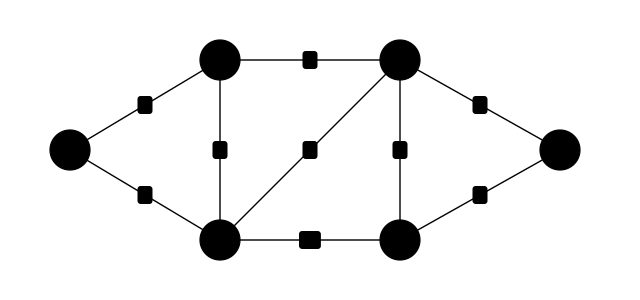
The six-town graph used throughout Phase 6 (edge labels are road lengths).
| Vertex | Adjacency list (neighbour, weight) |
|---|---|
| A | (B, 4), (C, 2) |
| B | (A, 4), (C, 1), (D, 5) |
| C | (A, 2), (B, 1), (D, 8), (E, 10) |
| D | (B, 5), (C, 8), (E, 2), (F, 6) |
| E | (C, 10), (D, 2), (F, 3) |
| F | (D, 6), (E, 3) |
5 · Worked Examples
Example 1 Easy
How many entries does the adjacency matrix of a 100-vertex graph have?
Solution
100 × 100 = 10,000.
Example 2 Medium
A simple undirected graph on 12 vertices: maximum number of edges?
Solution
12 × 11 / 2 = 66.
Example 3 GATE
A tree has 25 vertices. How many edges? If one more edge is added between two of its vertices, how many cycles are created?
Solution
24 edges; the new edge closes exactly 1 cycle.
6 · GATE Traps
⚠️
- Handshake: degrees sum to 2E, not E.
- Adjacency-matrix algorithms usually cost Θ(V²) even for sparse graphs.
- A tree always has n − 1 edges.
- Directed simple graph: n(n − 1) edges max (both directions count).
7 · Memory Hook
🧠
"Matrix: V², fast lookup. List: V + E, fast scan."
8 · Connect the Dots
Phase 0 is complete: steps, math, and the price lists of arrays, lists, trees, heaps and graphs. Phase 1 makes "about n" and "about log n" precise: asymptotic notation and recurrences.
9 · Self-Test
GATE format. Try every question before opening the vault.
Q1NAT1 markHandshake
An undirected graph has 10 edges. What is the sum of all vertex degrees?
Numerical answer: ________
Q2NAT1 markTree edges
A tree on 40 vertices has how many edges?
Numerical answer: ________
Q3NAT2 marksMax edges
Maximum number of edges in a simple directed graph with 9 vertices?
Numerical answer: ________
Q4MCQ1 markRepresentation
For a sparse graph with V = 10⁶ and E = 3 × 10⁶, which representation uses less memory?
- (A) Adjacency list
- (B) Depends on the weights
- (C) Adjacency matrix
- (D) Both the same
Q5NAT2 marksDegrees
In the six-town graph, what is the degree of vertex D?
Numerical answer: ________
10 · Rule Card
- Σ degrees = 2E (undirected); Σ in = Σ out = E (directed).
- Tree: connected, acyclic, n − 1 edges. Max edges: n(n−1)/2 undirected, n(n−1) directed.
- Matrix: Θ(V²) space, O(1) edge test. List: Θ(V + E) space, O(deg) neighbours, O(V + E) scan.
11 · Concept Ledger
Unlocked in this lesson. From here on, these terms may be used.
graph G = (V, E)directed and undirected edgesweighted graphdegree, in-degree, out-degreehandshake lemmapath and cycleconnected and strongly connectedtree has n − 1 edgesDAGsparse vs denseadjacency matrixadjacency listsix-town running example
12 · Answer Vault
Answer Vault
Try the questions first. Open when you are ready to check.
Recall Warm-up
- 2i and 2i + 1.
- Up to n comparisons.
- ⌊log n⌋.
Self-Test
Q1 Answer: 201 mark
2E.
Re-read: Lesson 0.2.3 — Graphs: vocabulary, adjacency matrix vs adjacency list
Q2 Answer: 391 mark
n − 1.
Re-read: Lesson 0.2.3 — Graphs: vocabulary, adjacency matrix vs adjacency list
Q3 Answer: 722 marks
9 × 8.
Re-read: Lesson 0.2.3 — Graphs: vocabulary, adjacency matrix vs adjacency list
Q4 Answer: (A)1 mark
Θ(V + E) is far below V² = 10¹².
- (B) is wrong: Weights don't change the order of size.
- (C) is wrong: 10¹² entries.
- (D) is wrong: No.
Re-read: Lesson 0.2.3 — Graphs: vocabulary, adjacency matrix vs adjacency list
Q5 Answer: 42 marks
Neighbours B, C, E, F.
Re-read: Lesson 0.2.3 — Graphs: vocabulary, adjacency matrix vs adjacency list