0 · Recall Warm-up
Answer from memory first. Answers are in the Answer Vault at the bottom.
- An edge to a grey vertex is a? from Lesson 6.1.2
- A DAG is? from Lesson 0.2.3
- BFS cost with adjacency lists? from Lesson 6.1.1
1 · The Hook
🎣
Courses have prerequisites, build steps depend on each other, spreadsheet cells refer to other cells. Any of these can be scheduled only if there is no cycle, and then a topological order lists the tasks so every dependency comes first. GATE asks how many such orders exist, and how many components a graph has.
2 · Predict First
🤔
Courses a → b means "a before b". Edges: a → b, a → c, b → d, c → d, c → e, d → f, e → f. Write one valid order of all six courses.
Make a guess in your head. The answer opens Section 3.
3 · Core Concept
💡
Predict First — the answer
For example a, b, c, d, e, f: every arrow goes left to right. (a, c, e, b, d, f also works.)
Topological sort (only for DAGs)
A linear order with every edge u → v having u before v.
- DFS method: run DFS; output vertices in decreasing finish time. (If DFS finds a back edge, there is a cycle and no order exists.)
- Kahn's method: repeatedly output a vertex of in-degree 0 and delete its out-edges. If vertices remain but none has in-degree 0, there is a cycle.
- Both run in Θ(V + E).
For the predict DAG: Kahn (alphabetical among ready vertices) gives a, b, c, d, e, f. DFS finish times are a 12, c 11, e 10, b 7, d 6, f 5, so the DFS order is a, c, e, b, d, f. The DAG has 5 topological orders in all.
Cycle detection
- Directed: DFS back edge (grey vertex) or Kahn stalls.
- Undirected: DFS meets an already-visited vertex that is not the parent.
Connected components (undirected)
Start a BFS or DFS from every unvisited vertex; each start is a new component. Θ(V + E). A forest with V vertices and E edges has V − E components.
Strongly connected components (directed)
Maximal sets in which every vertex reaches every other. Kosaraju: DFS to get finish times; reverse every edge; DFS again in decreasing finish order; each tree of the second pass is one SCC. Θ(V + E). Collapsing each SCC to a point leaves a DAG.
4 · Visual
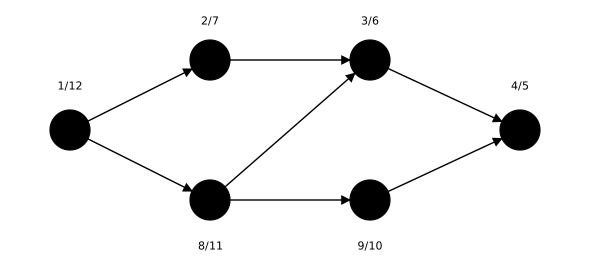
A DAG with DFS d/f times. Decreasing finish time gives a, c, e, b, d, f; Kahn's method gives a, b, c, d, e, f.
5 · Worked Examples
Example 1 Easy
DAG p → q, p → r, q → s, r → s. How many topological orders?
Solution
p first, s last, q and r in either order: 2.
Example 2 Medium
Directed graph: a → b, b → c, c → a, b → d, d → e, e → f, f → d, g → f, g → h, h → g. Number of strongly connected components?
Solution
{a, b, c}, {d, e, f}, {g, h}: 3.
Example 3 GATE
An undirected acyclic graph has 12 vertices and 8 edges. How many connected components?
Solution
A forest has V − E components: 4.
6 · GATE Traps
⚠️
- Topological order exists only for DAGs; there can be many.
- DFS method: decreasing finish time (not discovery time).
- SCCs need the reversed graph in Kosaraju's second pass.
- V − E components holds only for forests (no cycles).
7 · Memory Hook
🧠
"Last to finish goes first."
8 · Connect the Dots
Chapter 6.1 is complete: BFS, DFS and what they compute. Chapter 6.2 adds weights and asks for the cheapest set of edges that connects everything: the minimum spanning tree.
9 · Self-Test
GATE format. Try every question before opening the vault.
Q1NAT2 marksTopological orders
How many topological orders does the lesson's six-course DAG have?
Numerical answer: ________
Q2NAT1 markTopological orders
A DAG on 4 vertices has edges a → b and c → d only. How many topological orders?
Numerical answer: ________
Q3MCQ1 markDFS topological sort
Using DFS, a topological order lists the vertices by:
- (A) increasing finish time
- (B) increasing discovery time
- (C) decreasing discovery time
- (D) decreasing finish time
Q4NAT1 markComponents
An undirected forest has 20 vertices and 14 edges. Number of connected components?
Numerical answer: ________
Q5NAT2 marksSCCs
Directed graph on 1–6: 1 → 2, 2 → 3, 3 → 1, 3 → 4, 4 → 5, 5 → 6, 6 → 5. Number of strongly connected components?
Numerical answer: ________
10 · Rule Card
- Topological order (DAG only): decreasing finish time, or Kahn (in-degree 0); Θ(V + E).
- Cycle: back edge (directed), visited non-parent (undirected), Kahn stalls.
- Components: one BFS/DFS start per component; forest has V − E.
- SCCs (Kosaraju): DFS, reverse edges, DFS by decreasing finish; condensation is a DAG.
11 · Concept Ledger
Unlocked in this lesson. From here on, these terms may be used.
topological sortDFS-based topological orderKahn's algorithmcycle detectionconnected componentsforest V − E componentsstrongly connected componentsKosaraju's algorithmcondensation DAG
12 · Answer Vault
Answer Vault
Try the questions first. Open when you are ready to check.
Recall Warm-up
- Back edge.
- A directed graph with no cycle.
- Θ(V + E).
Self-Test
Q1 Answer: 52 marks
a first, f last, and between them bcde, bced, cbde, cbed or cebd.
Re-read: Lesson 6.1.3 — Topological sort, cycle detection, connected and strongly connected components
Q2 Answer: 61 mark
Choose 2 of the 4 positions for a, b (in that order): C(4, 2).
Re-read: Lesson 6.1.3 — Topological sort, cycle detection, connected and strongly connected components
Q3 Answer: (D)1 mark
A vertex finishes after everything it points to.
- (A) is wrong: That is the reverse of a topological order.
- (B) is wrong: Fails when a later branch must come first.
- (C) is wrong: Not guaranteed.
Re-read: Lesson 6.1.3 — Topological sort, cycle detection, connected and strongly connected components
Q4 Answer: 61 mark
V − E.
Re-read: Lesson 6.1.3 — Topological sort, cycle detection, connected and strongly connected components
Q5 Answer: 32 marks
{1, 2, 3}, {4}, {5, 6}.
Re-read: Lesson 6.1.3 — Topological sort, cycle detection, connected and strongly connected components