0 · Recall Warm-up
Answer from memory first. Answers are in the Answer Vault at the bottom.
- Adjacency list space for a graph? from Lesson 0.2.3
- Queue order? from Lesson 0.2.1
- Σ degrees in an undirected graph? from Lesson 0.2.3
1 · The Hook
🎣
"Fewest flights from Delhi to anywhere": with every hop counting 1, the answer is found by exploring outward in rings: everything one hop away, then everything two hops away, and so on. That is breadth-first search (BFS). It is the basis of unweighted shortest paths, and GATE asks for BFS orders, levels and BFS-tree properties.
2 · Predict First
🤔
In the six-town graph (ignore the road lengths, count roads), how many roads does the shortest route from A to F use?
Make a guess in your head. The answer opens Section 3.
3 · Core Concept
💡
Predict First — the answer
A's neighbours are B and C (1 road); D and E are 2 roads away; F is reached from D or E: 3 roads.
The algorithm
BFS(G, s):
    mark s visited; dist[s] = 0; enqueue(s)
    while queue not empty:
        u = dequeue()
        for each neighbour v of u:            // alphabetical in these notes
            if v not visited:
                mark v visited; dist[v] = dist[u] + 1; parent[v] = u
                enqueue(v)
- A vertex is marked when it is enqueued, so it enters the queue only once.
- Vertices come out of the queue in non-decreasing distance: all of level 0, then all of level 1, then level 2 ….
What BFS gives
- dist[v] = the smallest number of edges from s to v (unweighted shortest path).
- The BFS tree (edges u → v where parent[v] = u) has V − 1 edges if the graph is connected; the path in the tree from s to v is a shortest path.
- In an undirected graph, every non-tree edge joins two vertices whose levels differ by at most 1.
Cost
Each vertex is enqueued and dequeued once; each adjacency list is scanned once: Θ(V + E) with adjacency lists, Θ(V²) with an adjacency matrix.
Valid BFS orders
With any neighbour order allowed, an order is a valid BFS order if, when each vertex u is dequeued, its not-yet-seen neighbours appear next in the order as one block (in any order among themselves).
4 · Visual
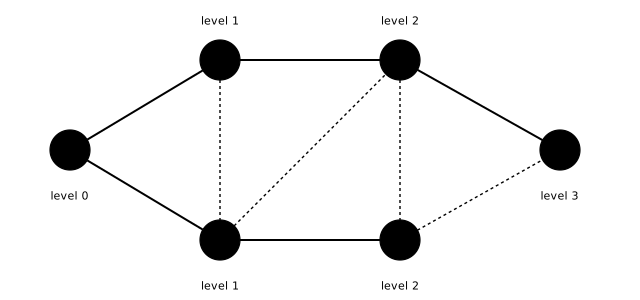
BFS from A on the six-town graph. Red: BFS-tree edges. Dashed: non-tree edges (each joins levels that differ by at most 1). Order A, B, C, D, E, F.
| Step | Dequeue | New vertices enqueued | Queue after |
|---|---|---|---|
| 1 | A | B, C | B C |
| 2 | B | D | C D |
| 3 | C | E | D E |
| 4 | D | F | E F |
| 5 | E | none | F |
| 6 | F | none | empty |
5 · Worked Examples
Example 1 Easy
BFS from F on the six-town graph (alphabetical neighbours): order?
Solution
F; then D, E; D adds B, C; E adds nothing new; B adds A: F, D, E, B, C, A.
Example 2 Medium
BFS from D: how many vertices are at level 1?
Solution
D's neighbours B, C, E, F: 4 (A is at level 2).
Example 3 GATE
A connected undirected graph has 30 vertices and 45 edges. How many edges are not in its BFS tree?
Solution
The BFS tree has 29 edges, so 16 are non-tree edges.
6 · GATE Traps
⚠️
- Mark vertices when enqueued, not when dequeued, or they may enter the queue twice.
- BFS gives shortest paths only when every edge counts 1 (unweighted).
- Several BFS orders can be valid when ties in neighbour order are allowed; these notes use alphabetical order.
- Θ(V + E) with lists; Θ(V²) with a matrix.
7 · Memory Hook
🧠
"BFS: a queue, ring by ring, fewest edges first."
8 · Connect the Dots
BFS explores in rings with a queue. The next lesson replaces the queue by a stack (recursion) and goes as deep as possible first: depth-first search, with its discovery and finish times.
9 · Self-Test
GATE format. Try every question before opening the vault.
Q1NAT1 markBFS distance
BFS from A on the six-town graph: distance (number of roads) to F?
Numerical answer: ________
Q2NAT1 markLevels
BFS from C on the six-town graph: how many vertices are at level 1?
Numerical answer: ________
Q3MCQ1 markBFS cost
BFS on a graph stored as adjacency lists runs in:
- (A) Θ(E log V)
- (B) Θ(V²)
- (C) Θ(V + E)
- (D) Θ(V)
Q4NAT2 marksBFS tree
A connected undirected graph has 25 vertices and 42 edges. How many edges are not in the BFS tree?
Numerical answer: ________
Q5MSQ2 marksValid BFS orders
Which are valid BFS orders of the six-town graph starting at A (neighbours may be taken in any order)?
- (A) A, B, C, D, E, F
- (B) A, C, B, E, D, F
- (C) A, B, C, E, D, F
- (D) A, B, D, C, E, F
10 · Rule Card
- BFS: queue; mark on enqueue; levels in non-decreasing order.
- dist = fewest edges (unweighted shortest path); BFS tree has V − 1 edges (connected).
- Undirected non-tree edges join levels differing by ≤ 1.
- Θ(V + E) lists, Θ(V²) matrix.
11 · Concept Ledger
Unlocked in this lesson. From here on, these terms may be used.
breadth-first searchqueue-based traversallevelsunweighted shortest pathBFS treevalid BFS orderBFS cost Θ(V + E)
12 · Answer Vault
Answer Vault
Try the questions first. Open when you are ready to check.
Recall Warm-up
- Θ(V + E).
- First in, first out (FIFO).
- 2E.
Self-Test
Q1 Answer: 31 mark
A–B–D–F.
Re-read: Lesson 6.1.1 — Breadth-first search: levels and unweighted shortest paths
Q2 Answer: 41 mark
A, B, D, E; F is at level 2.
Re-read: Lesson 6.1.1 — Breadth-first search: levels and unweighted shortest paths
Q3 Answer: (C)1 mark
Every vertex and every list once.
- (A) is wrong: That is a heap-based algorithm.
- (B) is wrong: That is the matrix cost.
- (D) is wrong: Ignores the edges.
Re-read: Lesson 6.1.1 — Breadth-first search: levels and unweighted shortest paths
Q4 Answer: 182 marks
42 − 24.
Re-read: Lesson 6.1.1 — Breadth-first search: levels and unweighted shortest paths
Q5 Answer: (A) (B)2 marks
After A comes {B, C}; the first of them dequeued must add its new neighbours next.
- (C) is wrong: B is dequeued first, so D must come right after B and C.
- (D) is wrong: C (a neighbour of A) must come before D.
Re-read: Lesson 6.1.1 — Breadth-first search: levels and unweighted shortest paths